In short
- Wreath, cuscino, casket spray and bouquet each have their own role: usually those closest to the person who died choose the flowers on the coffin.
- Time is short: order as soon as you know the place and time, from a florist near the service.
- The ribbon needs only a few words: who the flowers are from and a simple thought.
- If the family asks for "non fiori ma opere di bene" (no flowers, but charitable gifts), respect the request.
Choosing funeral flowers usually happens suddenly, often in grief and in a hurry. This guide is for anyone arranging flowers for a family funeral and for anyone who wants to send a sign of sympathy: friends, colleagues, companies. It is also written for readers abroad who do not know Italian customs and need to send flowers to Italy.
Funerals in Italy are almost always handled by a local florist or by the funeral director (impresa di onoranze funebri). For a more personal service, in a church or a non-religious space, some florists who dress churches also take on this work. You can also look for one with find a florist.
The arrangements: what they are and who sends them
In Italy, funeral arrangements have fairly precise names and uses. They are not written rules, but they are widely followed customs.
| Arrangement | What it is | Usually sent by |
|---|---|---|
| Copribara (casket spray) | Covers the lid of the coffin | Spouse, children, immediate family |
| Cuscino | A compact arrangement placed on the coffin or at its foot | Close relatives, grandchildren |
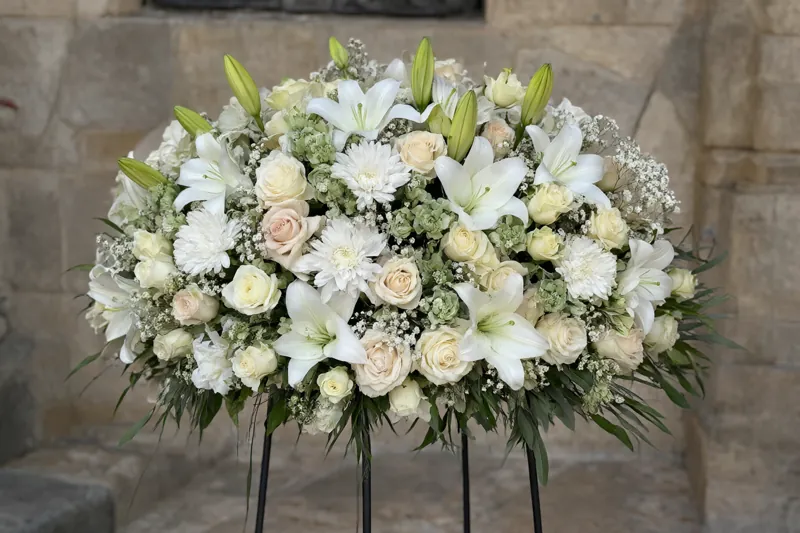
| Corona (wreath) | A circular arrangement on a stand | Friends, colleagues, associations, companies |
| Bouquet or sheaf | Tied flowers, laid down | Friends, acquaintances |
| Basket or arrangement in a container | Flowers in a container | Friends, neighbours, those who cannot attend |
| Plant | A green or flowering plant | Often sent to the family home |
Before ordering a casket spray or a cuscino, check with the family or the funeral director. It is usually the choice of the closest relatives, and two of them would be awkward.
Flowers and colours
At Italian funerals you will often see:
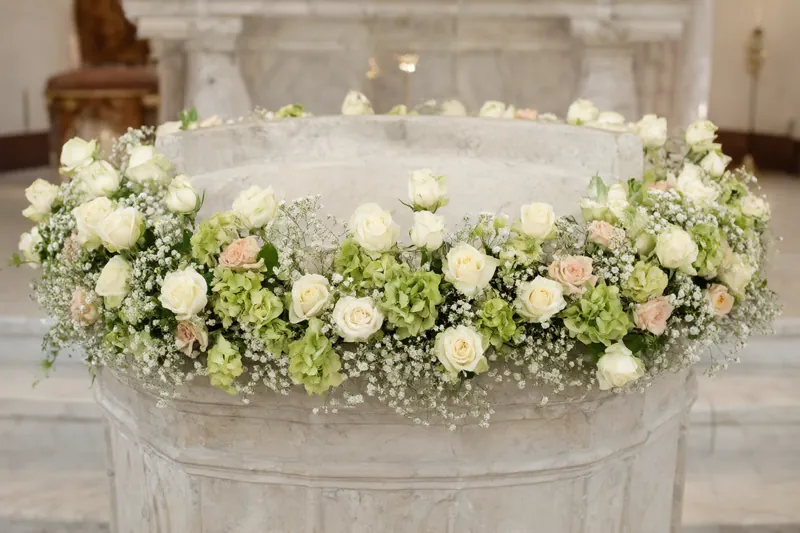
- white flowers: roses, lilies, calla lilies, lisianthus, orchids;
- red roses for a bond of love, often from the spouse;
- soft tones (cream, pale pink, lilac) for a young person or to express tenderness;
- plenty of greenery as a base.
No flower is compulsory. Often the most heartfelt choice is the flowers the person loved, even simple ones.
A note for readers abroad
In Italy chrysanthemums are linked to mourning and to the commemoration of the dead on 2 November (All Souls' Day). People take them to the cemetery, but never give them on other occasions. If you live abroad and send flowers to Italy for a celebration, avoid them. At a funeral, on the other hand, they are entirely appropriate. The guide to the meaning of flowers explains other Italian customs worth knowing.
Timing and delivery
In Italy a funeral is usually held a few days after the death, so time is tight. To get it right:
- Read the death notice or ask the funeral director: place, day, time. Notices are often posted on walls in towns and published online.
- Choose a florist near the service: it cuts the risk of delays and the cost of transport.
- Say where to deliver: the funeral home or chapel of rest (camera ardente), the church, the ceremony room, or the family home.
- Ask for the delivery time: flowers must arrive before the service, not during it.
- Send the name and ribbon text in writing, to avoid mistakes. This matters even more if you do not speak Italian.
Many funeral directors also take flower orders on behalf of the family. It is convenient, but you are free to use a florist of your choice.
What to write on the ribbon
The ribbon says who the flowers are from. Space is limited, so keep it short. Examples of simple wording:
- the family or people's names: "Mario e Lucia";
- the group: "Your colleagues in Purchasing", "Your friends at the club";
- a thought: "Con affetto" (with love), "Ti ricorderemo" (we will remember you), "Sempre con noi" (always with us);
- for a company: the company name, or "The management and colleagues".
You can write in English, but a short phrase in Italian is often appreciated by the family and the other mourners. The florist can help you fit it in the space. If you send a bouquet or a basket, you can add a card with a few more words for the family. Avoid long or very personal messages: the ribbon stays on display.
When not to send flowers
Sometimes the family asks people not to send flowers. The most common wording in notices is "non fiori ma opere di bene" (no flowers, but charitable gifts), or the name of a charity to donate to. In that case, respect the request: a donation and a card are the right gesture.
Some religious traditions use few or no flowers at funerals. If the person who died, or the family, follows a faith other than Catholicism, ask the organisers first.
The service in a church or ceremony room
If you are dressing the service yourself, ask:
- the parish what can be placed near the altar and the coffin, and when you can get in;
- the ceremony room or cemetery which spaces are available and whether there are rules on flowers;
- the funeral director how flowers are moved from the church to the cemetery.
After the service, some flowers follow the coffin to the cemetery; the rest can stay in church or be taken home. Some cemeteries have rules on what can be left and for how long: check with the cemetery.
What it costs
The cost depends on the type of arrangement, its size, the flowers and delivery. In general, casket sprays and large wreaths are the most substantial pieces, while bouquets and baskets cost less. When several people want to send flowers (colleagues, a group of friends) it is common to share the cost of one arrangement with a single ribbon. Ask for a clear price in euros with delivery and VAT (IVA) included.
Sending flowers from far away
If you live in another city or abroad and cannot attend, you can still send a sign of sympathy. There are two simple routes: contact a florist near the service by phone or email, or ask the funeral director whether they take orders. Give the exact name of the person who has died, the place, the day and time, and the ribbon text. Ask for written confirmation of delivery. If you hear the news too late for the service, a plant or a bouquet sent to the family home in the following days is just as welcome.
Questions to ask the florist
- Can you deliver in time for the service, to this address?
- Which flowers are fresh at the moment?
- Which arrangement would suit the sender (family, friends, company)?
- How many words fit on the ribbon?
- Is delivery included in the price?
- Do the flowers go on to the cemetery? Who moves them?
- Can you issue an invoice in the company's name, if needed?
Companies and colleagues
When a colleague, a client or a relative of an employee dies, companies often send a wreath or an arrangement. Usually someone in HR or the office collects contributions from colleagues and chooses the ribbon wording. Two points to watch: check the death notice, because the family may have asked for donations instead of flowers, and write a name on the ribbon that the family will recognise, such as "Colleagues at" followed by the department or office.
To wrap up
A final farewell does not need much: choose an arrangement that fits your relationship with the person, have it delivered on time and write a few sincere words. Respecting the family's wishes comes first.
If you later want to arrange a moment of remembrance, such as an anniversary Mass or a ceremony to scatter ashes, a florist can help with a simple, quiet arrangement. You can ask for a quote when you are ready, with no hurry.