In short
- The language of flowers is a tradition with many versions: meanings change from country to country.
- In Italy "orange blossom" means a wedding, and myrtle has a long bridal history.
- Chrysanthemums are linked to mourning in Italy: best avoided at a wedding with Italian guests.
- By tradition the bouquet is a gift from the groom, but today couples choose freely.
Choosing your wedding flowers is not only about colour and season. Wedding flower meanings matter too: some flowers carry symbols, traditions and, sometimes, associations to avoid. This guide is for couples who want their choices to mean something, and for those getting married in Italy from abroad who want to avoid any missteps with Italian family and guests.
The language of flowers: a game, not a rule
The language of flowers, sometimes called floriography, was hugely popular in nineteenth-century Europe. Each flower had a meaning, and a posy could become a message. There are many versions, often contradicting each other: the same flower can mean love in one book and jealousy in another.
Use it as inspiration, not as an obligation. A flower you love, or one tied to your story, is worth more than any symbol. If you want to work with someone who pays attention to these details, browse our list of wedding florists across Italy.
Common flowers and their meanings
The meanings below are the most widespread in European tradition. They vary a lot between sources and countries.
| Flower | Most common traditional meaning | Note |
|---|---|---|
| Orange blossom (zagara) | Purity, fertility, marriage | In Italy a synonym for a wedding |
| Myrtle | Love, faithfulness | Linked to Venus in classical tradition |
| Red rose | Love, passion | The most universal symbol |
| White rose | Purity, a new beginning | Very common in church |
| Yellow rose | Jealousy in some traditions, friendship in others | Ambiguous meaning |
| White lily | Purity | Linked to the Virgin Mary in Christian tradition |
| Peony | Prosperity, happiness | Also much loved in East Asia |
| Olive | Peace | Welcome in church |
| Ivy | Faithfulness, a lasting bond | Used in cascading bouquets |
| Lily of the valley | Return of happiness | Toxic plant: never near food |
Further down you will find the A-Z dictionary of wedding flowers, with season, uses and cautions for each flower, and a table of colour meanings.
Orange blossom
In Italian, "fiori d'arancio" (orange blossoms) means getting married. The expression comes from the custom, widespread in Europe especially in the nineteenth century, of wearing orange blossom in brides' hair, crowns and bouquets. The orange tree, which can bear flowers and fruit at the same time, was a symbol of fertility; the white flower, of purity.
Today real orange blossom is rarely used in bouquets: it blooms mainly in spring, is delicate and does not last long once cut. But citrus trees in flower, fruiting branches and leaves are very present in Italian wedding decor. We cover this in our guide to lemon, orange and olive trees in wedding decor.
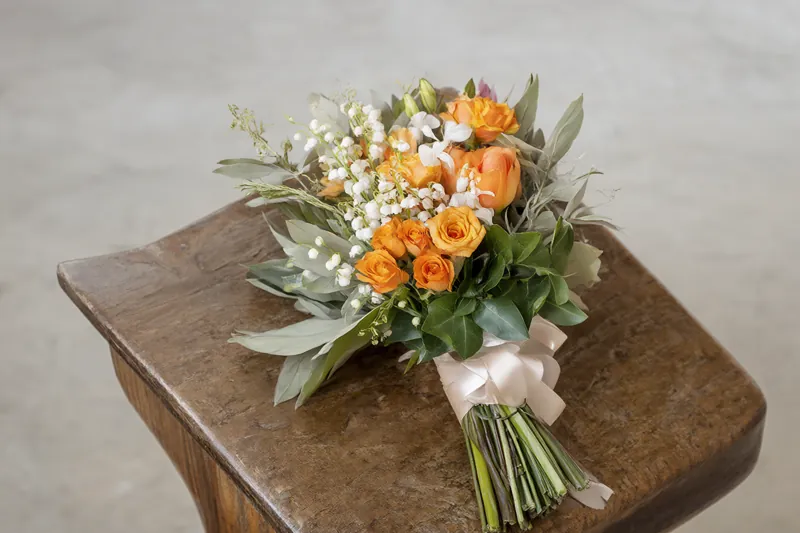
Myrtle
Myrtle (Myrtus communis) is a Mediterranean shrub with small, fragrant leaves. In classical tradition it was sacred to Venus, goddess of love. For centuries it was used in bridal crowns and bouquets in several European countries; some British couples will know it from royal wedding bouquets. In Sardinia and other parts of the South it is still a familiar presence, including as greenery in wedding decor. A small sprig in your bouquet is a discreet way to carry this symbol.
Italian customs worth knowing
Some flower customs are still alive in Italy. They are not rules, but it is good to know them:
- the bouquet is a gift from the groom: by tradition the groom chooses it and has it delivered to the bride on the wedding morning;
- the groom's buttonhole often echoes a flower from the bouquet;
- the bouquet toss to unmarried friends is common, often with a smaller bouquet made specially;
- odd numbers of flowers in bunches given as gifts are a widespread custom; for composed bridal bouquets it matters little.
For the full picture of traditions, from confetti (sugared almonds, not paper confetti) to wedding favours, read our guide to flowers and Italian wedding traditions.
Flowers to avoid: chrysanthemums
In Italy chrysanthemums are associated with remembering the dead. They are taken to cemeteries at the start of November, for All Saints' Day and All Souls' Day. For many Italians a chrysanthemum at a wedding is out of place, however beautiful.
For couples from abroad this is often a surprise: in other countries the chrysanthemum has different meanings, even positive ones, and in the UK and US it is a common autumn flower. If you have Italian guests, especially older ones, avoid it. If you love its shape, ask your florist for similar alternatives, such as some dahlias or asters.
Wreaths and cushion-shaped arrangements also recall funerals in Italy: choose different shapes for a wedding.
Colours and different cultures
At international weddings, guests come from different cultures. A few examples to keep in mind:
- in Italy and most of Europe, white is the bride's colour;
- in some East Asian cultures, white is traditionally linked to mourning, and red is the wedding colour;
- in some countries, yellow flowers have negative connotations.
You do not need to give up the colours you love. But if your families come from different traditions, talk about it first: sometimes a touch of colour is enough to make everyone feel at home.
Flowers and symbols in church
In a Catholic church some flowers have ties to religious tradition. The white lily is associated with the Virgin Mary, the rose features in many Marian devotions, and olive recalls peace and Palm Sunday. These choices fit in naturally.
Parishes may have rules on decorations: what can go on the altar, what can be fixed to the pews, when arrangements must be removed. At certain times of the liturgical year, such as Lent, there may be specific guidance on decorations. Always ask the parish priest before planning. For everything else, see our guide to church wedding flowers.
Protected flowers and mountain symbols
The edelweiss is a symbol of the Alps and of steadfast love in mountain traditions. But in the wild it is protected: it must not be picked. For a mountain wedding, florists use cultivated plants or different symbols. The same goes for other alpine flowers.
A-Z dictionary of wedding flowers
Here are the flowers you will see most often at Italian weddings, in alphabetical order. For each one you will find four things: the meaning tradition gives it, its indicative season in Italy, how it is used at a wedding, and anything to watch out for.
Three points apply to every entry:
- the meaning is the most widespread one in the European language of flowers: it is a tradition, with different versions from book to book, not a fact;
- the season refers to flowering in Italy and is indicative: it changes with the region and the year. Many flowers are also available out of season, from greenhouses or imported, usually at a higher cost. The month-by-month picture is in our guide to seasonal flowers in Italy;
- the cautions do not replace your florist's advice. As a general rule, no decorative flower should be eaten or placed in contact with food unless it was grown for eating. For details see the glossary entries on toxic plants and pollen and allergies.
Agapanthus
- Traditional meaning: the name comes from the Greek words for "love" and "flower", which is why it is often called the flower of love.
- Season in Italy: high summer, roughly June to August.
- At the wedding: the blue, purple or white globes work in tall centrepieces, entrance arrangements and garden set-ups. In bouquets florists usually use the individual florets, as the whole head is large.
- Cautions: the sap can irritate sensitive skin and the plant should not be eaten. It copes with heat better than many summer flowers.
Alstroemeria
- Traditional meaning: friendship, devotion. Its common name is "Peruvian lily".
- Season in Italy: available all year from greenhouses.
- At the wedding: it lasts a long time in a vase and is inexpensive. A good filler for centrepieces, church arrangements and bridesmaids' bouquets.
- Cautions: people who handle it for long periods can get skin irritation. No issue for guests.
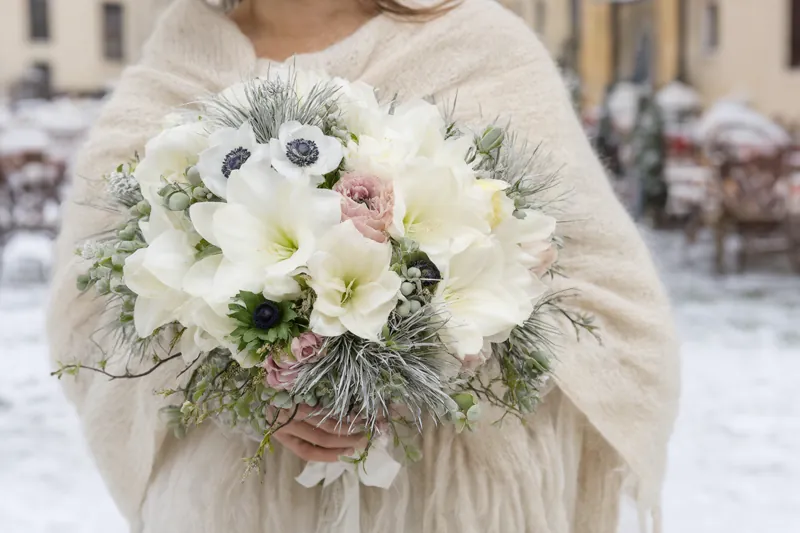
Anemone
- Traditional meaning: anticipation, lost love. Greek myth has it born from Venus's tears for Adonis. More recently it has also been read as a flower of hope.
- By colour: white with a black centre is the wedding favourite; red and blue give a bolder tone.
- Season in Italy: late autumn to spring. See the anemone glossary entry and our guide to ranunculus and anemones.
- At the wedding: bouquets, buttonholes and low centrepieces in winter and spring.
- Cautions: delicate and dislikes heat. Like all the buttercup family, it is toxic if eaten: keep it away from food.
Calla lily
- Traditional meaning: purity, beauty, elegance.
- Season in Italy: all year from greenhouses; outdoors in spring.
- At the wedding: clean, minimal bouquets and tall arrangements for church and tables. It comes in white, cream, yellow, pink, burgundy and near-black.
- Cautions: toxic if eaten, irritating to mouth and skin. In the UK and some other English-speaking countries it is also associated with funerals.
Camellia
- Traditional meaning: admiration, constant love.
- Season in Italy: late winter and early spring, roughly February to April. It has a long tradition on Lake Maggiore and around Lucca in Tuscany.
- At the wedding: more as a flowering branch or glossy foliage than as a single cut flower. It suits winter weddings and historic villas.
- Cautions: the flower drops off whole and bruises when touched. Not ideal for a bouquet that has to last all day.
Carnation
- Traditional meaning: love, fascination, affection.
- By colour: red means love and passion, but in Italy it is also a political symbol linked to 1 May. White is purity, pink affection. Yellow, in some nineteenth-century versions, meant disappointment.
- Season in Italy: all year from greenhouses. The Ligurian Riviera has a long history of growing carnations.
- At the wedding: hardy and affordable, carnations are back in fashion, grouped by colour in centrepieces or installations.
- Cautions: nothing in particular for people.
Chrysanthemum
- Traditional meaning: in Italy it is the flower for remembering the dead. In Japan, by contrast, it is an imperial symbol and stands for long life.
- Season in Italy: autumn, peaking at the end of October; from greenhouses all year.
- At the wedding: with Italian guests it is best avoided. See the chrysanthemums glossary entry and the section above.
- Cautions: if you love its shape, dahlias and asters are the closest alternatives.
Cornflower
- Traditional meaning: delicacy, hope. In the English-speaking world it was the buttonhole of a man in love, hence the name "bachelor's button".
- Season in Italy: May to July.
- At the wedding: the deep blue is a natural way to carry "something blue". Lovely in wildflower bouquets and rustic centrepieces.
- Cautions: small and delicate. The petals are edible only if grown for eating.
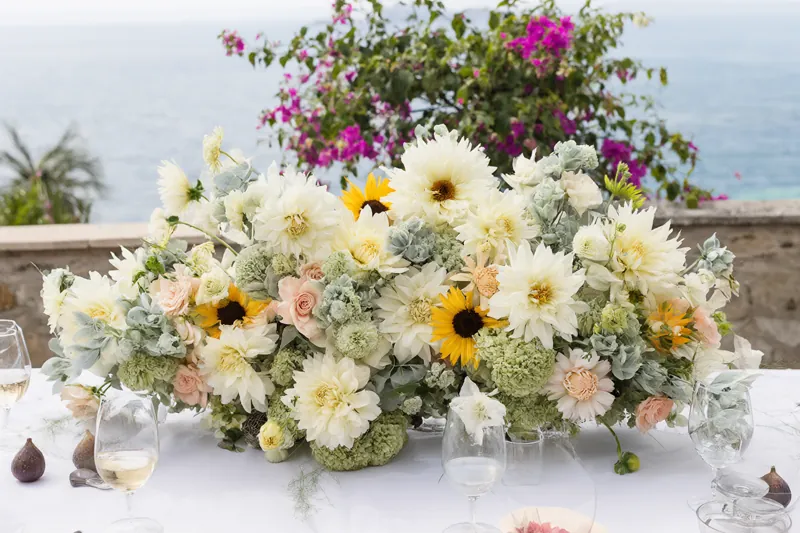
Dahlia
- Traditional meaning: gratitude, elegance. Some nineteenth-century versions also give it fickleness.
- Season in Italy: from July to the first frosts, peaking in September. See the dahlia glossary entry.
- At the wedding: the flower of late summer. Large varieties add volume to bouquets and centrepieces; pompon types add texture.
- Cautions: short vase life and it suffers in strong heat. No significant toxicity for people.
Daisy
- Traditional meaning: innocence, simplicity. It is the flower of the "loves me, loves me not" game.
- Season in Italy: April to June.
- At the wedding: country weddings, relaxed bouquets, crowns for flower girls. See our guide to wildflower weddings.
- Cautions: it belongs to the daisy family, which causes allergies in some people.
Eucalyptus
- Traditional meaning: it has no established meaning in Italian tradition. Today it is associated with freshness and protection.
- Season in Italy: all year. See the eucalyptus glossary entry and our guide to wedding greenery.
- At the wedding: the most widely used greenery in bouquets, table runners and centrepieces.
- Cautions: a strong, medicinal scent that not everyone likes at the table. Toxic if eaten, including for cats and dogs.
Freesia
- Traditional meaning: friendship, trust, innocence.
- Season in Italy: naturally in late winter and spring; from greenhouses for much of the year.
- At the wedding: bouquets, flower crowns and buttonholes. It comes in many colours, from white and yellow to pink and lilac.
- Cautions: very fragrant. In a bouquet that is a plus; in large quantities on tables it can compete with the food.
Gerbera
- Traditional meaning: cheerfulness, innocence.
- Season in Italy: all year from greenhouses.
- At the wedding: informal, colourful weddings, children's areas, bright centrepieces.
- Cautions: the stem bends easily and often needs support. Not known to be toxic.
Gypsophila
- Traditional meaning: purity, innocence. One of its Italian common names is "velo da sposa", bridal veil; in English it is known as baby's breath.
- Season in Italy: all year. See the gypsophila glossary entry.
- At the wedding: white clouds in centrepieces, arches, single-variety bouquets and pew ends in church.
- Cautions: some people dislike its smell, especially in large quantities. It can irritate sensitive people.
Hellebore
- Traditional meaning: in folk tradition it is the "Christmas rose", linked to the festive season and to protection. Nineteenth-century flower language gives it contrasting readings, from serenity to anxiety.
- Season in Italy: December to March.
- At the wedding: one of the few true winter flowers. Bouquets and centrepieces in white, green, antique pink and plum.
- Cautions: the whole plant is highly toxic: never near food. Cut too young it wilts quickly; it holds up better when the flower is mature.
Hydrangea
- Traditional meaning: a flower of opposite meanings. Today it is linked to gratitude and abundance; some Victorian versions gave it coldness or vanity.
- By colour: in the garden the colour depends on the soil, blue in acid soils and pink in chalky ones. White is the most used at weddings; pale blue can be your "something blue".
- Season in Italy: June to September outdoors; from greenhouses from spring. See the hydrangea glossary entry and our guide to hydrangeas for weddings.
- At the wedding: big volume from few stems: centrepieces, aisles, arches.
- Cautions: extremely thirsty and quick to wilt in heat. Toxic if eaten.
Iris
- Traditional meaning: message, hope, faith. It is named after Iris, messenger of the gods. The "lily" on Florence's coat of arms is actually an iris.
- Season in Italy: April and May outdoors; some varieties all year from greenhouses.
- At the wedding: blue and purple for clean-lined bouquets and church arrangements; a natural nod for couples marrying in Florence.
- Cautions: short vase life. Bulbs and rhizomes are toxic.
Ivy
- Traditional meaning: faithfulness, a lasting bond.
- Season in Italy: all year.
- At the wedding: cascading bouquets, garlands on long banquet tables, columns and gates.
- Cautions: leaves and berries are toxic if eaten and the sap can irritate skin. On tables, keep it off plates and food.
Lavender
- Traditional meaning: devotion, serenity.
- Season in Italy: fresh in June and July; dried all year.
- At the wedding: wildflower bouquets, Provençal-style centrepieces, little bags for the wedding exit instead of rice.
- Cautions: strong scent, and bees when outdoors. Ask your venue whether there are rules on throwing petals or herbs.
Lilac
- Traditional meaning: lilac is first love, white the innocence of youth.
- Season in Italy: April and May.
- At the wedding: spring bouquets, romantic centrepieces, church arrangements.
- Cautions: once cut it wilts fast in heat and needs plenty of water. Intense scent.
Lily
- Traditional meaning: the white lily stands for purity and is linked to the Virgin Mary and St Anthony. Other colours have no meaning as widely shared.
- Season in Italy: all year from greenhouses; outdoors in June and July.
- At the wedding: tall arrangements for church, altar and entrance. Less common in bouquets because of its weight and scent.
- Cautions: a very strong scent that can be overpowering indoors. The pollen stains dresses and tablecloths, so florists remove the anthers. Highly toxic to cats. In many countries, Italy and the UK included, white lilies are also common at funerals: used with restraint, this is not a problem at a wedding.
Lily of the valley
- Traditional meaning: the return of happiness. In France it is given on 1 May for luck.
- Season in Italy: April and May. Out of season it is rare and expensive.
- At the wedding: small, precious bouquets, buttonholes and flower crowns.
- Cautions: the whole plant is highly toxic, even the vase water: never near food or within children's reach.
Lisianthus
- Traditional meaning: a recent addition to floristry, with no historic meaning. Today it is often linked to gratitude.
- Season in Italy: available most of the year, best in summer.
- At the wedding: its soft petals recall roses and peonies, and it lasts well. A more affordable alternative when peonies are out of season.
- Cautions: delicate petals, to be handled with care. No significant toxicity.
Magnolia
- Traditional meaning: dignity, nobility, perseverance.
- Season in Italy: the evergreen magnolia flowers between May and July; deciduous magnolias in March and April. The glossy leaves are used all year.
- At the wedding: one large bloom at the centre of a bouquet, leaves for garlands and runners, flowering branches in historic villas.
- Cautions: petals turn brown wherever they are touched. Strong scent.
Mimosa
- Traditional meaning: strength, sensitivity. In Italy it is above all the flower of 8 March, International Women's Day, when it is given to women everywhere.
- Season in Italy: February and March.
- At the wedding: a bright yellow for late-winter weddings. Italian guests will instantly think of 8 March: bear that in mind.
- Cautions: it sheds and dries out quickly. The pollen can bother people with allergies.
Myrtle
- Traditional meaning: love, faithfulness. It is the bridal plant of classical tradition, sacred to Venus.
- Season in Italy: flowers in June and July; the foliage is used all year, the berries in autumn and winter.
- At the wedding: a sprig in the bouquet or buttonhole, greenery in centrepieces. More in the section above.
- Cautions: none in particular. The leaves have a light scent.
Olive
- Traditional meaning: peace, renewal. In church it recalls Palm Sunday, when olive branches are blessed in Italy.
- Season in Italy: branches and leaves all year. See the olive glossary entry and our guide to lemon, orange and olive trees.
- At the wedding: runners on banquet tables, potted trees, sprigs in buttonholes and bouquets. A staple of the Mediterranean style.
- Cautions: none in particular. In spring, flowering branches carry pollen that affects some allergy sufferers.
Orange blossom
- Traditional meaning: purity, fertility, marriage. It is the flower of citrus trees, hence the Italian expression "fiori d'arancio" for a wedding. See the orange blossom glossary entry and the section above.
- Season in Italy: mainly in spring, roughly March to May; lemons flower several times a year.
- At the wedding: more as a flowering citrus tree than as a cut flower, since it does not last. A sprig in the hair is a nod to tradition.
- Cautions: intense scent. Only flowers grown for eating should go on food.
Orchid
- Traditional meaning: refinement, rare beauty.
- Season in Italy: all year, from greenhouses.
- At the wedding: cascading bouquets, hanging installations, modern centrepieces. Some varieties cope with heat better than many European flowers.
- Cautions: the most common varieties are not toxic. Medium to high cost, especially for large blooms.
Peony
- Traditional meaning: prosperity, happiness, a happy marriage. In China it is the "king of flowers".
- Season in Italy: short, roughly late April to June, peaking in May. See the peony glossary entry and our guide to peonies for weddings.
- At the wedding: the most requested flower for romantic bouquets and the top table.
- Cautions: out of season it comes from the southern hemisphere at a higher cost. Roots and seeds are toxic if eaten.
Ranunculus
- Traditional meaning: charm, "you are radiant".
- Season in Italy: winter to April or May, grown in Italy's milder areas. See the ranunculus glossary entry.
- At the wedding: bouquets, low centrepieces, flower crowns. The many petals make it look like a small rose.
- Cautions: dislikes heat. Toxic if eaten, and the sap can irritate skin.
Rose
- Traditional meaning: love, in all its forms. It has the richest symbolism of any flower, and most of it comes through colour.
- By colour: red love and passion, white purity and a new beginning, pink sweetness and gratitude, yellow friendship or jealousy depending on the tradition. Every colour, the number of roses and palette pairings are in our guide to rose colour meanings.
- Season in Italy: all year from greenhouses; outdoor-grown garden roses roughly from May into autumn.
- At the wedding: bouquet, church, centrepieces, top table. Types, vase life and price are in our guide to wedding roses in Italy.
- Cautions: thorns must be removed from bouquet stems. Around Valentine's Day red roses cost more.
Sunflower
- Traditional meaning: devotion, loyalty, cheerfulness. The myth of the nymph Clytie, in love with the Sun, is linked to flowers that follow the light.
- Season in Italy: June to September.
- At the wedding: summer country weddings, rustic centrepieces, informal bouquets. See our guide to sunflower weddings.
- Cautions: large and heavy; a few are enough in a bouquet. Not toxic.
Tulip
- Traditional meaning: a declaration of love.
- By colour: red is love declared, white a new beginning, purple royalty. Yellow, once hopeless love, is now read mostly as cheerfulness.
- Season in Italy: January to April.
- At the wedding: spring bouquets, simple centrepieces in glass vases.
- Cautions: tulips keep growing in the vase and bend towards the light, so arrangements change shape during the day. The bulbs are toxic and the sap can irritate skin.
Violet and pansy
- Traditional meaning: the sweet violet stands for modesty and humility; the pansy for remembrance, a thought for someone (its name comes from the French "pensée").
- Season in Italy: sweet violets from February to April; pansies from autumn to spring.
- At the wedding: small posies, cake decoration, place settings in little pots.
- Cautions: among the most popular edible flowers, but only flowers grown for eating should go on food.
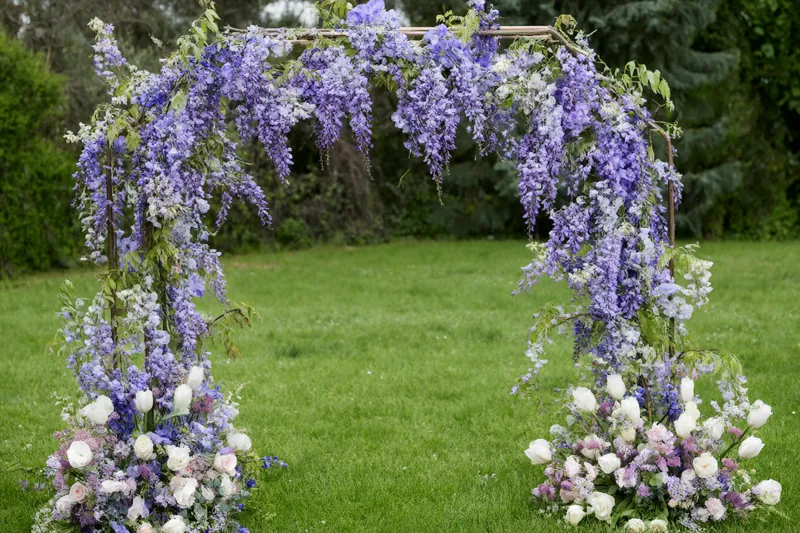
Wisteria
- Traditional meaning: friendship, welcome, patience.
- Season in Italy: April and May, for a few weeks.
- At the wedding: it is more beautiful alive than cut. A pergola of wisteria in bloom at your venue is decor already done. Cut racemes wilt quickly; hanging installations often use good-quality artificial wisteria.
- Cautions: seeds and pods are toxic.
Flower meanings by colour
Colour often says more than the species. The table sums up the meaning European tradition gives to flower colours, the flowers that most often carry them and the moment of the wedding where they work best. Again, these are traditions, not rules: in other cultures the same colour can mean the opposite.
| Colour | Traditional meaning | Typical flowers | When to use it at your wedding |
|---|---|---|---|
| White | Purity, a new beginning, faith | Roses, peonies, calla lilies, lilies, gypsophila, hydrangeas | Classic bouquet, church, elegant weddings in any season |
| Ivory and cream | Elegance, warmth, tradition | Roses, lisianthus, ranunculus, carnations | Next to an ivory dress; softer than bright white in photos |
| Blush pink | Sweetness, grace, gratitude | Roses, peonies, ranunculus, carnations | Romantic style, spring weddings, bridesmaids' bouquets |
| Red | Love, passion | Roses, dahlias, anemones, tulips | Bouquet, top table, winter and evening weddings |
| Burgundy and plum | Deep passion, maturity | Dahlias, calla lilies, dark roses, hellebores | Autumn and winter, accents in warm palettes |
| Orange and peach | Enthusiasm, warmth, gratitude | Roses, ranunculus, dahlias, gerberas | Late summer, country weddings and sunset receptions |
| Yellow | Cheerfulness, friendship; jealousy in some traditions | Sunflowers, mimosa, tulips, freesias | Summer and informal weddings; take care with guests from cultures where yellow has negative connotations |
| Green | Renewal, hope, harmony | Eucalyptus, olive, green hydrangeas, green roses | The base of almost every scheme; the star in botanical and minimalist styles |
| Blue | Trust, faithfulness, serenity | Cornflowers, agapanthus, hydrangeas, irises | Your "something blue" in the bouquet, seaside weddings |
| Lilac and purple | First love, admiration, royalty | Lilac, lavender, irises, lisianthus, anemones | Spring and early summer, country weddings |
Before choosing, look at the flowers in person or in unfiltered photos: many colours change with the light. To build your colour scheme, start with our guide to wedding flower colour palettes; for roses there is a dedicated guide to rose colours and their meanings.
Questions to ask your florist
- Which flowers have a special meaning in the traditions of this area?
- Can you add a flower linked to our story to the bouquet?
- Are there flowers or colours you would advise against with Italian or international guests?
- Do you also make a smaller bouquet for the toss?
- Will the buttonhole echo a flower from the bouquet?
- Can we include a flower from the region or country our families come from?
- Does the parish priest have any specific guidance on decorations at the time of our wedding?
Final thoughts
The meaning of flowers is a way to tell something about yourselves, not a rule to follow. A flower from your grandparents' garden, the flower of the place where you met, a sprig of myrtle or olive tied with a ribbon: these are small details that guests notice and remember more than any symbol read in a book. Know the few associations to avoid, like chrysanthemums in Italy, and for the rest choose with your heart. To pick the right bouquet, read our guide to bridal bouquet styles.
Once you have a date and a venue, request a quote and tell your florist which flowers mean something to you.