In short
- The most common respiratory allergies come from plants with airborne pollen, such as grasses, more than from cut flowers.
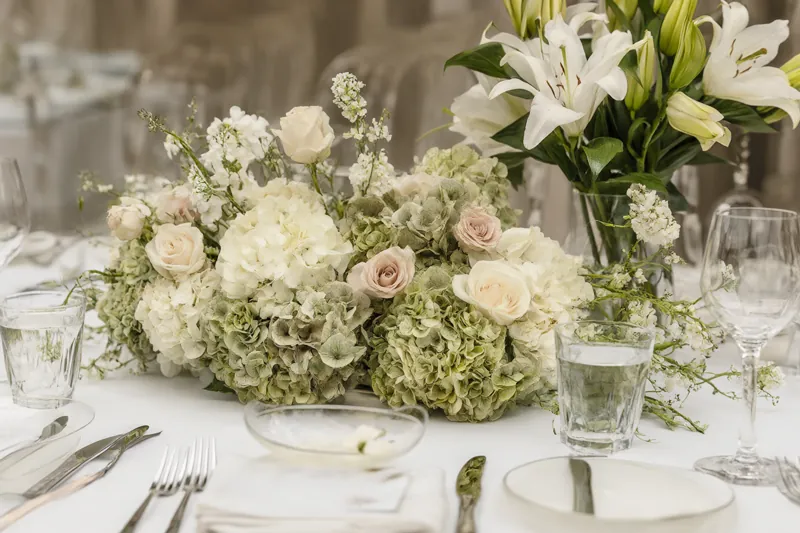
- Flowers with many petals and little exposed pollen (double roses, hydrangeas, orchids) usually cause fewer problems.
- Lilies have an intense scent and pollen that stains: keep them away from the table.
- At the table choose lightly scented flowers; strong scents belong outdoors and along walkways.
A wedding brings many people together in a few spaces for many hours. Among them there may be someone with a pollen allergy, someone with asthma, someone who gets headaches from strong scents. This guide helps you choose hypoallergenic wedding flowers with them in mind, without giving up the design you want. It does not replace medical advice: in serious cases, the first thing to do is ask the guest what they need.
Allergies and flowers: what to really know
Many seasonal respiratory allergies, what British readers call hay fever, come from plants whose pollen is light and travels in the air: grasses, some trees, some wild herbs. Many flowers used in wedding design, on the other hand, are pollinated by insects: their pollen is heavier and stickier and spreads less.
That does not mean cut flowers are always harmless. Close up, in a closed room, some flowers can still bother sensitive people. And some people react to contact with certain plants or to their scents.
If one of your guests has significant allergies, ask them what to avoid and tell your florist at the first meeting. To find florists who pay attention to these things, see our list of wedding florists across Italy.
Low-pollen flowers and flowers to manage
| Flower | Pollen | Scent | Note |
|---|---|---|---|
| Double roses | Little exposed | Light to strong (garden roses) | Good choice for tables and bouquets |
| Hydrangeas | Little | Almost none | Excellent for tables |
| Orchids | Does not spread | Light in many varieties | Very safe in this respect |
| Ranunculus and double peonies | Little exposed | Light | Suitable for tables |
| Tulips | Moderate | Light | Generally well tolerated |
| Lilies | Lots, stains | Very strong | Remove anthers, keep away from tables |
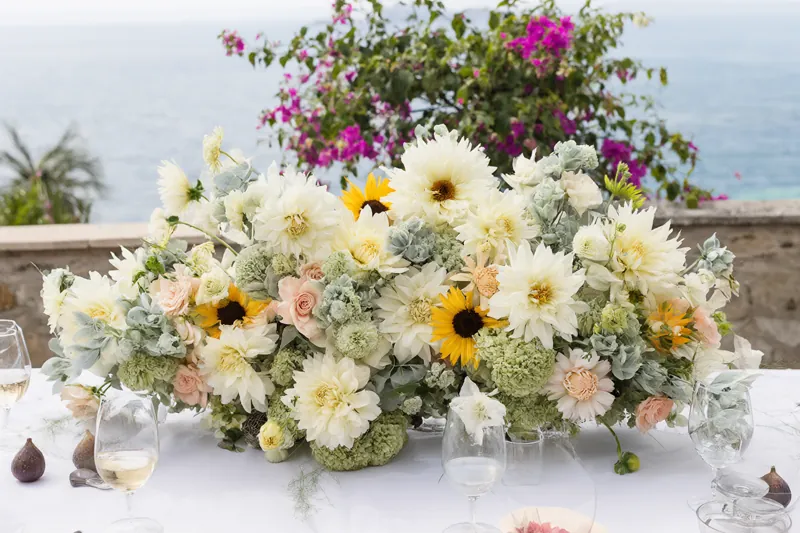
| Sunflowers | Depends on variety | Light | Pollen-free cutting varieties exist |
| Daisies, chamomile, chrysanthemums | Present | Herbal | Think twice with sensitive guests |
| Grasses and ornamental herbs | Present | None | Limit with pollen-allergic guests |
These are general indications: there are many varieties, and reactions vary from person to person.
The case of lilies
Lilies are beautiful and dramatic, but they have two drawbacks at a wedding:
- their scent is very strong: in a closed room, on many tables, it becomes heavy;
- their anthers are loaded with orange pollen that stains tablecloths, clothes and skin, and is hard to remove.
Florists usually remove the anthers before arranging. Even so, the scent remains. If you love lilies, use them in church, at the entrance or outdoors. At the table, choose something else.
Strong scents: where yes and where no
Some flowers and greens have a very recognisable scent: tuberose, gardenia, jasmine, hyacinth, freesia, narcissus, lilac, oriental lilies, some garden roses, eucalyptus. They are lovely, but scent needs balancing.
- At the table, scent mixes with food and wine. Choose lightly scented flowers.
- In small enclosed spaces, an intense scent can give someone a headache.
- Outdoors, at the entrance, along paths, a strong scent is a pleasure.
- In the bouquet, scent is a plus: it is mostly the bride who smells it.
For tables and for coordinating flowers with service, see also our guide to coordinating flowers, catering and venue.
Guests with allergies: how to plan
If you know someone is allergic, a few choices help:
- choose double flowers with little pollen for tables near that guest;
- reduce herbs, grasses and daisy-family flowers;
- ask your florist to remove anthers where possible;
- avoid very tall, heavily loaded arrangements right above their seat;
- in a closed room, make sure there is air and ventilation, if the venue allows it;
- for the closest spots, consider preserved or treated dried flowers, which have no fresh pollen.
Dried and preserved flowers have pros and cons: they can hold dust. We cover them in our guide to dried and preserved flowers.
Outdoor flowers: bees and insects
Outdoors, nectar-rich flowers attract bees, wasps and other insects, especially in summer. For a guest allergic to stings, this is serious. Your florist can limit the flowers most attractive to insects near tables and the buffet. Desserts, fruit and sugary drinks attract insects too: coordinate with the caterer.
Airborne pollen: the seasonal context
For people with seasonal allergies, the time of year of the event often matters more than the flowers on the tables. In Italy, roughly speaking, spring and early summer are the months with the most pollen in the air: grasses, some trees and, in Central and Southern Italy, flowering olive trees. Dates vary with region and year.
At an outdoor countryside wedding in May or June, a very allergic guest may suffer regardless of the decor. In these cases, indoor or covered spaces to retreat to help, and above all advice from their own doctor. Olive branches used in decor are usually not in flower, but if the venue sits in the middle of an olive grove in full bloom, it is worth knowing.
The same applies to guests flying in from abroad: plants and pollens in Italy may differ from those at home, and a guest who never has hay fever in Sydney or Toronto may react to something new.
The bouquet and the bride
The bride may be allergic too. If you are, say so straight away: your florist will choose suitable flowers and can make a trial bouquet some time beforehand, to see how you react. Holding a bouquet for hours, close to your face, is different from looking at a centrepiece. If you live abroad, a trial can sometimes be arranged during a planning visit, or with a local florist at home using the same flowers.
Questions to ask your florist
- Which flowers do you suggest for the tables if there are allergic guests?
- Do you remove the anthers from lilies and other high-pollen flowers?
- Which flowers in the design are the most fragrant?
- Can you use pollen-free varieties, for example for sunflowers?
- Can herbs and grasses be reduced or replaced?
- Can you make a trial bouquet so I can check for reactions?
- In a closed room, which arrangements would you advise against so the air does not feel heavy?
- If a guest has a problem during the party, can an arrangement be moved?
Final thoughts
With a little care, flowers can be chosen with the most sensitive guests in mind. You do not need to give up scent: just put it in the right place, ask early who has particular needs and let your florist find suitable varieties. Strong scents where people walk, lightly scented low-pollen flowers where people eat. For flowers on the table and near food, read our guide to food-safe flowers.
Once you have a date and a venue, request a quote and mention any guest allergies from the start.