In short
- No decorative flower should touch food, platters or serving cutlery.
- Some plants used in wedding decor are toxic: keep them away from the table and the cake.
- Florist flowers are not food: they may have been treated with products unsuitable for eating.
- Edible flowers must be sold as food and prepared by the caterer or cake maker.
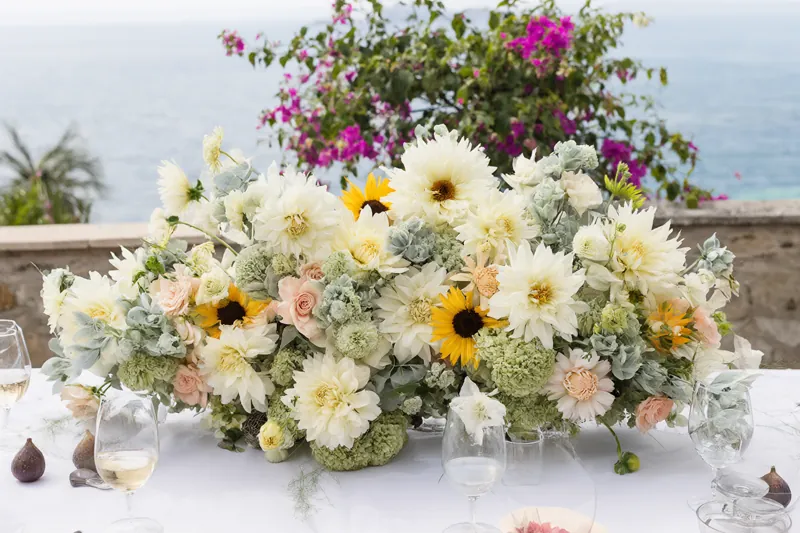
Flowers and food meet in many places at a wedding or event: on the table, on the buffet, on the cake, sometimes on the plate. This guide explains how to keep that closeness safe. It is written for couples, but also for anyone organising corporate events with aperitivo (pre-dinner drinks with nibbles, a big part of Italian receptions) and buffets. Food safety rules are the caterer's and the cake maker's responsibility: this guide helps you ask the right questions.
Who is responsible for what
First of all, the roles:
- the caterer is responsible for the safety of the food they serve, including everything on the platters;
- the cake maker is responsible for the cake and whatever sits on it;
- the florist is responsible for the arrangements, the choice of flowers and how they are set up.
That is why decisions about flowers near food are made together. If your florist has never spoken to the caterer, set up the contact yourself. Our guide to coordinating flowers, catering and venue explains how to get them working together. If you are still looking for someone to work with, start with our list of wedding florists across Italy.
Toxic plants used in wedding decor
Some flowers and greens common in wedding decor are toxic if swallowed, or irritating to the touch. They are not dangerous in an arrangement on the table, but they must not touch food or end up on the cake.
| Plant | Why to be careful | Where you often see it |
|---|---|---|
| Oleander | Very toxic in all parts | Gardens in the South, ornamental branches |
| Lily of the valley | Toxic | Spring bouquets |
| Foxglove | Toxic | Garden style, cultivated wildflowers |
| Hellebore | Toxic | Winter designs |
| Narcissus and jonquils | Toxic, irritating sap | Spring |
| Ranunculus and anemones | Irritating sap | Winter and spring |
| Calla lilies | Irritating if swallowed | All year |
| Delphinium and larkspur | Toxic | Natural, meadow style |
| Hydrangeas | Not suitable for eating | Summer |
| Ivy, mistletoe, holly, yew | Toxic berries or leaves | Winter and Christmas designs |
The list is not complete: it shows some common cases. Even non-toxic plants should not be eaten if they were not produced as food.
With children present, avoid toxic plants in low arrangements within easy reach. The same goes for animals, if the venue has any.
Treated flowers: why they are not for eating
Decorative cut flowers are grown to last and to look good, not to be eaten. Along the supply chain they may be treated with products to protect them from pests and disease, and preservatives are often added to vase water. These products are designed for flowers, not for food.
So a florist's flower, even of an edible species such as a rose or a violet, is not an edible flower. The difference lies in how it was grown and sold, not in the species.
Edible flowers: what they are
Edible flowers are grown and sold as food, in line with food regulations. You find them through specialist growers and suppliers to the restaurant trade. Some examples often offered: violas, borage, calendula, nasturtium, courgette (zucchini) flowers, food-grade rose petals, cornflower, lavender.
A few practical rules:
- they are chosen and prepared by the caterer or cake maker, not the florist;
- they must be bought from someone selling them as food;
- they must be declared to guests with allergies, like any other ingredient;
- they should not be mixed with decorative table flowers, to avoid confusion.
Flowers on the cake
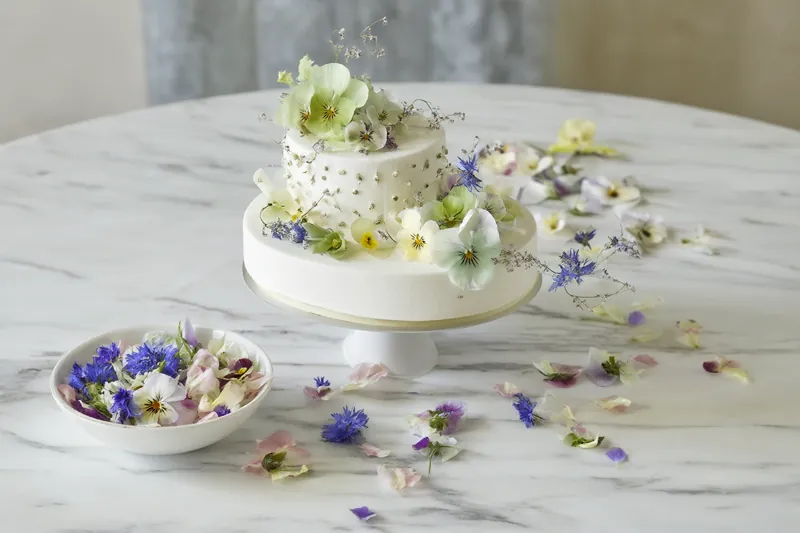
A cake with fresh flowers is a very popular request. It can be done safely:
- choose non-toxic flowers that the cake maker knows and approves, such as roses; avoid hydrangeas and the plants in the table above;
- stems should not go straight into the cake: use protection such as flower picks, food-safe tape or holders;
- remove the flowers before cutting and serving;
- avoid flowers that shed pollen or petals;
- alternatively, use edible flowers supplied by the cake maker, or sugar flowers.
Who puts the flowers on the cake? Often the florist prepares the flowers and the cake maker decides how to place them. Agree this in advance. For details, see our guide to flowers on the wedding cake.
Buffet, aperitivo and food stations
On the buffet, flowers add colour but can cause problems. A few simple rules:
- flowers do not touch food, platters or serving cutlery;
- no arrangements shedding petals, pollen or leaves over the platters;
- no tall, unstable arrangements where people reach across;
- leave space for guests to serve themselves and for waiting staff;
- in hot weather, no flowers that wilt and lean over the food.
On these points the caterer has the final word. Strong scents near food are another issue: we cover it in our guide to fragrant flowers and allergies.
Water, vases and glass
It is not only flowers that need attention. Containers matter too:
- vase water often contains preservatives and, after a few hours, plant residue: it must not end up on plates and tablecloths;
- thin glass vases near the buffet can break, and glass splinters and food do not mix;
- floral foam leaks water and fragments: closed containers or foam-free solutions are better on food tables;
- vases are filled and placed before the caterer lays the tables, not over a table that is already set.
Experienced florists know these details. Ask how they manage water and containers near food.
Branches, fruit and leaves as decoration
Lemons, pomegranates, grapes and leaves are popular decorations, especially in Southern Italy. The same rules apply: decorative fruit may be treated on the surface and should not be served or placed in contact with food. If fruit is meant to be eaten, the caterer supplies it.
Questions for your florist, caterer and cake maker
- Which flowers in the design are toxic or irritating? Where will they go?
- Have the buffet flowers been agreed with the caterer?
- Who places the flowers on the cake, and with what protection?
- Are you using edible flowers? Who do you buy them from?
- Are guests with allergies informed about edible flowers on their plates?
- With children present, are there plants to avoid in low arrangements?
Final thoughts
The golden rule is simple: decorative flowers are for looking at, edible flowers are bought as food. When in doubt, the safest choice is always to keep flowers a few centimetres from the food. The rest is coordination between whoever does the flowers and whoever prepares the food.
Once you have a date and a venue, request a quote and put your florist in touch with the caterer and cake maker from the start.
Sources
- Regulation (EC) No 178/2002 laying down the general principles and requirements of food law: https://eur-lex.europa.eu/eli/reg/2002/178/oj
- Regulation (EU) 2015/2283 on novel foods: https://eur-lex.europa.eu/eli/reg/2015/2283/oj