In short
- Make one shared list of who brings what: linen, plates, vases, candles, stands.
- Centrepieces must leave space and sightlines on the caterer's laid table.
- On the buffet, flowers must not touch food or drop petals or pollen.
- Candles and open flames follow the venue's rules: ask for them in writing.
Flowers, food and spaces meet on the same table, in the same corridors, at the same hours. If the florist, caterer and venue do not talk to each other, it shows: centrepieces that force guests to move their glasses, teams tripping over each other, candles banned at the last minute. This guide helps you coordinate your wedding florist and caterer with the venue, even without a wedding planner, and even from abroad.
Three teams, one space
Each has a role:
- the florist designs and places flowers, greenery and sometimes candles and hire items;
- the caterer lays the tables, cooks, serves and is responsible for food safety;
- the venue sets rules, timings and access, and sometimes provides furniture.
Many Italian venues, especially villas, have an exclusive caterer and a list of recommended suppliers, sometimes for flowers too. Ask straight away whether you can choose your florist freely. If you are looking for florists who work near your venue, start from our list of wedding florists in Italy.
If nobody is coordinating, the point of contact is you. It is worth putting them in direct contact by email, with the floor plan attached. To see how the roles split when there is a planner, read our guide to floral designers and wedding planners.
Who brings what
This is the most useful document and the one most often forgotten. A shared table avoids duplicates and gaps.
| Item | Usually who | What to check |
|---|---|---|
| Tables and chairs | Venue or caterer | Shape and size of tables |
| Tablecloths and napkins | Caterer or hire company | Colour, matched to the flower palette |
| Plates, glasses, cutlery | Caterer | How many glasses per place |
| Charger plates | Caterer or hire company | Space they take on the table |
| Centrepieces and vases | Florist | Sizes compatible with place settings |
| Candles and holders | Florist or caterer | Venue rules on flames |
| Place cards and menus | Couple or designer | Space on or beside the plate |
| Table plan display | Florist or stationery designer | Position and lighting |
| Buffet decorations | Florist with the caterer | Distance from food |
| Lighting | Venue or lighting company | Sockets, switch-on times |
For matching linen, glassware and flowers, see also our guide to tables and flowers.
The laid table
The centrepiece lives on the caterer's table. Three practical rules:
- Clear sightlines. Arrangements either low, below eye level, or tall on a slim stem, above eye level.
- Room to serve. With three or four glasses per place and bottles on the table, the space in the middle shrinks a lot, especially on long banquet tables (Italians call them tavoli imperiali).
- Stability. Outdoors, wind knocks over tall, light vases.
Send the florist the table sizes and a photo of the planned place settings. If possible, do a test together: see our guide to the centrepiece sample and table mock-up.
Flowers near food and people
Buffet and drinks reception
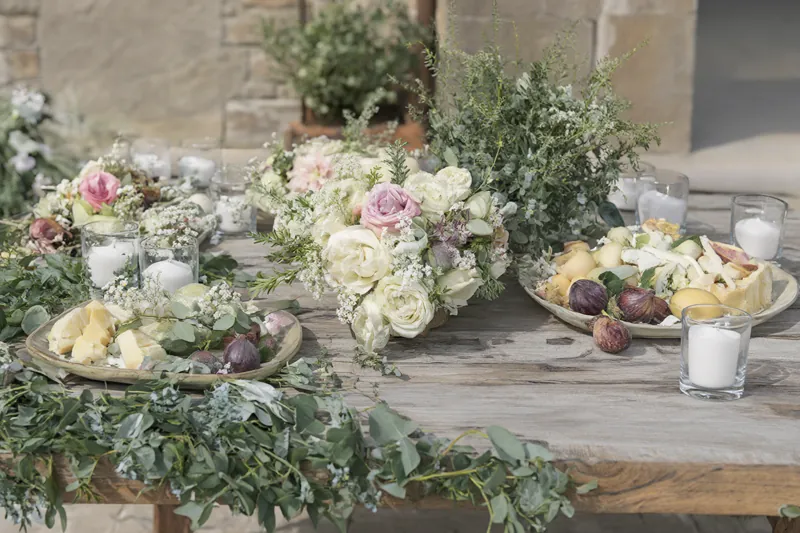
On the buffet and at the food stations of the drinks reception (in Italy often a long, generous aperitivo), flowers sit close to the food. Agree with the caterer that:
- flowers do not touch food, platters or serving utensils;
- they are placed behind or above the food, never where people reach;
- they do not drop petals or pollen onto plates: some flowers, such as certain lilies, shed a lot;
- arrangements do not block the waiting staff.
The caterer is responsible for the hygiene of the food they serve, under EU and Italian rules. Follow their guidance. If you want flowers on plates or on the cake, the person preparing the food should choose them and use only suitable edible flowers. See our guide to flowers that are safe near food.
Scent and allergies
At the table, a strong scent can overpower the food and bother guests. Ask for lightly scented flowers on the tables and keep the more intense ones for entrances and the ceremony. If any guests have pollen allergies, tell both suppliers.
Candles and open flames
Candles often sit on the border between flowers and catering. Before designing them, ask the venue:
- whether open flames are allowed, and where;
- whether enclosed holders, such as glass cylinders, are required;
- whether LED candles are required in some rooms or near fabrics and wood;
- who lights and puts out the candles, and when.
Never put lit candles near dried arrangements, branches, curtains or hanging installations. Fire safety rules are set by the venue according to the regulations that apply to it: always check them with the venue manager. More in our guide to flowers and candles.
Timings
The teams often work in the same spaces at the same time. Put in writing:
| Moment | Who | What to agree |
|---|---|---|
| Arrival | Florist and caterer | Who goes in first and through which entrance |
| Tablecloths | Caterer | Before the centrepieces |
| Centrepieces | Florist | Before or after place settings |
| Candles | Florist or caterer | Who lights them and when |
| Room change | Everyone | Who moves flowers and furniture after the ceremony |
| End of party | Everyone | Order of breakdown and who leaves last |
For details on timings and moves, read our guide to set-up and breakdown.
The venue and its rules
Ask the venue for its written rules and share them with every supplier. They usually cover:
- access and exit times;
- unloading areas and vehicle parking;
- the use of nails, tape and hooks;
- candles, petals, confetti and rice (note that in Italy confetti are sugared almonds, while paper confetti is called coriandoli);
- exclusive suppliers;
- waste disposal, including flowers and greenery after the event.
If the venue is empty
Some venues are rented empty: no tables, no kitchen, sometimes no power in outdoor areas. In that case coordination matters even more. You need to hire tables and chairs, a field kitchen for the caterer, lighting, sometimes generators and toilets. The florist needs to know early which tables are coming, because their size decides the centrepieces. They also need to know where they can work out of the sun, with water available.
The top table and the cake
These are two points where flowers and catering meet. At the top table, the front arrangement must not hide the couple in photos or get in the way of service. On the cake, decorative flowers must be agreed with the cake maker: not all flowers are suitable for contact with food. See our guide to flowers on the wedding cake.
Questions to ask the caterer and the venue
- How many glasses and plates will there be per place?
- What is the maximum size you recommend for centrepieces?
- Where can flowers go on the buffet?
- Are candles allowed? In what kind of holders?
- What time do you lay the tables, and when can the florist come in?
- Who lights the candles, and who moves the flowers after the ceremony?
- Where do flowers and greenery go at the end of the party?
In practice
One email with the table plan, the who-brings-what table and the timings, sent to everyone, solves most problems. Once you have your venue, request a quote from a florist and attach the venue's rules and the caterer's contacts.
Sources
- Regulation (EC) No 852/2004 on the hygiene of foodstuffs, EUR-Lex: https://eur-lex.europa.eu/eli/reg/2004/852/oj