In short
- Ranunculus and anemones are late winter and spring flowers: the season is indicative and varies with region and year.
- In Italy they are grown mainly in mild areas, especially on the Ligurian Riviera.
- They have delicate petals: they dislike heat and need precise timing.
- Anemones move: they open and close with light and temperature.
If you are getting married between winter and spring in Italy, ranunculus and anemones are among the loveliest wedding flowers you can have. Light, full of colour, perfect for bouquets and tables. This guide explains when they are available, how they behave and how to use them well, with the right questions for your florist.
Two different flowers, one season
Ranunculus (Ranunculus asiaticus, sometimes called Persian buttercup) and anemone (Anemone coronaria, the poppy anemone) are relatives, from the same botanical family, but they look very different.
| Ranunculus | Anemone | |
|---|---|---|
| Shape | Many thin, layered petals, sometimes like a small rose | Broad petals around a dark or light centre |
| Common colours | White, cream, pink, peach, orange, yellow, red, burgundy | White with black centre, red, blue-violet, pink, burgundy |
| Indicative season | Winter to April or May | Late autumn to spring |
| Behaviour | Opens slowly and grows in volume | Opens and closes with light and temperature |
| Typical use | Bouquets, centrepieces, buttonholes | Bouquets, low arrangements, graphic contrasts |
Seasons are indicative: they vary with region and year. If you are looking for a florist who works with seasonal flowers, start with our list of wedding florists across Italy.
When they are available
In Italy ranunculus and anemones are grown mainly in mild-climate areas, with significant production on the Ligurian Riviera and in other parts of Central and Southern Italy. The main season runs from winter into spring.
- Anemones: often from late autumn, plentiful in winter and early spring.
- Ranunculus: from winter until April, sometimes into May.
- End of season: as it warms up, quality drops, stems get shorter and the flowers open faster.
Out of season they can sometimes be imported, with more variable choice and quality. For the full month-by-month picture, see our guide to seasonal flowers in Italy.
Ranunculus: what to know
The cut ranunculus has a hollow, flexible stem and a head made of dozens of thin petals. Bought in bud, it opens over the following days and grows in size.
A few practical points:
- delicate stems: they bend easily, so they need skilled hands in a bouquet;
- gradual opening: your florist chooses the right stage for the wedding day;
- lots of colours: from pure white to burgundy, via peach, coral and bicolour tones;
- large ranunculus: some varieties have big heads and dense petals and are used as a spring alternative to peonies.
The sap of ranunculus and anemones can irritate sensitive skin: florists handle them carefully, and they are not flowers to put on food.
Anemones: flowers that move
The anemone has a rare quality: it keeps living in the vase. It opens with light and warmth, partly closes when it is cool and dark, and bends towards the light. It is a living flower that brings movement to an arrangement.
This has practical consequences:
- an arrangement set up in the morning may look different in the evening;
- in a very warm room anemones open fully and last less;
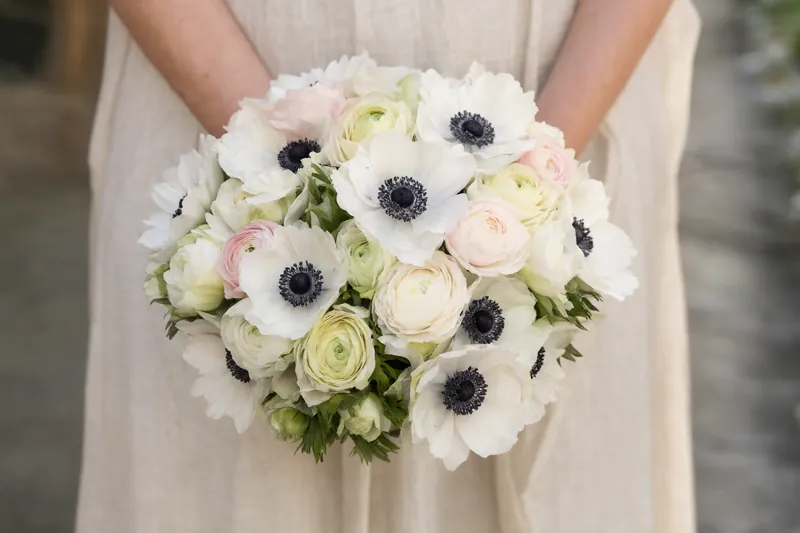
- the white anemone with a black centre is very graphic and suits modern and minimal styles.
Your florist knows how to handle them. But it helps to know, so you are not surprised if the flowers have changed by the time you cut the cake.
Delicacy and heat
Both flowers are delicate. They work beautifully in winter and spring, much less in heat. For a March or April wedding in Tuscany or Rome they are a natural choice. For a late May wedding in Puglia or Sicily, the heat may already be a problem.
Ask your florist:
- whether they can still find good quality on your date;
- whether the arrangements will be in shade or sun;
- how much time passes between set-up and the guests arriving;
- which hardier flowers they suggest for exposed areas.
How to use them at your wedding
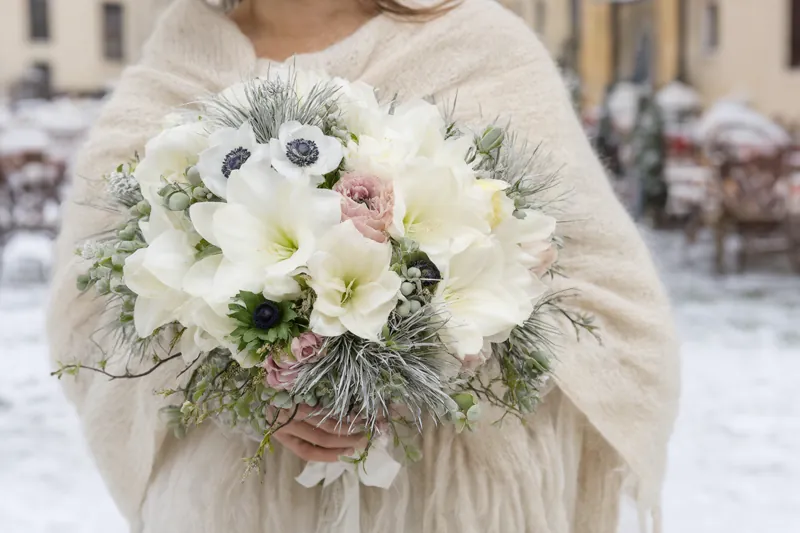
Bouquet. They are among the best-loved flowers for spring bouquets. Light and colourful, they combine with spray roses, tulips, freesias and fine greenery. We cover this in our guide to seasonal bridal bouquet flowers.
Centrepieces. They work well in small, low vases, grouped together, or in low arrangements along a long banquet table. They do not have the volume of hydrangeas, so you need more stems to fill.
Buttonholes. A small ranunculus or anemone is perfect on a lapel. They should be made as late as possible.
Church. They can be used, but large spaces need big quantities. They are often combined with fuller flowers and greenery.
How much they cost
We do not give per-stem figures: they change with season, variety, colour, size and origin. Some things move the price:
- start and end of season: flowers are less plentiful and often dearer;
- large and unusual varieties: big-headed ranunculus or those with special petals cost more than standard ones;
- quantity: you need more stems to fill than with fuller flowers;
- origin: Italian-grown flowers in their season travel little; out of season they come from far away.
A smart way to use them is to concentrate them where they are seen up close: bouquet, top table, low centrepieces. For large surfaces, combine them with greenery and fuller flowers.
An opportunity for winter weddings
Couples marrying between December and March often think they have little choice. In fact this is exactly the season of anemones and ranunculus, together with hellebores, amaryllis and branches. A winter table with white and red anemones, dark greenery and candles, where the venue allows them, is elegant and in tune with the season. We cover this in our guide to winter wedding flowers.
Spring palettes
Ranunculus and anemones cover almost the whole colour range. Some common combinations:
- white and green: white ranunculus, white anemones with dark centres, pale greenery;
- pastel: peach, blush pink, cream;
- bold colour: orange, coral, red, yellow, for a joyful wedding;
- contrast: the burgundy and blue-violet of anemones, for a more intense table.
Questions to ask your florist
- On my date, are ranunculus and anemones in full season?
- Are they Italian grown or imported?
- How will they change over the course of the day?
- If it is warmer than expected, what is your plan?
- How many stems do the centrepieces I have in mind need?
- Which flowers will you pair them with for more volume?
- Can arrangements with ranunculus and anemones be moved from the ceremony to the reception without damage?
- How many extra flowers do you buy to make up for those that do not open well?
Final thoughts
Ranunculus and anemones are the simplest way to say "spring" with flowers, even when it is still winter outside. They are at their best between winter and April, with cool temperatures and well-organised set-ups. For the spring alternative to peonies, read our guide to peonies for your wedding.
Once you have a date and a venue, request a quote and ask your florist which ranunculus and anemones they can find in your month.