In short
- Seasonal flowers are fresher and more plentiful, and often more reasonably priced.
- Flower seasons are indicative: they shift with the year, the region and greenhouse growing.
- From June to September, heat tolerance matters as much as how a flower looks.
- Fragrance needs balancing: a strong scent carries into close-up photos and into a church.
Choosing seasonal bridal bouquet flowers, starting from your wedding month, is the easiest way to get a bouquet that is fresh, beautiful and in tune with the landscape around you. This guide is for anyone getting married in Italy, including couples flying in from abroad, who wants to know what is actually available month by month. You will find an indicative table, notes on scent and heat, and the questions to ask your florist. If you are still looking for someone to make your bouquet, browse our list of wedding florists across Italy.
Why start with the season
A flower in season has travelled less, spent less time in cold storage and usually arrives more open and more fragrant. Italy has strong flower-growing areas, such as the Ligurian Riviera, the part of Tuscany between Pistoia and Pescia, Campania, Puglia and Sicily. Many flowers still come from abroad, though, mostly through the big Northern European markets.
So almost everything can be found almost all year. But "available" does not mean "a good idea". Out of season a flower can cost more, look less lovely or fail to arrive at the last minute. Starting with the season reduces those risks.
Month-by-month table
Treat this table as a guide. Seasons depend on the year, the region and greenhouse growing. Your florist will know what they can get for your week.
| Month | Flowers often available | Notes |
|---|---|---|
| January | Anemones, ranunculus, hellebores, tulips, amaryllis | Lots of greenery and branches; short days |
| February | Ranunculus, anemones, tulips, freesias, mimosa | Mimosa is linked to Women's Day on 8 March in Italy |
| March | Ranunculus, tulips, freesias, narcissi, blossom branches | Spring starts earlier in the South |
| April | Ranunculus, tulips, lilac, viburnum, first roses | A month of great variety |
| May | Peonies, garden roses, sweet peas, viburnum, astrantia | A very popular month for weddings |
| June | Peonies early in the month, roses, hydrangeas, delphinium, lavender | The heat starts to matter |
| July | Hydrangeas, lavender, sunflowers, lisianthus, first dahlias | Choose hardy flowers |
| August | Dahlias, zinnias, cosmos, lisianthus, sunflowers | Very hot; plan timings carefully |
| September | Dahlias, roses, muted hydrangeas, cosmos, berries | Very popular month, warm colours |
| October | Dahlias until the first cold, roses, celosia, berries, foliage | Full autumn, golden light |
| November | Roses, hellebores, berries, branches, first amaryllis | Avoid chrysanthemums (see below) |
| December | Amaryllis, anemones, ranunculus, hellebores, berries and conifers | Winter and Christmas feel |
Roses, carnations, lisianthus, calla lilies and orchids are available practically all year, because they are greenhouse grown or imported. For the full table of all flowers, not just bouquet flowers, read our guide to seasonal flowers in Italy.
Spring: delicate flowers and light colours
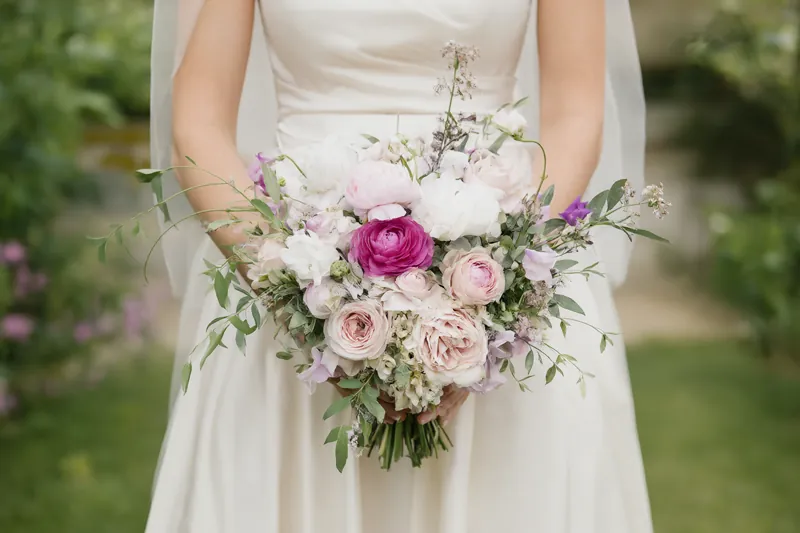
From March to May the bouquet can be light and bright. Ranunculus and anemones bring colour and movement, tulips work well in loose bunches, lilac and viburnum add soft volume. May is the month of peonies and garden roses, much loved for romantic bouquets.
A word of caution: spring flowers are often fragile. Ranunculus droop in the heat and sweet peas wilt quickly out of water. If your wedding is at the end of May somewhere warm, ask for a plan to keep them fresh.
Summer: choose flowers that last
Between June and August the main issue is heat. A bouquet stays out of water for hours, goes from a hot car into a church and then out into the sun for photos. Some flowers cope, others do not.
| Usually cope better | Usually struggle more |
|---|---|
| Calla lilies | Hydrangeas, unless well hydrated |
| Lisianthus | Ranunculus |
| Carnations and spray carnations | Sweet peas |
| Roses with firm petals | Gardenias (they bruise and brown) |
| Sturdy orchids | Fully open peonies |
| Lavender and aromatic greenery | Lily of the valley |
You do not have to give up the flowers you love. You just need to know they need managing: later delivery, the bouquet kept in water until the last moment, shade during photos. Our guide to summer weddings and flowers in the heat explains how.
Autumn: warm colours and texture
September and October are among the most popular months for weddings in Italy, including for couples from abroad. An autumn bouquet can play with dahlias, roses in rust or blush tones, hydrangeas turning green and red, berries, leaves, wheat and grasses. It is the season when the colours of the vineyard and the countryside find their way into the flowers.
An important note if you are coming from abroad: in Italy chrysanthemums are associated with mourning and with All Souls' Day at the start of November, when families take them to cemeteries. Many Italian guests would notice. It is best to leave them out of the bouquet and the decorations, even if they are a celebration flower where you come from.
Winter: greenery, berries and greenhouse flowers
A winter wedding has fewer field flowers to choose from, but still plenty of options: amaryllis, hellebores, greenhouse anemones and ranunculus, branches, berries, conifers, eucalyptus. Winter bouquets often lean towards white and green or deep reds. For more ideas read our guide to winter wedding flowers.
A fragrant bouquet
Some flowers have a strong scent: gardenia, tuberose, jasmine, lily of the valley, freesia, lilac, peonies and garden roses. A fragrant bouquet makes a powerful memory, but it needs balancing.
- In a church or a closed room, scent becomes concentrated.
- Your partner, your witnesses and the photographer are close to you for a long time.
- Some people are sensitive to strong scents or to pollen.
A good compromise is one fragrant flower among neutral ones. Our guide on fragrant flowers and allergies goes into more detail.
Bringing a piece of Italy into your bouquet
If you are getting married in Italy from abroad, local plants are a way to carry the place into your bouquet: olive branches, lemon leaves, myrtle, lavender, cultivated wildflowers, aromatic herbs. You do not need an "Italian" style to use them. They can be a small detail in a bouquet of any style.
If the flower you want is out of season
This happens a lot: you fell for a peony bouquet and your wedding is in September, or you picture ranunculus in August. You have three options.
- Import it: sometimes it can be sourced from foreign growers or greenhouses. It costs more and quality can vary. Ask your florist how reliable the supply is.
- Find a similar flower: a very full garden rose recalls a peony, and lisianthus can stand in for ranunculus in a pale palette. In photos the difference is often hard to see.
- Keep the idea, not the flower: colour, shape and movement matter more than the species. A soft, blush pink bouquet can be made in almost any month.
A good florist will tell you honestly what is realistic. Be wary of anyone who promises any flower on any date without explaining where it will come from.
Questions to ask your florist
- Which flowers can you source well for my wedding week?
- Where do they come from: Italian growers, greenhouses or imports?
- If the flower I want does not arrive, what will you use instead?
- Which flowers in my month cope best with the heat?
- What time will you deliver the bouquet, and how should I keep it until the ceremony?
- Will the bouquet be fragrant? Can we tone the scent down?
- Which flowers in my bouquet could be dried and kept afterwards?
Final thoughts
Start from the month, see what it offers, then choose shape and colours. Your bouquet will be fresher and more in keeping with the place. To decide on the shape, read our guide to bridal bouquet styles.
Once you have a date and a venue, request a quote and ask the florist which seasonal flowers they would suggest for your bouquet.