In short
- The cost depends on how many points you decorate: altar, pews, entrance, aisle.
- As an indicative range, a full church scheme often costs between €1,000 and €2,500, but you can do a lot with less.
- The parish rules come first: timings, fixings, petals, liturgical seasons.
- Sharing flowers with another couple on the same day, or reusing them at the reception, lowers the cost.
How much do church wedding flowers cost in Italy? An Italian church is a large space, already beautiful, and often has precise rules. Decorating it well does not mean filling it. This guide explains the elements of church wedding flowers, what they may cost as an indicative range, and what to ask the parish and the florist before you decide. If you are coming from abroad, it also covers the customs that may be new to you.
The elements of church flowers
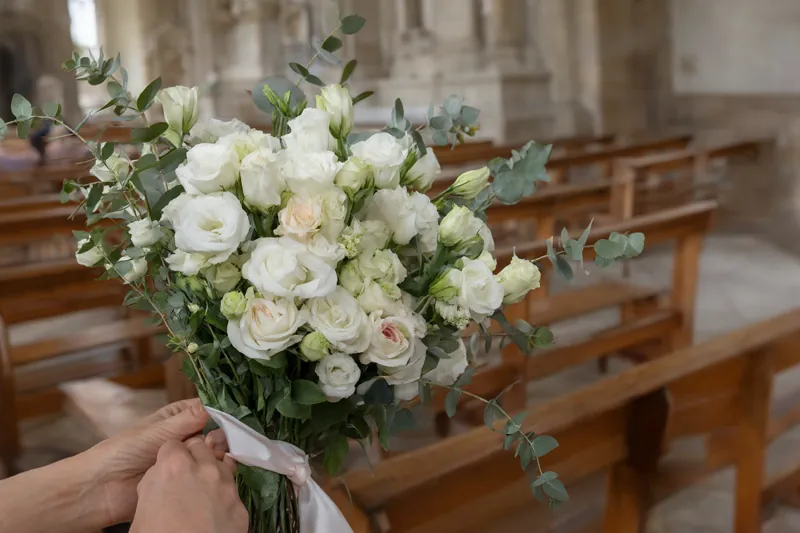
Church flowers are built from a few elements that combine. The ranges below are indicative, for fresh seasonal flowers, and vary a lot with the size of the church.
| Element | Indicative range | What moves it |
|---|---|---|
| Altar arrangements (2) | €300-1,600 | Size, flowers, height of the church |
| Pew ends | €25-120 per pew | Simple posies or arrangements with trailing foliage |
| Entrance or doorway | €300-1,500 and up | Floor vases, garland, arch over the door |
| Aisle (floor vases or lanterns) | €200-800 | Number of pieces, container hire |
| Aisle runner | €100-400 | Hire, length, laying |
| Kneelers or chairs for the couple | €50-200 | Small arrangements or garlands |
| Lectern, font, statues | €50-200 each | Only if the parish allows it |
A simple scheme, with the altar and every other pew, often stays at a few hundred euros. A large church with the doorway, every pew and the aisle easily reaches €1,500 to €2,500. If you are looking for florists who regularly work in churches in your chosen area, see the list of church wedding flowers.
First of all, the parish rules
There is no single rulebook for all Italian churches. Each parish, sanctuary or basilica decides for itself. If you are marrying in a Catholic church as a foreign couple, your paperwork usually goes through your home parish and the Italian parish; the flowers are a separate conversation, but often with the same priest or parish office. These are the questions that come up most:
- Set-up and breakdown times. The church is often open for worship and may have other services. Sometimes set-up is only possible an hour before.
- Fixings. Nails, adhesive tape on wood and wire on historic furnishings are almost always forbidden. Florists use hooks or supports that leave no marks.
- Petals, rice and confetti. Many churches forbid them inside, sometimes on the square in front too. Note that in Italy confetti are sugared almonds given to guests, not paper confetti.
- Candles and open flames. Only as the parish allows.
- Times of year. In some liturgical seasons, such as Lent, restraint is asked for in altar decorations. The priest will tell you what is possible.
- A florist chosen by the parish. Some churches work with a trusted florist or ask that they handle the altar.
- Offering. Many parishes ask for a donation, free or suggested, separate from the flowers.
Ask for these rules in writing or by email and pass them on to your florist before they prepare the design. There is more in the guide on what is allowed with church flowers.
What moves the price
The size of the church
A country church with ten rows of pews and an abbey with twenty-metre-high naves call for arrangements on a very different scale. In a tall space a small pew posy almost disappears: it is better to concentrate flowers on the altar and the entrance.
The number of points
Every extra point is one more piece to make, transport, set up and take down. Every other pew, or only the front rows, is a common choice that lowers the cost without losing the effect in photos.
Set-up and breakdown
If the church has another service straight after your wedding, the florist has to clear quickly, perhaps with extra people. If flowers are moving to the reception, you need a van and someone to do it while you are having photos or at the drinks reception.
Logistics
Churches in historic centres with limited traffic zones (ZTL), villages with narrow lanes, long flights of steps, islands: deliveries take time. In these cases transport may be a separate line in the quote.
Flowers and the season in church
Churches are often cool even in summer, which helps the flowers. But many ceremonies take place in the morning or early afternoon, with set-up in the hottest hours and church squares in full sun. For the entrance and doorway choose flowers and foliage that cope with heat; for the altar you can use more delicate varieties.
In spring and autumn the choice is wider. In winter, greenery, branches and berries add volume with few flowers, especially in stone churches. One thing worth knowing as a foreign couple: in Italy chrysanthemums are strongly associated with funerals and All Saints' Day, so most florists will steer you away from them for a wedding. In every season, Italian flowers of the moment are an excellent base: ask your florist what is good that week.
Historic churches and basilicas
In churches of great artistic value the rules are usually stricter: no fixings on furnishings, set routes for carrying things in, sometimes a custodian present during set-up. They are also often the most photographed spaces, where a few large, well-placed pieces work better than many small decorations. Ask in advance whether special permissions are needed or whether the church already has its own trusted florist.
Sharing flowers with another couple
In the busiest months the same church may host two weddings on the same day. Sharing the flowers can halve the cost, but you need to agree on:
- style and colours: both couples have to like them;
- a single florist, or two florists who coordinate;
- who pays for what, in writing;
- who clears away, when, and where the flowers go afterwards.
Ask the parish whether there are other weddings that day: the priest is often the one who puts couples in touch.
Reusing flowers at the reception
The altar arrangements can become the backdrop of the top table. The aisle vases can go to the villa entrance. It is one of the most effective ways to keep the budget down. But ask the florist:
- whether the pieces are designed to be transported;
- who moves them and with what vehicle;
- whether they will arrive in time, before the guests come in.
More ideas for spending less are in the guide on how to save on wedding flowers.
Questions to ask your florist about the church
- Have you worked in this church before? Do you know its rules?
- How many points do you suggest decorating, given its size?
- How will you attach pew decorations without leaving marks?
- What time do you set up, and how long do you need?
- Who clears away, and how soon after the ceremony?
- Can the altar flowers go to the reception? Who takes them?
- Are the aisle runner and floor vases hired? Is there a deposit?
- Is the price including or excluding VAT (IVA)?
Final thoughts
For the full picture of all your wedding flowers, not just the church, read how much wedding flowers cost in Italy. If you receive several offers, the guide on how to read a florist's quote helps you compare them line by line.
Once the church is confirmed and you have its rules in writing, you can request a quote and attach them to your request: the florist can design something feasible straight away.