In short
- As an indicative range, a bridal bouquet with seasonal flowers often costs between €100 and €250; across all styles most stay between €100 and €350.
- The price rises with premium or out-of-season flowers, a large size and shapes such as the cascade.
- The throwing bouquet and buttonholes are almost always separate items.
- The bouquet is a small share of the flower budget, but it appears in nearly every photo.
The bouquet is the most personal part of your wedding flowers, and also the one with the most varied prices online. This guide explains what drives bridal bouquet cost in Italy, gives indicative ranges by style and helps you work out what to ask, including the throwing bouquet and flowers for the groom.
How much a bridal bouquet costs
There is no national price list. The ranges below are indicative and are meant to help you get your bearings. They refer to the bouquet alone, with fresh flowers, made by a florist who is also doing the rest of your wedding flowers.
| Type of bouquet | Indicative range | Notes |
|---|---|---|
| Small, simple, seasonal flowers | €80-150 | Suits a civil ceremony or elopement |
| Classic round, medium size | €120-250 | Roses, ranunculus, seasonal flowers |
| Loose or asymmetric, garden style | €150-300 | More flowers, more foliage, more work |
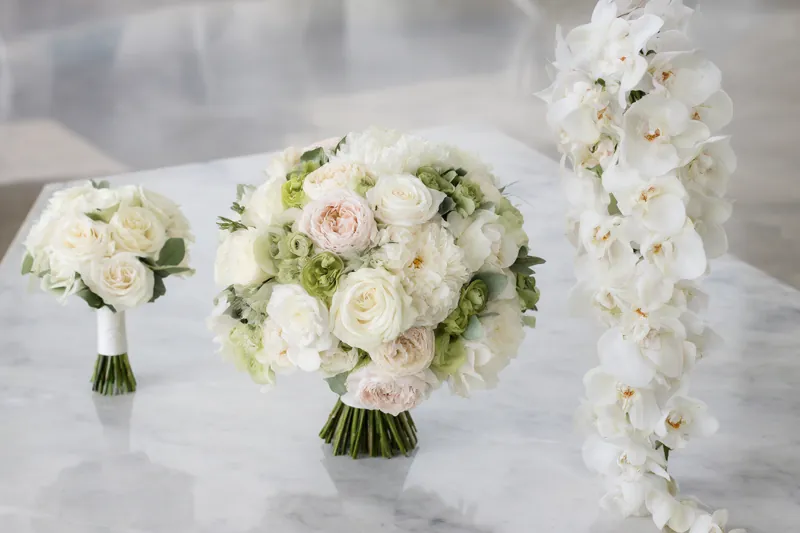
| Cascade | €250-500 and up | Many stems, structure, weight to manage |
| Single premium variety (peonies, orchids) | €150-400 | Depends on season and variety |
| Dried or preserved | €100-300 | Flower treatment, lasts over time |
If the bouquet is the only thing you order, some florists charge more or apply a minimum spend, because buying and delivery take the same work. This is worth knowing for elopements and very small weddings. To see who makes bouquets in your area, browse the list of wedding florists in Italy.
What pushes the price up
The flowers you choose
This is the biggest variable. Peonies, scented garden roses, orchids, giant ranunculus and unusual colours cost more than standard roses, lisianthus or cultivated wild-style flowers. A bouquet with a few expensive stems can cost as much as a large one with common flowers.
The season
A flower in its own season costs less and lasts better. In Italy peonies have a short window, usually from late April to June: in October they come from far away and the price goes up. The guide to seasonal flowers in Italy shows what is available month by month.
Shape and size
A compact round bouquet needs fewer stems than a wide loose one. The cascade is the most demanding shape: many flowers, a binding or frame that carries the weight, more hours of work. Shapes are explained in the guide to bridal bouquet styles.
Finishing touches
Silk ribbons, special bindings, charms or a small photo frame sewn into the handle are small details that add up. If you are bringing one of your own, tell the florist in advance, especially if it is travelling with you in your luggage.
Delivery
The bouquet needs to arrive fresh, usually on the morning of the wedding, wherever the bride is getting ready. If your hotel or villa is far from the venue or from the florist's studio, delivery can be a separate line on the quote.
When you pay and what the price covers
The bouquet is usually part of the overall flower quote and follows the same terms: a deposit on signing, the balance close to the date. If you order it on its own, some florists ask for full payment up front, because the flowers are bought specifically for you. Quotes are in euros; if you pay from abroad, bank fees and the exchange rate are on top.
Besides the flowers, the price covers design time, buying at the market, preparing the flowers in the days before (cleaning stems, hydrating, opening buds), binding and delivery. A €200 loose bouquet can take a couple of hours just to compose. That is why two bouquets with similar flowers can have different prices: one is denser, the other needs more handwork.
Also ask whether the price includes Italian VAT (IVA). Quotes can be written either way, and the full guide to wedding flower costs explains why this line matters.
The bouquet for a civil ceremony
For a ceremony at the town hall (in Italy, the Comune), many brides choose a smaller bouquet or a clutch-style posy that is easier to hold while signing and in photos inside the room. It often costs less, but the same rule applies: the choice of flowers matters more than the size. If the ceremony is short and the party follows straight after, ask for a bouquet that holds up well out of water for a few hours.
The throwing bouquet
Tossing the bouquet is a common custom at Italian weddings. Many brides prefer to keep their own and throw a second, smaller and lighter one. It usually costs less than half the main bouquet, but it needs to be asked for and written into the quote. An alternative is to use one of the arrangements from the room, if the florist agrees.
Buttonholes and matching flowers
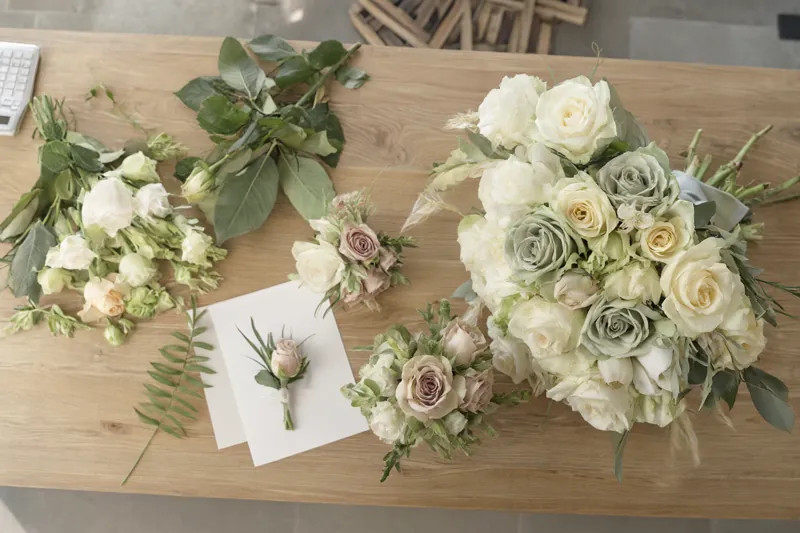
The bouquet rarely stands alone. It is often paired with:
| Piece | Indicative range | For whom |
|---|---|---|
| Buttonhole (boutonnière) | €15-40 each | Groom, best man, fathers |
| Wrist corsage | €25-60 each | Mothers, witnesses |
| Mini bouquet | €40-90 each | Bridesmaids, witnesses |
| Flower crown | €40-120 each | Flower girls, bride |
These are also indicative ranges. Buttonholes often use one flower and some of the foliage from the bouquet, so everything stays coordinated. Ideas and combinations are in the guide to buttonholes and flowers for the groom.
How to keep the bouquet cost down
- Choose seasonal flowers and give the florist freedom to swap one variety for a similar one.
- Use more foliage: eucalyptus, olive, ruscus and leaves add volume at a lower cost.
- Go for a round or small loose bouquet rather than a cascade.
- Keep the bouquet in proportion to your frame and your dress: bigger is not more beautiful.
- Order the bouquet with the rest of the flowers, so buying and delivery are shared.
More ideas for the whole set of flowers are in the guide on how to save on wedding flowers.
The bouquet in the heat
From June to August, especially in the south and at outdoor ceremonies, the bouquet stays out of water for hours. Ask the florist which flowers hold up best, where to keep it during lunch or dinner and whether a holder with a water reservoir is worth it. Hydrangeas, gardenias and some delicate varieties suffer in the heat more than others.
Questions to ask your florist about the bouquet
- Which flowers would you use in the month of my wedding?
- Is the price including or excluding IVA?
- Is delivery included? At what time and to which address?
- Can I see photos of similar bouquets you have made?
- Is the throwing bouquet included or extra?
- Will the buttonholes match the bouquet?
- What happens if a flower is not available that week?
- How should I look after it during the party?
- Can you advise on drying or preserving it afterwards, given that I am flying home?
Final thoughts
It is easier to choose the bouquet when you know the rest of the flower budget. For the full picture, start from how much wedding flowers cost. If you want to keep it afterwards, read how to preserve your bridal bouquet.
Once you know your date, style and colours, you can request a quote and attach two or three photos of bouquets you like: it is the quickest way to get a realistic price.