In short
- The parish rules come before any idea: ask for them in writing before planning.
- The classic spots are the altar, pews, entrance and doorway. You do not have to decorate them all.
- Timing matters: Masses, other weddings and closing hours decide when flowers can go in and come out.
- Many arrangements can be reused at the reception, if someone moves them in time.
The church is often the first place guests see on the wedding day. It is also a place of worship, with its own rules, its own timetable and a heritage to respect. This guide is for couples having a religious ceremony in Italy who want to understand what can be done with church wedding flowers, where to put them and what to ask the priest and the florist. If you are looking for professionals used to working in churches, start with our list of florists for church and ceremony flowers.
The parish rules to ask about
Every church has its own rules. Some are very relaxed, others very strict, especially historic churches, basilicas and sanctuaries. There is no single rulebook: practice varies from one diocese to the next and, within the same diocese, from parish to parish. Treat what follows as a list of questions, not a set of rules that apply everywhere. Always check with the parish priest or the parish office before you plan the flowers.
Take this checklist to your first meeting, or send it by email:
- Access times: from what time the florist can come in to set up, when they must be finished, and which door they can use to unload.
- What can be decorated: altar, sanctuary area, pews, aisle, doorway, and the sagrato, the square or steps in front of the church.
- Flowers on the altar: whether they are allowed in front or at the sides, and whether the altar table itself must stay clear, as it often must.
- Petals and rice: whether they can be thrown in the aisle, outside on the sagrato, or not at all.
- Fixings: whether nails, drawing pins, sticky tape, glue and wire are banned on pews, columns and furnishings.
- Candles: whether they are allowed, only in closed holders, or banned altogether.
- Liturgical seasons: whether your date falls in Advent or Lent, and what that means for flowers.
- Number of arrangements: whether there is a maximum, or a footprint to respect, for example for floor vases along the aisle.
- Cleaning up: whether the florist must clear leaves, petals and water, and by what time.
- Usual florist: whether the parish has a florist it works with, whether that is compulsory or just a suggestion, and whether they look after the altar regardless.
- Donation to the church: whether it is left to you or a set amount, and whether it is separate from the flowers.
- Other weddings that day: how many, at what time, and whether the parish can put you in touch with the other couples.
- After the ceremony: whether the flowers must stay, for example for the next day's Mass, or be cleared straight away.
Get the answers in writing, or at least by email, and pass them on to your florist. It avoids surprises on the day. If you are planning from abroad, your wedding planner or the florist can often make this contact in Italian for you.
Liturgical seasons
At some times of year the Church asks for restraint. During Lent many parishes limit flowers on the altar or ask for very plain decorations. In Advent moderation is often preferred. On major feast days, on the other hand, the church may already be decorated by the parish: sometimes you can keep those flowers and add very little. If your wedding falls in one of these periods, ask the priest what is possible.
Where the flowers go
You do not need to decorate everything. A few well-chosen spots are better than many small pieces lost in a large nave.
| Spot | What is often done | Notes |
|---|---|---|
| Altar | Low or side arrangements | Do not cover the altar table or get in the way of the liturgy |
| Sanctuary and couple's kneelers | Two arrangements at the sides, flowers on the floor | Leave room for the celebrant and witnesses |
| Pews | Small arrangements or ribbons every two or three pews | Fix them without damaging the wood |
| Aisle | Floor vases, lanterns, an aisle runner | Check walkways and exits |
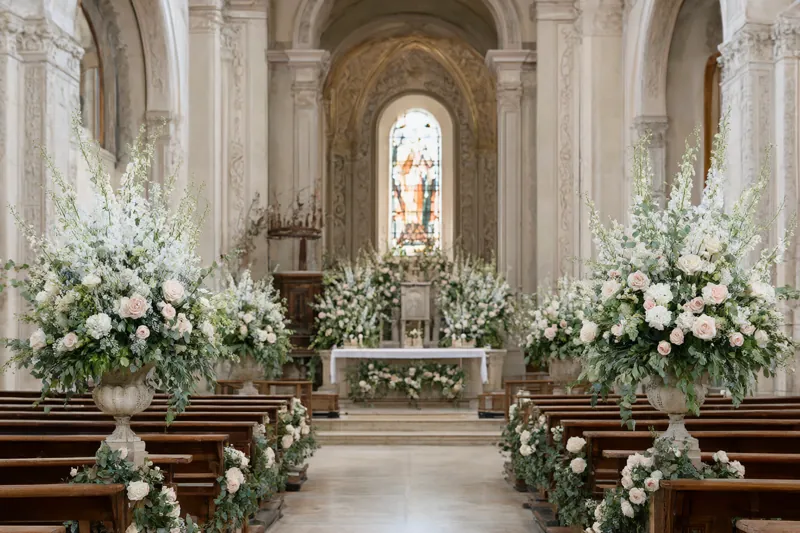
| Entrance and doorway | Large urns, garlands, arches | Often allowed even where the interior is restricted |
| Church steps or square | Potted plants, trees, floor arrangements | Permits may be needed if it is public land |
The altar
The altar is the most important place in the church. Many parishes allow flowers beside it or in front, but not on the altar table itself. Arrangements must leave the space for the celebration clear and not hide the crucifix, the tabernacle or works of art. Two large symmetrical arrangements at the sides are common.
The pews
Pew ends are the most common decoration. You can decorate every pew, every other one, or just the front rows reserved for family. Arrangements are fixed with hooks, ribbons or soft supports that do not scratch the wood. In historic churches any fixing on the pews may be banned: in that case floor vases along the aisle are used instead.
The entrance and doorway
Entrance flowers are very popular, because guests gather outside before the ceremony and many photos are taken there as you come out. Large urns either side of the door, garlands around it, small potted trees. Even where the inside has strict rules, the outside is often freer. If the area in front of the church is public land, ask whether you need a permit from the Comune, the local town council.
Style: simple or dramatic
Many couples ask for church flowers that are simple and elegant, and there is a reason: many Italian churches are already richly decorated. Marble, frescoes, stucco and gilding do not need much help. A few pointers:
- in a Baroque or highly ornate church, generous but orderly arrangements in a limited palette work well;
- in a Romanesque parish church or a country chapel, more natural flowers, greenery and cultivated wildflowers suit the setting;
- in a modern church you can be bolder with shapes and colours.
To find your way around styles, read our guide to floral design styles.
Set-up, breakdown and timing
Churches keep tight hours. The florist can often only come in after morning Mass and must finish before another wedding or evening Mass. For a Saturday afternoon wedding, set-up usually happens in the morning.
Ask your florist:
- how long they need to set everything up;
- whether they work with a team or alone;
- who takes things down and when: straight after the ceremony or the next day;
- who clears up fallen leaves and petals.
If there are two weddings on the same day, timing gets even tighter. For the full picture, read our guide to set-up and breakdown.
Sharing flowers with another couple
When two weddings are held in the same church on the same day, couples sometimes agree to share the flowers and split the cost. It works if:
- the parish agrees and puts you in touch with the other couple;
- you find a style and palette you both like;
- you use the same florist;
- it is clear in writing who pays for what and who keeps what after the ceremony.
How to agree
The first contact almost always goes through the parish, which knows the dates and can pass on details. Get in touch early, as soon as both dates are confirmed. One call or meeting with the shared florist helps you decide quickly.
- Same palette: choose neutral or seasonal colours that work with two dresses, two styles and two sets of photos. White, green and one soft colour almost always work.
- What is shared: usually the altar arrangements, the pew ends and the entrance. Bouquets, buttonholes and personal flowers stay with each couple.
- Timing: the first couple leaves everything in place after their ceremony, the second takes care of breakdown, or the other way round.
Who pays for what
The simplest split is half each on the shared items. If one couple wants something extra, such as an arch at the doorway or more pews, that item is theirs. If the flowers then go on to one couple's reception, it is fair for that couple to pay a little more or cover the transport.
Putting it in writing
A few lines signed by both couples, or a clear email exchange, is enough. Note down:
- which arrangements are shared and their total cost;
- each couple's share and when the deposit is due;
- who takes things down and where the flowers go afterwards;
- what happens if one couple cancels or changes date.
It is not always possible, but it is worth asking. For more budget-friendly ideas, read our guide to simple church flowers.
Taking the flowers to the reception
Many church flowers can be reused. Altar arrangements become buffet decorations, the entrance urns go to the villa entrance, pew arrangements end up on the tables. It is a practical way to make your budget go further, as our guide to saving on wedding flowers explains.
You do need someone to take everything down and move it while the guests are travelling. It has to be in the quote and in the schedule.
How much church wedding flowers cost
The cost depends on how many spots you decorate, the size of the church and the season. The ranges below are indicative industry estimates per piece, excluding VAT, including flowers and labour, without long-distance travel.
| Item | Lower range | Mid range | Upper range |
|---|---|---|---|
| Full church decoration (per set-up) | €300-800 | €800-1,800 | €1,800-4,000 |
| Altar arrangements (2) (per set-up) | €300-500 | €500-800 | €800-1,600 |
| Pew ends (per pew) | €25-40 | €40-70 | €70-120 |
| Church entrance or doorway (per set-up) | €300-600 | €600-1,000 | €1,000-1,500 |
| Arch or outdoor ceremony backdrop (per set-up) | €800-1,300 | €1,300-2,200 | €2,200-4,000 |
| Civil ceremony table arrangement (each) | €80-150 | €150-250 | €250-450 |
Indicative industry ranges, excluding VAT, flowers and labour included, without long-distance travel. They are not price lists: your florist's quote is the only price that counts.
The same figures shift by region: they go up in the north and in destination hotspots, and are often lower in the south.
| Area | Compared with the mid range | Why |
|---|---|---|
| North | +5-15% | Northern cities and hills: higher labour and venue costs, good access to flower markets. |
| Centre | reference | The reference for the ranges in the table. Large cities often sit at the top end. |
| South and islands | -5-15% | Labour is often cheaper, but imported flowers and transport to the islands add up. |
| Destination hotspots (lakes, Amalfi Coast, Capri, Venice, Florence) | +20-40% | Hard logistics (boats, restricted traffic zones, stairs), a short season and high demand: expect the upper range. |
Indicative differences: within each area the town, venue and date matter a lot.
Three indicative scenarios
| Scenario | What it includes | Indicative range |
|---|---|---|
| Simple | Two arrangements beside the altar, or one at the altar and one at the entrance, with greenery and seasonal flowers | €300-800 |
| Mid-range | Altar, every other pew, two urns at the doorway | €800-1,800 |
| Statement | Large altar design, every pew, vases along the aisle, an arch or garland at the doorway | €1,800-4,000 and up |
To see how the mid-range adds up: two altar arrangements (€250-400 each) and ten pew ends (€40-70 each) already come to €900-1,500, before the entrance urns. In the statement scenario the doorway weighs most: a ceremony arch alone often costs €1,300-2,200.
Our guide to how much church flowers cost goes through it item by item. If you want to stay at the lower end, our guide to simple church flowers has practical ideas.
Candles, petals and safety
- Candles: many churches ban them or allow them only in closed holders. Always ask.
- Petals: some parishes do not want petals in the aisle or on the steps. Others ask for immediate cleaning.
- Walkways: floor vases must not block the aisle, the exits or access for people with limited mobility.
- Historic furnishings: no glue, nails, sticky tape or water on wood, marble or antique fabrics.
Questions to ask your florist
- Have you worked in this church before? Do you know the rules?
- Which spots would you decorate, given the size of the nave?
- How do you fix arrangements to the pews without damaging them?
- How long do you need for set-up and breakdown?
- Can the church flowers be reused at the reception? Who moves them?
- Does the quote include collecting the vases and cleaning up?
- If the parish changes its rules, how will you adapt the design?
Final thoughts
Start from the parish rules, choose a few strong spots and think from the outset about what to reuse afterwards. For costs, read our guide to how much church flowers cost.
Once your church is confirmed, request a quote and attach the parish rules and a few photos of the nave.