In short
- The cost of wedding flowers depends above all on the number of pieces: centrepieces multiply by the tables and are often the biggest line.
- The figures in this guide are indicative ranges, not price lists: they change with region, season and florist.
- On top of the flowers you pay for labour, hire items, set-up, breakdown and travel.
- Always ask whether a quote is including or excluding VAT (IVA): the difference on the total is significant.
How much do wedding flowers cost in Italy? This guide is for couples setting a wedding budget who want to know how much of it the flowers will take before asking for a quote. It is written with destination weddings in mind, so it also explains the Italian details that can catch you out from abroad. You will find each item one by one in three indicative price ranges, how prices differ between the North, Centre and South, three worked examples for 60, 120 and 200 guests, a calculator for your own budget, and the things that push the bill up or down in Italy.
Why there is no single price
Floral design is not bought by the kilo. The price comes from four things: which flowers, how many pieces, how much work each piece takes, and where it has to be set up. Two couples with the same guest count can receive very different quotes simply because one wants low seasonal arrangements and the other a peony arch in October.
That is why the figures below are guide ranges. They help you judge whether a quote is reasonable; they do not replace it. If you want to see who works in your area, start from the list of wedding florists in Italy and compare portfolios and styles before prices.
Wedding flower items, one by one
Every wedding is different, but the same items come up again and again. The figures below are indicative industry estimates, per piece, excluding VAT, flowers and labour included, without long-distance travel. They are not any individual florist's price list.
| Item | Lower range | Mid range | Upper range |
|---|---|---|---|
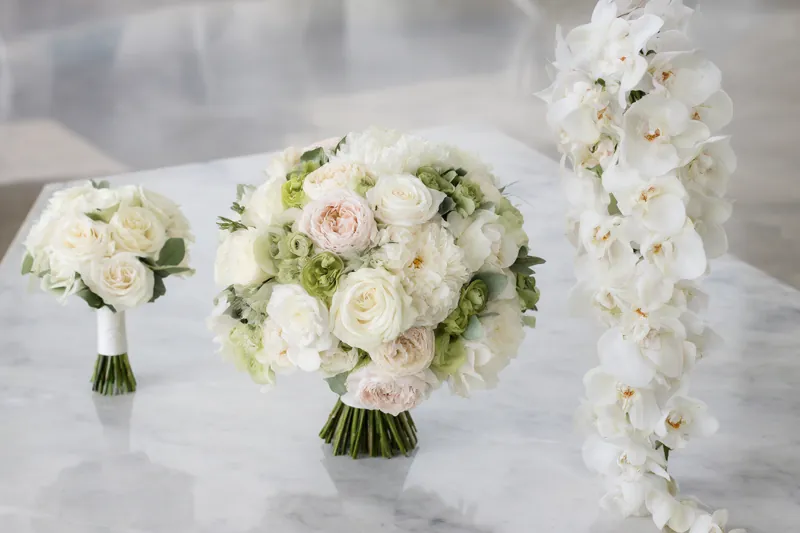
| Bridal bouquet (each) | €100-160 | €160-250 | €250-400 |
| Toss bouquet (each) | €40-60 | €60-90 | €90-130 |
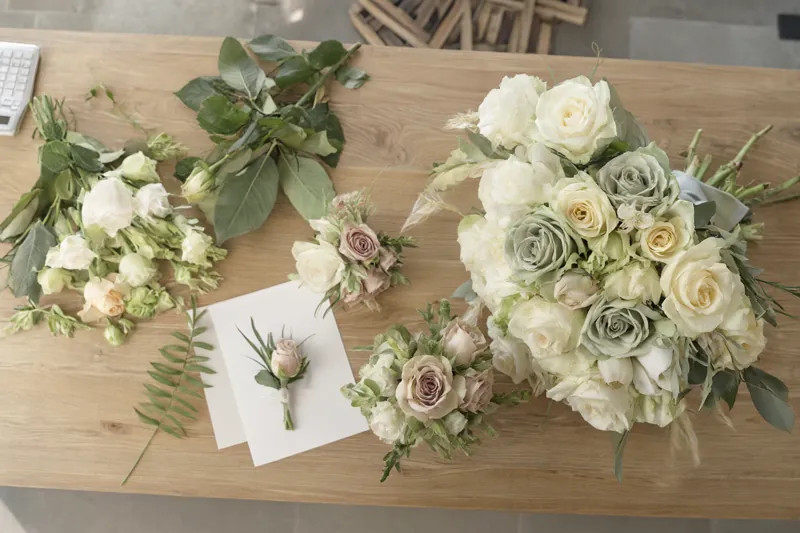
| Buttonhole (each) | €15-20 | €20-30 | €30-45 |
| Corsage (each) | €25-35 | €35-50 | €50-70 |
| Bridesmaid bouquet (each) | €40-60 | €60-90 | €90-140 |
| Flower crown (each) | €40-60 | €60-90 | €90-120 |
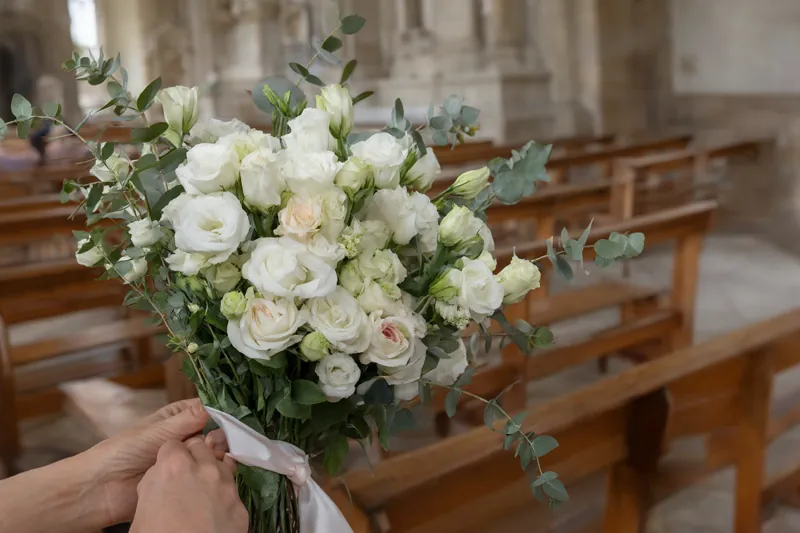
| Full church decoration (per set-up) | €300-800 | €800-1,800 | €1,800-4,000 |
| Altar arrangements (2) (per set-up) | €300-500 | €500-800 | €800-1,600 |
| Pew ends (per pew) | €25-40 | €40-70 | €70-120 |
| Church entrance or doorway (per set-up) | €300-600 | €600-1,000 | €1,000-1,500 |
| Arch or outdoor ceremony backdrop (per set-up) | €800-1,300 | €1,300-2,200 | €2,200-4,000 |
| Civil ceremony table arrangement (each) | €80-150 | €150-250 | €250-450 |
| Low centrepiece (each) | €40-70 | €70-110 | €110-160 |
| Tall centrepiece (each) | €120-180 | €180-280 | €280-450 |
| Greenery garland on a banquet table (per metre) | €25-40 | €40-60 | €60-80 |
| Garland with flowers and candles (per metre) | €40-60 | €60-90 | €90-140 |
| Top table (per set-up) | €200-400 | €400-700 | €700-1,200 |
| Floral seating plan (per set-up) | €100-250 | €250-450 | €450-800 |
| Hanging installation (per set-up) | €2,000-3,500 | €3,500-6,000 | from €6,000 |
Indicative industry ranges, excluding VAT, flowers and labour included, without long-distance travel. They are not price lists: your florist's quote is the only price that counts.
How to read the three columns:
- lower range: seasonal flowers, plenty of greenery, simple shapes and modest quantities;
- mid range: a well-designed set of flowers, with varieties chosen together and fuller arrangements;
- upper range: premium or out-of-season flowers, large volumes, structures and many hours of work on site.
Within the same item, the price moves mainly with size, flower choice and the amount of work. A cascading peony bouquet sits at the top, a loose posy of meadow flowers at the bottom.
Each item has its own detailed guide: what a bridal bouquet costs, what it costs to decorate a church and how much wedding centrepieces cost.
Prices in the North, Centre and South of Italy
The ranges in the table use central Italy as the reference. Elsewhere the same items cost a little more or a little less, for very practical reasons:
- labour: where rents, wages and venue costs are higher, an hour of the team's time costs more too;
- markets: florists close to the big flower markets buy with more choice and fewer steps, while imported flowers reaching the South and the islands travel further;
- logistics: boats, restricted traffic zones, stairs and narrow lanes all mean extra hours and extra people;
- destination hotspots: on the lakes, the Amalfi Coast, Capri, Venice and Florence the season is short and demand is high, so quotes often start from the upper range.
| Area | Compared with the mid range | Why |
|---|---|---|
| North | +5-15% | Northern cities and hills: higher labour and venue costs, good access to flower markets. |
| Centre | reference | The reference for the ranges in the table. Large cities often sit at the top end. |
| South and islands | -5-15% | Labour is often cheaper, but imported flowers and transport to the islands add up. |
| Destination hotspots (lakes, Amalfi Coast, Capri, Venice, Florence) | +20-40% | Hard logistics (boats, restricted traffic zones, stairs), a short season and high demand: expect the upper range. |
Indicative differences: within each area the town, venue and date matter a lot.
These multipliers are indicative estimates too: within the same region a city and an inland village can price quite differently. Use them for the order of magnitude, then compare real quotes for your venue.
Three examples for 60, 120 and 200 guests
The examples below are rough calculations for orientation: they add up the ranges in the table for a realistic number of pieces. The total runs from the lower range of every item to the upper range; the last column shows the sum of the mid ranges. Figures exclude VAT, hire items, travel and late-night set-up. They are not quotes.
| Scenario | What it includes | Lower to upper range | Mid range |
|---|---|---|---|
| 60 guests, civil or symbolic ceremony at a villa | Bouquet, 5 buttonholes, civil ceremony table arrangement, 8 low centrepieces, top table | about €800 to €3,600 | about €1,400 to €2,200 |
| 120 guests, church ceremony and villa reception | Bouquet, 2 bridesmaid bouquets, 6 buttonholes, 2 corsages, full church flowers, 10 low and 3 tall centrepieces, top table, seating plan | about €1,700 to €10,000 | about €3,200 to €5,600 |
| 200 guests, outdoor ceremony and dinner at long banquet tables | Bouquet, 4 bridesmaid bouquets, 8 buttonholes, 2 corsages, arch, 12 aisle decorations, 40 metres of garland on the banquet tables, top table, seating plan | about €3,400 to €14,500 | about €5,500 to €8,700 |
Styled corners, hanging installations and flowers for getting ready come on top of these figures. Two things to notice. First, moving from 60 to 200 guests does not just add centrepieces: there are more spaces to decorate and more hours of set-up. Second, below a certain size many florists have a minimum spend, because the site visit, buying and transport cost the same either way. That matters for elopements and micro weddings. More examples, written out line by line like a real quote, are in the guide with sample floral quotes.
Work out your flower budget
To run the numbers for your own wedding, use the calculator below. Choose the items, the quantities and the range, and you get an indicative estimate based on the same figures as the table. It is not a quote: it gives you the order of magnitude. When the estimate looks right, you can use it to pre-fill your quote request and send it to florists with the items already listed.
Work out your flower budget
An indicative estimate based on the price ranges in this guide. Change the values and the total updates straight away.
Indicative estimate
€2,800 - €5,500
excluding VAT · 10 tables
See the item-by-item breakdown
- Bridal bouquet × 1€150 - €250
- Toss bouquet × 1€50 - €100
- Buttonhole × 4€100 - €100
- Corsage × 2€50 - €100
- Full church decoration × 1 (per set-up)€800 - €1,800
- Low centrepiece × 10€700 - €1,100
- Top table × 1 (per set-up)€400 - €700
- Floral seating plan × 1 (per set-up)€250 - €450
- Transport, set-up, breakdown and hire€250 - €900
This is not a quote: flowers, date and venue can move the total. The form opens already filled in with guests, budget and services.
How much of the wedding budget goes on flowers
Industry estimates often put flowers at somewhere between 5 and 10% of the overall budget, higher when the floral design is the heart of the wedding's look. This is a rule of thumb, not a statistic. If flowers are what you care about most in your photos, it makes sense to move budget from other items. How to think about priorities is covered in the guide on what share of the budget to give to flowers.
VAT (IVA) on your quote
This is the line that causes the most surprises, especially for couples used to other tax systems. In the UK and Australia, prices for consumers usually include VAT or GST. In the US, sales tax is usually added at the till. In Italy, a wedding quote can go either way, so never assume.
What we can say with confidence:
- In Italy VAT is called IVA and the standard rate is 22%.
- The sale of some floriculture products can fall under a reduced rate, while a decoration and set-up service is often invoiced at the standard rate.
- How the work is classified is decided by the business issuing the invoice, with its accountant. It is not something you choose, and the rules can change, so do not rely on a rate you read somewhere for your own case.
What you need is simple: the quote must say clearly whether prices include or exclude IVA, and at what rate. On a €5,000 set of flowers, the difference between the two readings is more than a thousand euros.
A few practical points for couples paying from abroad:
- Do not assume a tax-free or refund scheme applies. Schemes you may know from shopping as a tourist are designed for goods, not for a service delivered at your wedding. If you think something should apply to you, ask the florist and let their accountant confirm it in writing.
- Ask how the invoice will be issued and in whose name, especially if a wedding planner is paying suppliers on your behalf.
- Agree the currency and the payment method. Quotes are in euros. Bank transfer fees and exchange rates are on top, and depend on your bank, so leave a small margin.
What moves the price in Italy
The season
Seasonal flowers are easier to find, fresher and usually cheaper. Peonies in May are a classic. In September they usually have to be imported and the price changes. The guide to seasonal flowers in Italy helps you choose by month.
Italian and imported flowers
Italy has important flower-growing areas, from the Ligurian Riviera to Tuscany, Campania, Puglia and Sicily. Many flowers, however, pass through the large markets of northern Europe. Unusual varieties, rare colours and out-of-season flowers cost more and leave less room for error if a delivery goes wrong.
The venue and logistics
A villa with direct van access is very different from a terrace in a historic centre, a hill village with narrow lanes or an island reached by ferry. Stairs, limited traffic zones (ZTL, areas of historic centres closed to unauthorised vehicles), small lifts, deliveries by boat on the lakes: all of it turns into extra hours and extra people. The same goes for breakdown at the end of the night, often after midnight.
Labour and structures
A low centrepiece in a vase is made in the studio. An arch, a ten-metre garland or a floral ceiling is built on site, with frames, ladders and more people. Skilled labour is often the largest part of the price.
Region and date
Beyond the North to South differences above, prices vary between cities, tourist areas and inland areas, and Saturdays in May, June and September are in high demand. Italy also slows down around mid-August (Ferragosto), when some suppliers and markets close for holidays. There are no fixed rules: ask whether the florist applies different conditions by day or period.
Costs you may not see at first
As well as the flowers, a quote may include:
- hire of vases, stands, candelabra and structures;
- set-up and breakdown, sometimes with a late-night supplement;
- transport and travel, with overnight stays for the team if the venue is far away;
- moving flowers from the ceremony to the reception;
- site visit and a trial centrepiece, if not included;
- deposit on hired items.
They are explained in the guide to the extra costs of wedding flowers.
Questions to ask your florist about price
- Is the quote including or excluding IVA? At what rate?
- How many pieces does each item include, and what size?
- Which flowers will you use? What happens if one is not available that week?
- Are vases, stands and structures included or hired?
- Are set-up, breakdown and transport included?
- Is there a supplement for breakdown after midnight?
- Can the ceremony flowers be reused at the reception? Who moves them?
- Is there a minimum spend?
- How much is the deposit, and when is the balance due? Can I pay by international bank transfer?
- Until when can I change the number of tables?
- Which language will we work in, and who is my contact on the day?
Final thoughts
To read a quote properly and compare two of them, follow the method in the guide on how to read a florist's quote. If your budget is tight, the guide on how to save on wedding flowers shows where to cut without it showing.
Once you have a date, a guest count and a venue, you can request a quote from two or three florists with the same information, so the numbers can actually be compared.
Sources
- DPR 26 ottobre 1972, n. 633 (Italian VAT law), Normattiva: https://www.normattiva.it/uri-res/N2Ls?urn:nir:stato:decreto.del.presidente.della.repubblica:1972-10-26;633