In short
- Seasonal, Italian-grown flowers: the choice that lowers the bill most without changing the look.
- Foliage fills space and costs less than flowers: eucalyptus, olive, ruscus, ivy.
- Reuse ceremony flowers at the reception and focus the budget where guests look.
- Fewer, larger pieces work better than many small, scattered ones.
If you want to save money on wedding flowers, you do not need a sparse wedding. It means spending where it shows and cutting where nobody looks. This guide collects the choices florists suggest most often to keep the budget in check, with an idea of how much each one matters and what to keep in mind. It is written for couples marrying in Italy, including those planning from abroad.
Start from one priority
Before cutting, decide what matters most to you. For some it is the bouquet, for others the ceremony arch, for others the tables. Putting most of the budget on one or two elements and simplifying the rest gives a stronger result than spreading a little everywhere.
A good florist helps you choose. If you are looking for someone in your chosen area, browse the list of wedding florists in Italy and ask explicitly for proposals within a given budget.
The choices that save the most
| Choice | Effect on the bill | Does it show? |
|---|---|---|
| Seasonal, Italian-grown flowers | High | No, they are often fresher |
| Freedom over varieties | Medium | No, if colours and shapes are agreed |
| More foliage, fewer flowers | Medium to high | Little, especially in Mediterranean and garden styles |
| Reusing ceremony pieces at the reception | High | No, if planned in advance |
| Fewer, larger pieces | Medium | No, the effect is often better |
| Mixing low and tall centrepieces | Medium | No |
| Hiring instead of buying | Medium | No |
| Decorating half the church | Medium | Little, photos focus on the altar and aisle |
Seasonal and Italian-grown flowers
A flower in season costs less, is easier to find in quantity and lasts better. Peonies in May, dahlias in September, ranunculus in spring. Out of season the same flowers come from far away, cost more and are more fragile.
Where they come from matters too. Italy has important flower-growing areas, and a florist who buys locally can offer you beautiful varieties at better prices. The guide to seasonal flowers in Italy helps you build the palette starting from your month.
Give freedom over varieties. Instead of asking for "dusty pink English garden roses", ask for "soft flowers, dusty pink and white, garden style". The florist will choose what is most beautiful and best value that week. It is a simple way to pay less without losing the style.
Let foliage do the work
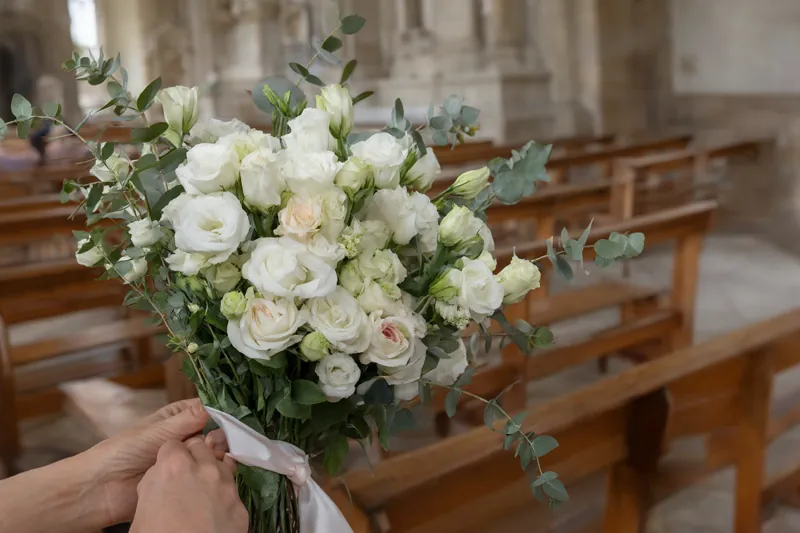
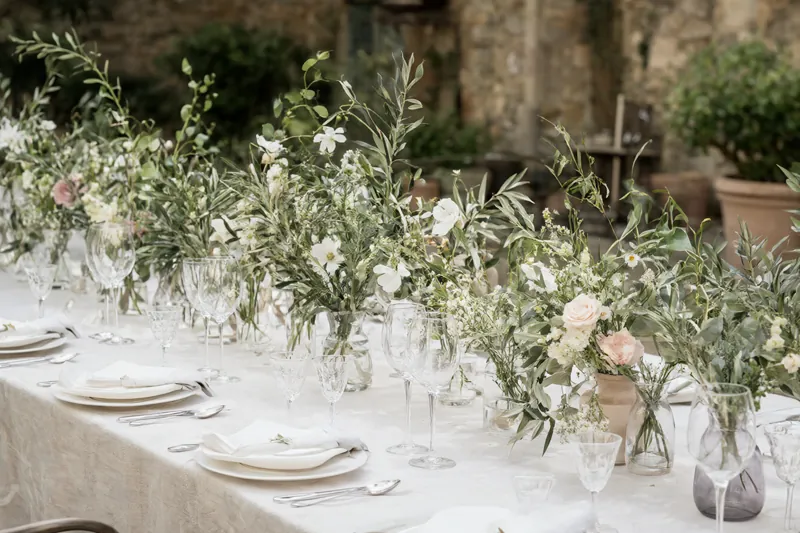
Eucalyptus, olive, ruscus, pittosporum, ivy, ferns, citrus branches: foliage adds volume, movement and a natural feel. It costs less than flowers and often lasts longer. A foliage garland with a few flowers tucked in along a long banquet table makes a big impression at a modest cost, and olive and lemon branches feel very much at home in Italy. Types and uses are in the guide to foliage in floral design.
Reuse the ceremony flowers
This is the choice that saves most without anyone noticing. Common examples:
- altar arrangements become the backdrop of the top table;
- aisle vases move to the reception entrance or the buffet;
- the arch from a symbolic ceremony is moved behind the top table or onto the dance floor;
- bridesmaids' bouquets go into vases on the seating plan.
But the pieces must be designed to travel, and someone has to move them while you are having photos. Ask whether transport is included.
Fewer, larger pieces
Ten small arrangements scattered around a large room get lost. Two large arrangements either side of the entrance, a generous top table and simple centrepieces have more impact and take less labour. The same goes for churches: in a tall space it is better to concentrate flowers on the altar and the entrance, and to decorate every other pew.
Hiring instead of buying
Vases, stands, candelabra, lanterns, arches: buying them for one day rarely makes sense, even less when you are flying home afterwards. Hiring from the florist costs less and leaves you nothing to deal with afterwards. Just check the terms on deposits and breakages. The guide to hiring vases and structures covers it.
Date and timing
The calendar matters too. Saturdays in May, June and September are in high demand and leave little room to negotiate. A Friday, a Sunday or a quieter month may give the florist more flexibility, for example on set-up and breakdown. Bear in mind that around mid-August (Ferragosto) many Italian businesses close for holidays, which can limit choice rather than lower prices. There is no fixed rule: ask whether different conditions apply.
Timing matters for a practical reason. If the ceremony is at midday and the reception is at the same venue, the team sets up once and moving flowers is quick. If the church is far from the villa and the party ends late at night, more trips and more hours are needed.
One venue for ceremony and reception
Holding a civil or symbolic ceremony at the same venue as the reception cuts transport, set-up and waiting time. Many villas and masserie (fortified farmhouses in Puglia) have a ceremony space and a room or garden for dinner a few steps away. The ceremony arch can become the backdrop for the top table with no vans and no race against the clock. If you want a legally binding civil ceremony, check with the Comune which locations are authorised; a symbolic ceremony can take place where the venue allows.
Where cutting is a false saving
Some choices look like savings and end up costing in stress or quality:
- Large-scale DIY. A few bud vases, yes. Twenty centrepieces in the two days before the wedding, usually not, and even less in a country where you do not know the suppliers. Pros and cons are in the guide to DIY wedding flowers.
- Heat resistance. A cheap flower that wilts in two hours is not a saving. In summer choose robust varieties.
- Breakdown. Leaving it to friends at the end of the party often means broken vases and lost deposits.
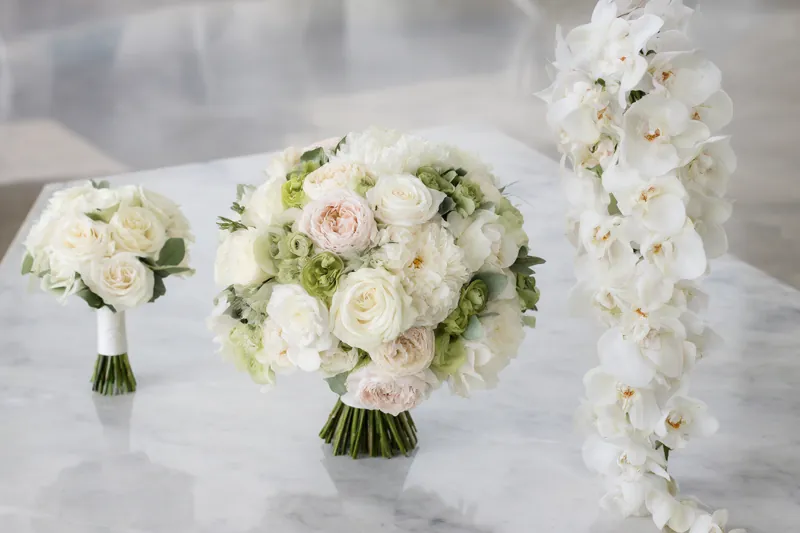
- The bouquet. It is a small share of the total and appears in almost every photo.
The flower budget, in practice
If you want to set a figure, start from the guide on what share of the wedding budget goes on flowers. Then ask your florist: "With this amount, what would you suggest?" It is more useful than asking for a quote for everything and cutting afterwards.
Always work with figures that include VAT (Italian quotes are sometimes written without it) and keep a small margin for the unexpected, such as a few extra guests or moving indoors because of rain. If you pay from abroad, add bank fees and exchange costs too. A budget that holds up in these cases saves you from removing flowers at the last minute, when pieces have already been ordered and changes cost more.
Questions to ask your florist to save money
- Which flowers can you find easily in the month of my wedding?
- Can I give you freedom over varieties, with just colours and style?
- Which ceremony pieces can we reuse at the reception?
- With my budget, where would you concentrate the flowers?
- How much foliage would you use to add volume?
- Is vase hire included?
- What would you remove first without it showing?
Final thoughts
To know how much each item adds to the cost before cutting, read how much wedding flowers cost in Italy and the guide to centrepiece prices, which are usually the biggest line.
When you know how much you want to spend, request a quote stating the amount and your priorities: a florist can work much better starting from a clear budget.