In short
- In Italy First Communion is almost always a group celebration: church flowers are often decided and shared among families.
- Dates cluster between April and June: local florists get many requests for the same Sundays.
- There is no compulsory flower: white, wheat and grapes are the most common symbols; for Confirmation sometimes red.
- At the party, the table, cake, photo corner and perhaps some plant favours are what matter.
First Communion (prima comunione) and Confirmation (cresima) are family celebrations with a public part, in church, and a private part, at a restaurant or at home. Flowers are needed for both, but with different rules. This guide is for parents who need to understand what the parish decides, what they decide themselves and how to organise the party without spending more than necessary. It is also useful for families who live abroad and return to Italy for a child's Communion in the family's home parish, where customs may differ from those at home.
To find professionals in your area, see our list of florists for christenings, First Communions and Confirmations.
The church is shared: who decides
First Communion is usually celebrated with all the children of the same catechism group. Confirmation is often celebrated by the bishop or his delegate, sometimes for several parishes together. This means the church is one space for many families.
In practice it works like this:
- the parish names a florist or leaves the choice to the parents;
- a parents' representative collects the contributions and keeps in touch;
- colours and style are agreed for the whole church;
- individual families can sometimes add a touch to their own child's pew.
Before ordering anything, ask the parish how it works. Turning up with your own arrangement when decorations have already been decided only causes embarrassment. Rules vary from parish to parish: follow the ones you are given.
What gets decorated in church
| Spot | Common solutions | Note |
|---|---|---|
| Altar | Two symmetrical arrangements or one low central one | Do not cover the altar and the books |
| Lectern (ambo) | A small front-facing arrangement | Visible during the readings |
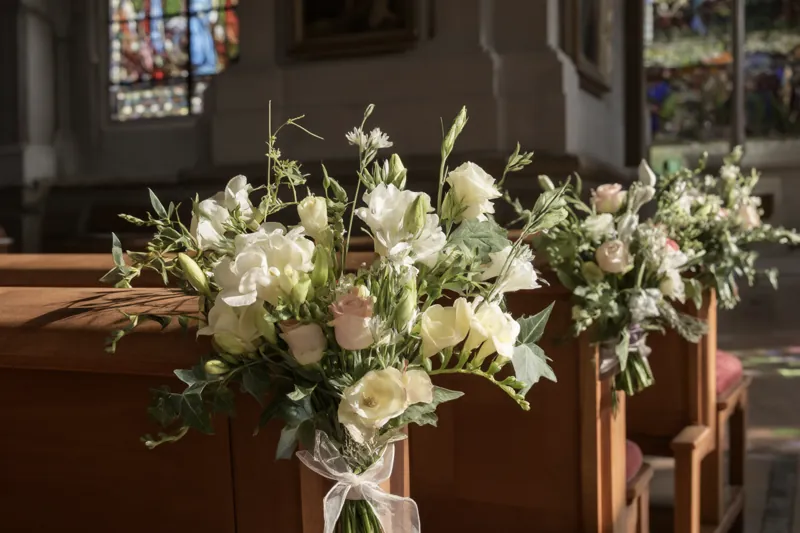
| Children's pews | Posies, ribbons, small flowers with the child's name | Often paid for by individual families |
| Entrance and aisle | Tall vases or plants | Optional, depends on the church |
| Statue of the Virgin Mary or the patron saint | A floral tribute | Ask whether it is a custom in that parish |
For practical details (access times, what can be hung, candles) much of what you will find in our guide to church flowers applies.
Flowers and symbols
There is no compulsory liturgical flower. But some symbols come up again and again.
For First Communion
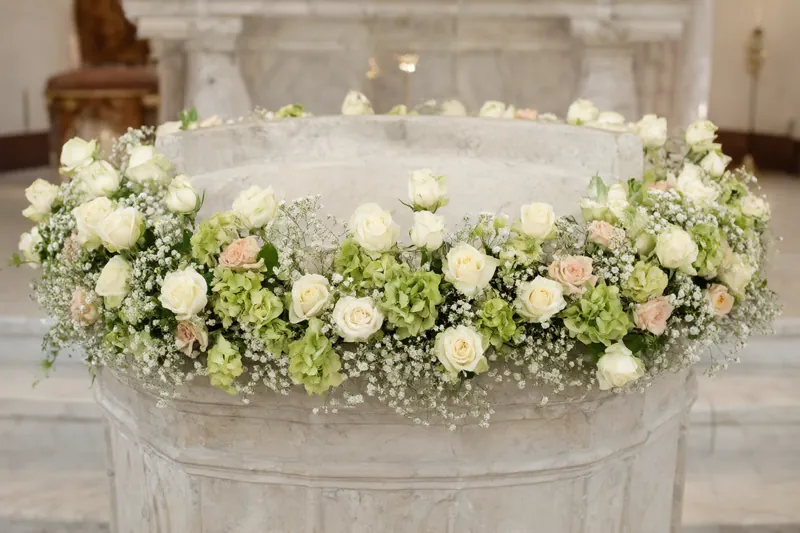
- White flowers: roses, calla lilies, lilies, lisianthus, associated with purity.
- Ears of wheat: a reminder of the bread of the Eucharist.
- Bunches of grapes, even artificial ones or decorative vine branches: a reminder of the wine.
- Light greenery and small cultivated field flowers.
For Confirmation
- Red, the colour of the Holy Spirit and Pentecost, is a frequent choice, even just as an accent.
- White remains common, perhaps with red or gold details.
- For older children, simpler arrangements are often preferred.
Pink for girls and blue for boys is a tradition, not a rule. Many families today choose neutral tones for everyone. If you want to know more about meanings, read our guide to the meaning of flowers.
The season: April, May, June
First Communions cluster in spring and early summer, often on the same Sundays in May. Confirmations have more varied dates, sometimes in autumn. Two practical consequences:
- Book early: florists receive many requests for the same dates, on top of weddings.
- Choose seasonal flowers: in spring you will find ranunculus, peonies towards May, roses, daisies, lisianthus. They are fresh and easier to source.
Our guide to seasonal flowers in Italy has a month-by-month table.
The party: table, cake and favours
After Mass, everyone moves on to a restaurant, an agriturismo (a farm with a restaurant) or home. Here you decide. The places where flowers are seen most:
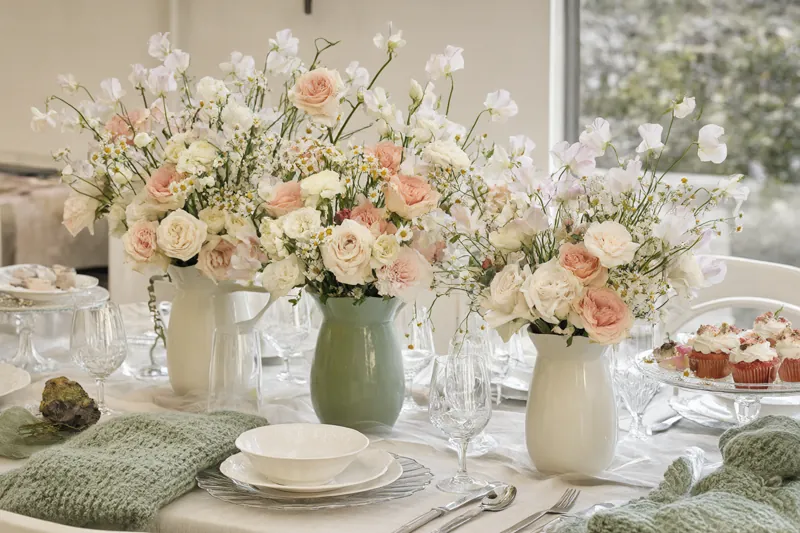
- the child's table, with a low arrangement or a garland;
- the cake and confetti table, the most photographed (confetti are sugared almonds, present at every Italian family celebration);
- centrepieces for guests, simple and low;
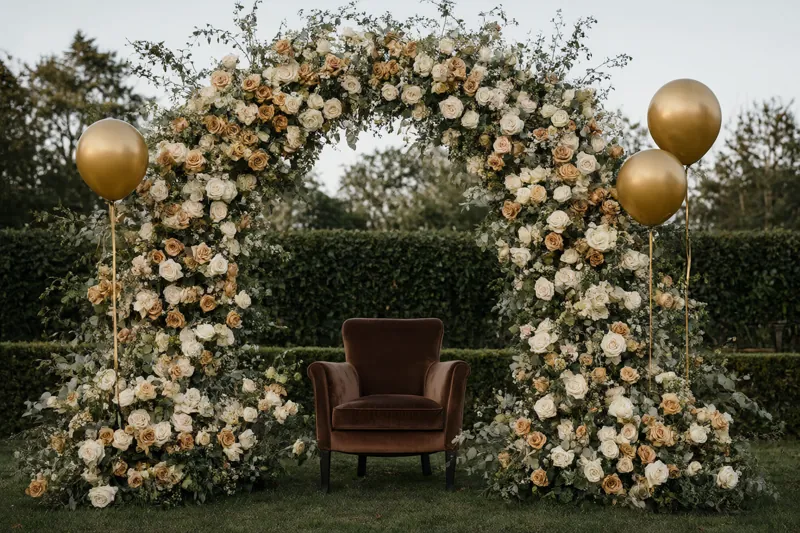
- a photo corner with a panel, a small arch or the child's name;
- favours (bomboniere) with herb plants, succulents or dried flowers.
If the party is at a restaurant, ask whether it already has flowers on the tables and whether you can replace them. If it is at home or in a garden, bear in mind the afternoon sun in May and June: some flowers suffer. Our guide to summer weddings and flowers that cope with heat has useful tips here too.
What it costs, and how to share it
For the church, the cost is usually shared among families, so each family's share stays modest. The total depends on the number of arrangements, the flowers chosen and the size of the church.
For the party, the budget is yours. The items are the usual ones: flowers, labour, transport, any hire of vases or structures. Two ways to keep costs down:
- concentrate flowers on the cake table and the child's table;
- choose plants as favours and as centrepieces, which guests then take home.
Prices are in euros; check whether VAT (IVA) is included.
A flower for the child
Children making their First Communion are often given a flower or a small posy, or girls wear a small crown. Some parishes ask that all children have the same flower or none at all, so nobody stands out: ask first. If the flower is up to you, choose something light the child can hold throughout Mass, with the stem wrapped in ribbon. For Confirmation it is less common, but a buttonhole is still a smart detail in the photos.
Questions to ask (the parish and the florist)
The parish or the parents' representative:
- Have the church decorations already been decided? Who is the florist?
- What is the contribution per family and what does it cover?
- Can we add something to our child's pew?
The florist, for the party:
- Are you free on the date of the Communion? How many parties do you have that day?
- Which flowers do you suggest for that period?
- Can you also prepare plant favours?
- Are transport and set-up at the restaurant or at home included?
- What time do you set up, if the party starts straight after Mass?
If the party is at home
Many families celebrate at home or in the garden, perhaps with a caterer or a buffet prepared by relatives. In that case the florist needs to know: how many tables there will be and what size, where the cake will go, whether there is a gazebo or a portico, and what time you will be back from church. Often the best solution is to have everything delivered early in the morning, before Mass, so it is ready when you return. Leave the keys, or the job of opening up, with someone you trust.
To sum up
For First Communion and Confirmation the rule is simple: in church, agree with the parish and the other families; at the party, choose freely. Booking early and choosing seasonal flowers makes everything easier.
If there is also a christening to organise in the family, read our guide to christening flowers. Once you have a date and a party venue, request a quote.