In short
- Ornamental flowers are not edible by definition: keep them away from the icing or replace them with edible flowers sold as food.
- You need flowers that are not toxic and not treated with products unsuitable for contact with food.
- The pastry chef is responsible for the cake: agree flowers, protection and who places them.
- For the cutting and the photos, decide in advance where the cake goes and whether flowers come off before serving.
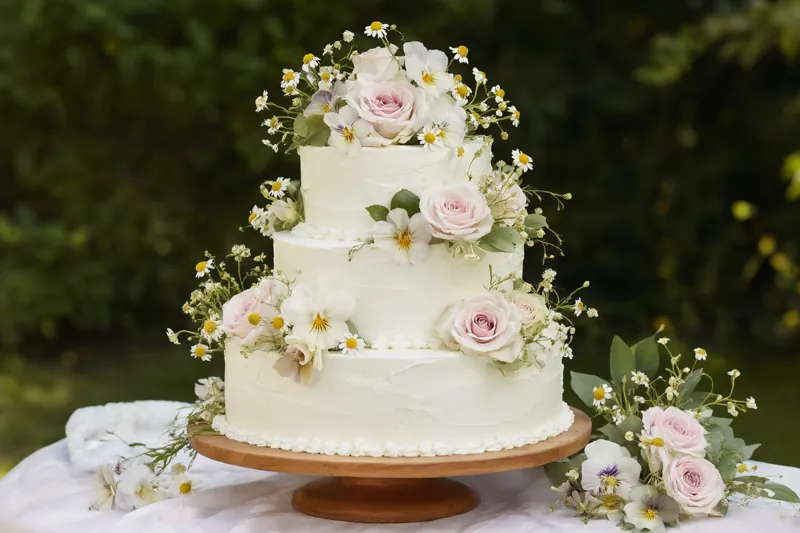
Wedding cake flowers make a lovely image, and many couples want fresh flowers on the cake. But a cake is eaten, and the flowers a florist uses are meant to be looked at. This guide explains which flowers can be used, how to protect the cake and how to get the florist and the pastry chef working together. To find someone for your wedding flowers in your area, see our list of wedding florists in Italy.
The starting point: decorative flowers and flowers to eat
There are two different categories, often confused:
- Ornamental flowers: the ones florists use. They are grown for beauty and vase life, and along the supply chain they may receive treatments not intended for food.
- Edible flowers: flowers sold as food, grown and packed to be eaten, with labelling and traceability.
The same species can fall into both categories. A bouquet rose and an edible rose can be the same plant, but the first is not guaranteed safe to eat. So the species alone is not enough: what matters is where the flower comes from and how it has been treated.
Three ways to use flowers on a cake
| Option | How it works | Pros | Watch out for |
|---|---|---|---|
| Edible flowers | Flowers sold as food, chosen and placed by the pastry chef | Can be eaten, no contact issues | Smaller choice, small and delicate flowers |
| Ornamental flowers with a barrier | Florist's flowers with protected stems and a base kept off the icing | Fuller look, matched to the décor | Must come off before cutting, flowers must be non-toxic |
| Flowers around the cake | Arrangement on the cake stand or table, cake stays clean | No contact with food | Less "on the cake" effect |
Many couples combine them: ornamental flowers around, a few edible flowers on the cake. It is the simplest way to get a lovely result without risk.
Flowers to avoid
Some flowers widely used in floral design are toxic if eaten or can irritate. You do not need a complete list: you need a rule. Every flower that touches the cake must be approved by whoever makes it. Ask the florist for the exact list of flowers they will use, with variety names, and pass it to the pastry chef.
Watch out too for:
- flowers that shed pollen or petals onto the icing;
- artificially coloured or dyed flowers;
- flowers with stems treated with preservatives;
- flowers picked from private gardens or roadsides, whose treatments you do not know.
Our guide to flowers near food and edible flowers goes into more detail on plants to keep away from the table.
How the cake is protected
When ornamental flowers are used, the pastry chef and the florist take steps to avoid direct contact:
- stems wrapped in food-safe tape or inserted into food-safe picks;
- discs or bases placed under the arrangements as a barrier;
- flowers resting on top of the decoration, not pushed into the icing;
- arrangements prepared separately and placed only at the last minute.
These are common solutions, but every pastry chef has their own rules. Some do not accept outside flowers on their cakes and prefer to use only their own edible flowers or sugar decorations. Ask at the start.
Coordinating the florist and the pastry chef
This is where things most often get lost. Put them in direct contact, sharing:
- the cake's shape and tiers, diameters, height;
- the palette and flowers chosen for the rest of the décor;
- the time the cake arrives at the venue and where it is kept;
- who places the flowers and when;
- whether the flowers must be removed before cutting and serving.
If the reception is run by a caterer, involve them too: the caterer often serves the cake and looks after the dessert table. Our guide on getting flowers, caterer and venue to work together helps divide the tasks.
Heat, timing and the cake stand
In summer the cake and the flowers suffer together. Icing softens and fresh flowers out of water wilt quickly. A few choices help:
- place the flowers as late as possible, shortly before cutting;
- choose hardy flowers or small buds that hold up better;
- keep the cake in the shade and somewhere cool until photo time;
- consider sugar or wafer decorations, which do not wilt.
The cake stand and the cake table are a great opportunity for ornamental flowers, with no contact with food. A ring of flowers at the base or an arrangement on the table looks wonderful in photos. If your wedding is in summer, read our guide to flowers that cope with the heat.
Edible flowers: what to know
Edible flowers are food in every sense. That is why whoever prepares the food chooses and handles them, not whoever does the décor. A few useful points:
- they come in labelled packs from producers who grow them for eating;
- they are often small and delicate: violas, borage flowers, petals of some roses, calendula;
- they do not last long: they are placed on the day, shortly before serving;
- like any food they can cause allergies: ask the pastry chef to list them among the ingredients.
If the pastry chef does not work with edible flowers, do not swap in flowers from the garden or the florist. Sugar decorations, fresh fruit or ornamental flowers only around the cake are better.
For couples coming from abroad
In many countries a tiered wedding cake with fresh flowers is a well-established tradition. In Italy the cake plays a slightly different role: it often sits alongside the confettata and a dessert buffet. An Italian pastry chef may suggest local ideas, such as decorations with candied citrus or seasonal fruit. Ask what they propose before fixing on a reference picture.
The cake table and the confettata
The table holding the cake is often the second most photographed spot at the reception, after the top table. Here ornamental flowers can shine with no food-contact limits: a garland along the edge, arrangements beside the cake stand, a backdrop of greenery. If you are having a confettata, the table of confetti (sugar-coated almonds, a classic Italian wedding tradition, not paper confetti), flowers can link the two tables. The same rule applies: no petals or pollen falling into open containers.
Questions to ask the pastry chef and the florist
- Do you accept flowers supplied by the florist on the cake?
- Do you have edible flowers? Where do they come from and how are they packed?
- What barrier do you use between flowers and icing?
- Who places the flowers, at what time, and who removes them before cutting?
- Which flowers will you use? Can you give us a list with varieties?
- Where will the cake be kept until cutting, and at what temperature?
- If it is very hot, what is the alternative plan for the decoration?
Final thoughts
A cake with flowers is only beautiful if it is also safe. The calmest route is to keep what is looked at separate from what is eaten, and to get the florist and the pastry chef talking with an exact list of flowers. For the full picture of flowers at the table, read our guide to top table flowers.
Once you have your date and venue, request a quote and mention in your message that you would like flowers on the cake.
Sources
- Regulation (EC) No 178/2002, general principles of food law: https://eur-lex.europa.eu/eli/reg/2002/178/oj
- Regulation (EC) No 852/2004 on the hygiene of foodstuffs: https://eur-lex.europa.eu/eli/reg/2004/852/oj
- Regulation (EU) 2015/2283 on novel foods: https://eur-lex.europa.eu/eli/reg/2015/2283/oj