In short
- Outdoors, hydrangeas bloom roughly from June to the end of summer; greenhouse ones are available much of the year.
- They have large heads: a few stems fill a lot of space, great for church and large arrangements.
- They drink a lot and suffer in direct sun and dry air: they need water, shade and late set-up.
- Colour can range from white to blue, pink to green: see it in person.
Hydrangea wedding decor is a familiar sight at Italian weddings. Hydrangeas (Hydrangea macrophylla) give volume, they are generous and they suit many styles. They do have a clear character, though: they love water and dislike heat. This guide explains when to choose them, how to use them and what to ask your florist so they stay fresh until the end of the evening.
Why couples love them
A hydrangea has a large, round flower head made of many small florets. A single stem covers the space of many smaller flowers. That makes it valuable in three cases:
- church: pews, altar and entrance can be filled with fewer stems;
- centrepieces: full bases into which more precious flowers can be added;
- large arrangements: arches, tall vases, statement pieces.
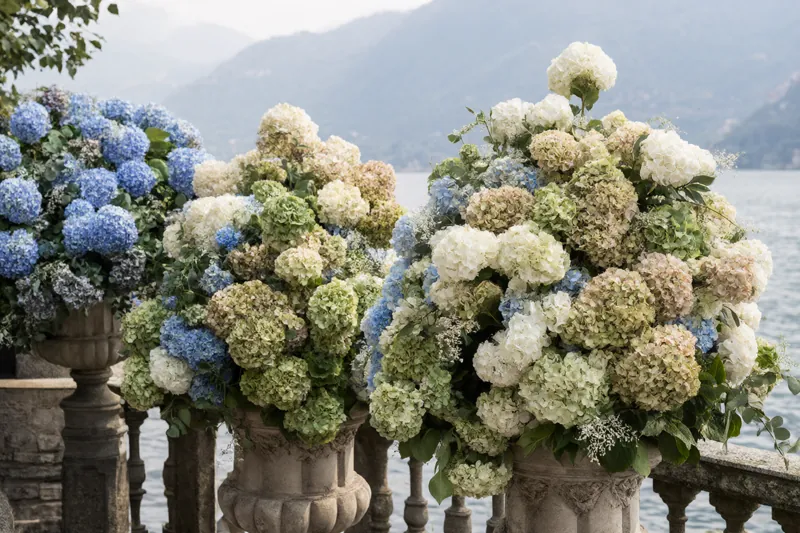
It is also a flower tied to many Italian landscapes: lakeside villas, gardens in the North, hill towns. To find florists who use it well in your area, see our list of wedding florists.
When they are available
| Period | Indicative availability | Look |
|---|---|---|
| Late spring | First hydrangeas, mostly greenhouse grown | Fresh, light colours |
| June to August | Full outdoor season | White, blue, pink, lilac, green |
| September | "Antique" hydrangeas | Green, burgundy and dusky pink tones, firmer petals |
| Autumn and winter | Greenhouse or imported | Smaller choice, variable price |
Dates are indicative and vary with region and year. In the North, on the lakes and in the hills the outdoor season can last longer. In the South the heat brings it forward and shortens it.
Late-summer hydrangeas, often called "antique" or "vintage" by florists, have thicker petals and blended colours. They often last better than the fresh hydrangeas of June. For a September wedding they are an interesting choice. See also our guide to seasonal flowers in Italy.
Colour: what it depends on
In the most common hydrangeas, colour also depends on the soil they grow in. Acid soils tend to give blue, chalky soils pink. White varieties stay white, but can turn green or pinkish over time.
For your wedding this means two things:
- your florist buys the colour needed, but shades vary from batch to batch;
- between blue, lilac and pink there are many in-between tones: look at unfiltered photos or, better, the flowers themselves.
White is a classic choice for church. Blue suits the seaside and the lakes. Green and antique tones suit natural and autumn palettes.
The weak spot: water and heat
The hydrangea drinks a great deal and also loses water through its petals. When it runs short, the head droops. In direct sun on a hot day, this can happen within hours. Your florist will usually:
- hydrate the stems for a long time before arranging;
- use vases with water or water reservoirs, rather than dry arrangements;
- set up as late as possible, especially outdoors;
- choose shaded spots away from heat sources;
- revive a drooping head by submerging it in cool water, if there is time.
If your event is outdoors in July or August during the middle of the day, consider using them indoors or in the shade and choosing hardier flowers for sunny areas. Our guide to summer weddings and heat explains how to plan for it.
Hydrangeas in church
Hydrangeas are a frequent choice for church decorations in Italy. On the pews, tied with ribbon or in small arrangements, they give a full look with few stems. On the altar they form large, bright bases.
Before deciding, check with the parish:
- what can be fixed to the pews and how (no nails, no adhesives that damage the wood);
- the access times for setting up;
- whether there are other ceremonies on the same day;
- what must be removed straight after the service.
Italian churches are often cool inside, which helps hydrangeas. But if the arrangements are then moved to the reception, they need water and short transfer times. For everything else, see our guide to church wedding flowers.
On the tables and in the bouquet
Centrepieces. The hydrangea acts as a base: one or two heads in a low vase, with a few more precious flowers added on top. It works well on round tables. On long banquet tables it is used in low arrangements spread along the table.
Bouquet. It can be used, with care. It is bulky and thirsty: a bouquet of hydrangeas alone can wilt during an outdoor photo shoot. It works better as part of a mixed bouquet, kept in water until the last moment.
Near food. Hydrangeas are not edible: keep them away from plates and do not use them to decorate the cake. For practical rules, read our guide to food-safe flowers.
Potted hydrangeas and after the party
As well as cut hydrangeas, there are potted hydrangeas. They are living plants, with roots and soil, and cope better with heat because they keep drinking. They are used along paths, beside the altar and in large outdoor spaces. After the party they can become a gift for your parents or for those who helped you, and then be planted in a garden.
Cut hydrangeas also dry well. Late-summer heads, with thicker petals, often dry while keeping part of their colour. If you want a keepsake of your wedding, ask your florist which stems are suitable and how to dry them in the shade. For more ideas, see our guide on what to do with your flowers after the wedding.
Hydrangeas and peonies together
This is a much-requested combination. Hydrangeas give volume, peonies give shape and scent. The window in which both are at their best is narrow, between late May and June. Outside that period one of the two comes from a greenhouse or is imported. Ask your florist whether the combination is realistic for your date, and which alternatives they suggest.
Questions to ask your florist
- On my date, will the hydrangeas be greenhouse grown or in their outdoor season?
- What shade of colour is it realistic to expect?
- How do you hydrate them and when do you set up, if the event is outdoors?
- Do you use vases with water or floral foam?
- If a head droops during the party, who deals with it?
- Can the church arrangements be reused at the reception?
Final thoughts
The hydrangea is generous and good value, as long as you respect its need for water and shade. A few stems cover a lot of space, which makes it especially valuable in church. Use it where it makes sense: church, indoors, as a base for centrepieces. For combinations with other flowers, such as peonies, ask your florist what they can find for your date.
Once you have a date and a venue, request a quote and ask how the florist will handle hydrangeas in your month.