In short
- A large event is run like a production: prototype, flower order, work in series, transport, set-up.
- You need cool spaces, sometimes cold rooms, and suitable vehicles.
- Set-up time depends on the venue: you need bigger teams, not just more hours.
- Numbers, deadlines for changes and the backup plan belong in the contract.
A wedding with 500 guests, a convention, a gala dinner with dozens of tables, a public event in a square or a historic palazzo: beyond a certain size, flowers stop being studio work and become logistics. This guide to large event floral design is for companies, agencies and private clients organising a large event in Italy who want to know what to ask the florist and what to keep under control. To find professionals used to these numbers, start with our list of florists for corporate events.
What changes with large numbers
| Aspect | Small event | Large event |
|---|---|---|
| Arrangements | Each slightly different | Repeated designs made in series, from a prototype |
| Flowers | Bought close to the date | Ordered in advance, sometimes from several suppliers |
| Storage | The studio | Cold rooms, rented spaces |
| Team | The florist and a few helpers | Teams with separate roles and coordinators |
| Transport | One van | Several vehicles, scheduled trips, unloading areas |
| Set-up | A few hours | Shifts, sometimes overnight, with times set by the venue |
| Risk | Fixed on the spot | One mistake multiplied by a hundred |
Design and prototype
With hundreds of pieces, the first arrangement decides everything. The most common process:
- Brief: number of guests, type of tables, style, colours, any brand colours.
- Proposal: centrepiece and installation designs, with photos or drawings.
- Prototype: a real centrepiece to see and photograph, on the actual tablecloth if possible. Sometimes it is charged for.
- Approval: sizes, flowers, containers, heights. From here on, production is in series.
Many events use two or three designs that alternate across the room. They add movement without complicating production. On centrepiece trials, read our guide to the floral mock-up and trial.
Ordering and storing the flowers
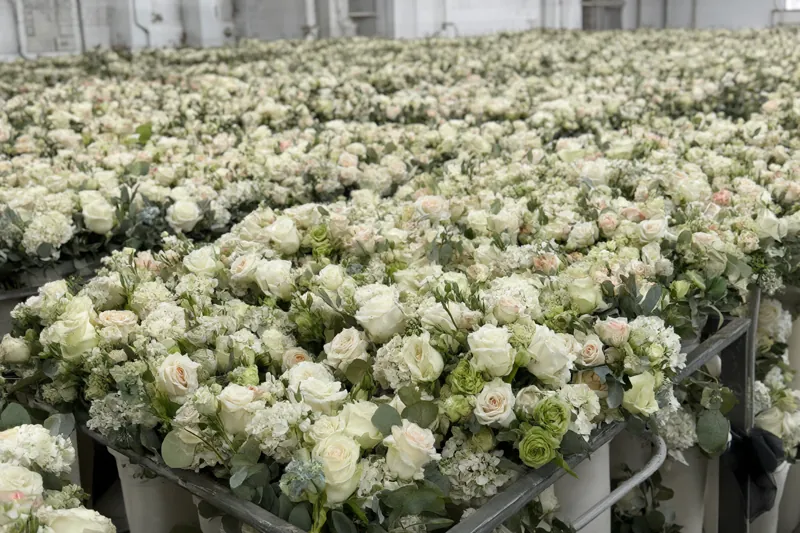
For large quantities flowers are ordered in advance, sometimes from several growers or wholesalers, to get uniform colour and size. Two points to clarify:
- availability: some flowers are hard to find in large quantities at certain times of year. The florist should suggest alternatives already at the design stage;
- storage: between arrival and set-up the flowers must be kept cool. Florists use their own cold rooms or rented spaces, sometimes close to the venue.
Ask where the flowers will be in the 24 to 48 hours before the event and how they will reach the site. In an Italian summer the weak point is the journey and the wait in the loading area.
Transport and access
| To clarify | Why it matters |
|---|---|
| Number and type of vehicles | Refrigerated vans for flowers, larger vehicles for structures |
| Unloading area | Distance from the room, ramps, goods lifts |
| Access times | Many venues and historic centres have strict time slots |
| Permits | Limited traffic zones (ZTL), pedestrian areas, trade fairs with accreditation |
| Parking during the event | For take-down and touch-ups |
At trade fairs and conference centres, access is managed by the organiser, with accreditation, time slots and safety documents. Ask for them in good time.
Teams and set-up times
The venue decides how many hours you have. If the hours are few, you need more people, not more hours. A large set-up is usually split into teams:
- placing the centrepieces on the tables, after or before the tables are laid, as agreed with the caterer;
- installations: arches, hanging pieces, walls, with installers and equipment;
- entrance and common areas: large arrangements, plants, signage;
- coordination: one person who checks, talks to the venue and solves problems.
Installations at height need equipment and trained people. Our guide to freelance florists and event crew explains the roles and the safety points.
Coordination with catering, lighting and production
At a large event the florist does not work alone. The caterer lays hundreds of places, the lighting and sound team runs cables and builds structures, the production team follows the running order. Without a precise sequence the teams get in each other's way.
- Who goes in first: often structures, lighting and sound, then tables and place settings, finally the flowers. But every event has its own order.
- Space on the table: with so many places, the caterer needs to know the size and position of the centrepieces so nothing has to be moved.
- Light on the flowers: the main arrangements need lighting, so the lighting team must know where they will be.
- One person in charge per supplier, with a phone always on, and someone from production who decides when there is a conflict.
A technical meeting with all suppliers, even a short one, saves hours on set-up day.
Take-down and the end of the event
Taking down a large event is a second set-up, often at night. To decide:
- the time by which the room must be clear;
- what is collected: vases, structures, hired plants;
- what stays: arrangements given to guests, plants donated, flowers sent to compost;
- waste: who takes it away and how it is sorted (Italian rules on separate waste collection are strict).
If you want the flowers to have a second life, organise it in advance. Many arrangements can be given to guests or donated, if the venue and the recipients agree.
Backup plans
With large numbers, the unexpected multiplies. The most common problems:
- bad weather at an outdoor event: the flowers must move under a marquee or into a room, with extra time and people. Read our guide to the wet-weather plan;
- heat: arrangements suffering in the hours before guests arrive;
- changing numbers: tables added or removed at the last minute;
- flowers not available: a batch that arrives damaged or does not arrive;
- delays in transport or access.
A small reserve of ready arrangements and loose flowers helps to cover breakages and extra tables. Ask the florist how they handle substitutions and what the contract says.
Contract and quote
For a large event the quote must be very detailed. Check that it states:
- number and type of arrangements, with reference to the approved prototype;
- main flowers and possible alternatives;
- hire, transport, set-up, take-down and any night work;
- the deadline for confirming numbers and the consequences of changes;
- deposits, balance and cancellation terms;
- who is liable for damage to hired items and to the venue;
- whether prices include Italian VAT (IVA).
To read each item, use our guide on how to read a floral designer's quote.
Questions to ask your florist
- Have you handled events of this size? Can you show me photos and numbers?
- Do you make a centrepiece prototype? Is it included?
- Where do you store the flowers before set-up? Do you have cold rooms?
- How many vehicles and people will you bring? Who coordinates on site?
- How many hours do you need, given the venue's access rules?
- By when can I change the numbers, and what happens if I do?
- What is your plan for rain, heat or flowers that are not available?
- Who handles take-down and waste?
To sum up
A large event succeeds when the flowers are designed like a production and installed like a well-run building site. If the event is high-end, see also our florists for gala dinners and formal events. Once you have guest numbers, venue and access dates, request a quote with the floor plan attached.