In short
- Every outdoor wedding needs a written backup plan, not just hope.
- Set a cut-off time for the decision and decide who decides: the venue, the wedding planner or you.
- Design the flowers with an eye on what can be moved and what cannot.
- Ask for the cost of the rain plan in the quote, even if you never need it.
A ceremony in a garden, dinner under the olive trees, an aperitivo on a sea-view terrace. In Italy many weddings take place outdoors, and almost always everything goes well. But summer thunderstorms, strong wind or a wet spring day do happen. This guide to an outdoor wedding rain plan helps you prepare the flowers for a wet-weather backup (what Italians call "piano B"), and tells you what to ask and what to expect. If you are planning an outdoor ceremony, the list of florists for symbolic ceremonies includes many who work outdoors regularly.
Why the backup plan involves the flowers too
People think of the rain plan as the venue's problem: is there an indoor room? Will a marquee go up? But flowers are the part of the design most tied to the space. An arch designed for a lawn will not fit in a room with a low ceiling. A thirty-metre garland will not fit under a twenty-metre gazebo.
Without a flower backup plan, this is what happens on a rainy day: everything is moved in a rush, something breaks, something stays outside, and the covered space looks bare.
The three shelter options
| Option | When it is used | Effect on the flowers |
|---|---|---|
| The venue's indoor room | Villas and hotels with covered spaces | You need the room's size and light in advance |
| Marquee (tensostruttura) | Lawns, gardens, beaches with no indoor rooms | Large space to dress; needs early set-up |
| Gazebo or covered pergola | Small receptions, aperitivo | Limited space, few arrangements but well placed |
Each has different costs and timings. A marquee often has to be booked, and sometimes put up, in advance, even without knowing whether it will be needed. Ask the venue what it offers and how it works.
When to decide
The trickiest point is the moment of choice. Too early, and you give up a day that might clear. Too late, and the flower team has no time to set up in the right place.
Good practice is to agree beforehand:
- the cut-off time for the decision, usually between the evening before and the morning of the wedding;
- who decides: often the wedding planner together with the venue, with your agreement;
- how the decision is passed on to every supplier.
For forecasts, rely on official weather services and, on alert days, on the guidance of Italy's Civil Protection Department. Forecasts more than a few days ahead are only indicative: make decisions close to the day.
Designing flowers that can move
The most useful choice is made months before: design a scheme that can change rooms.
What moves easily
- arrangements in vases and containers with a stable base;
- columns and plinths with flowers;
- centrepieces, which go on the tables wherever they are;
- potted plants, such as olive and citrus trees, if someone can move them.
What moves badly
- arches anchored in the ground;
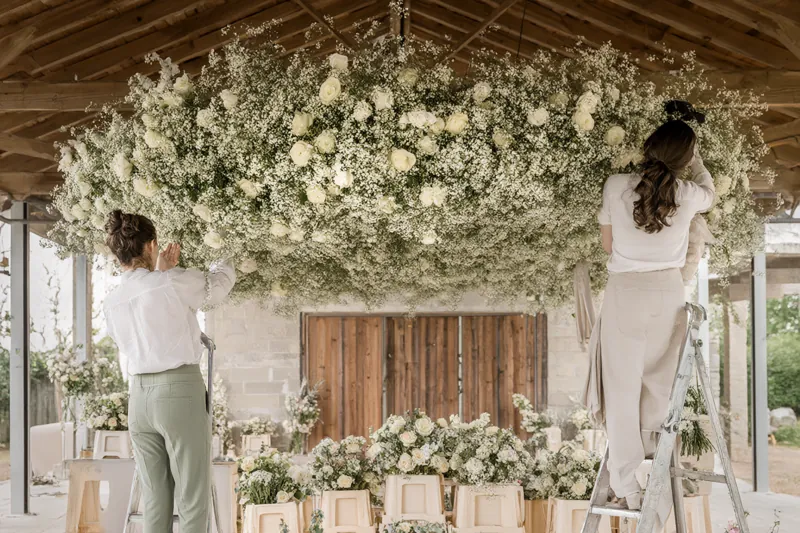
- installations hanging from trees;
- large ground-level arrangements built on site;
- long garlands fixed to banquet tables.
If you love an arch or a ground-level backdrop, ask the florist for a smaller alternative version for the covered space. For structures, read the guide to the ceremony flower arch.
What to prepare twice
You do not need to double the design. But some things should be ready for both scenarios:
- the table plan for the outdoor space and for the covered one;
- the list of arrangements, showing where each goes in either case;
- fixings for dressing the marquee, if it goes up;
- lighting: a marquee needs a different plan from an open garden.
For the lighting side, read the guide to lighting and flowers.
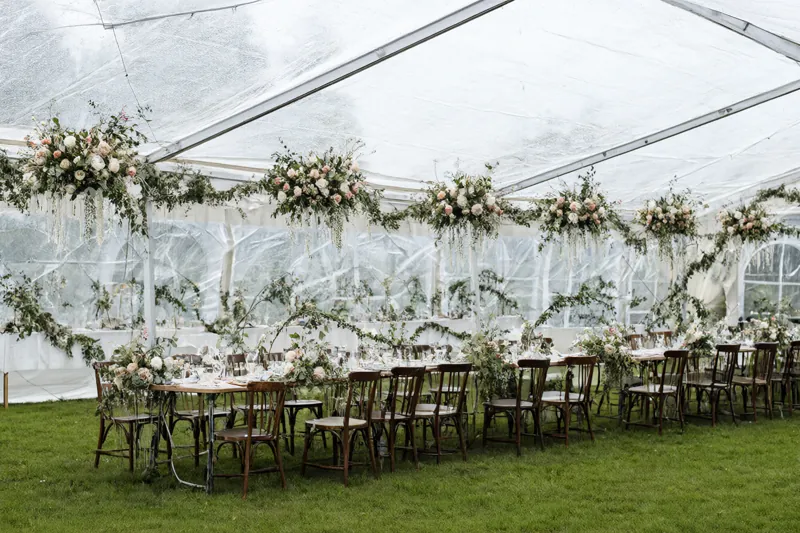
Dressing a marquee
A bare marquee is a big white space. Flowers can make it welcoming, but it takes care and clear agreements.
- Ask the hire company where things can be attached and how much weight poles and beams can take.
- Hanging installations need secure anchoring: whoever put up the structure decides.
- Garlands on poles, arrangements at the entrances and greenery along the edges are simple and effective.
- Think about heat: under canvas in summer the temperature rises and flowers suffer more.
Hanging arrangements should be designed together with whoever installs the marquee, not added at the last minute.
Rain, wind and heat: not just water
The backup plan is not only for rain. In Italy these matter too:
- wind, common in Puglia, Sardinia, along the coasts and on the lakes, which knocks over tall vases and tears garlands;
- heat, which in high summer may mean moving the ceremony into the shade or indoors;
- humidity, which on the lakes and by the sea makes some flowers droop.
For the hottest summers, read the guide to a summer wedding with heat-tolerant flowers.
On the day: who does what
If the backup plan kicks in, everything moves fast. To avoid improvising, prepare a short list covering:
- who tells the florist, caterer, musicians and photographer;
- who moves arrangements already set up outside, if the rain arrives after set-up;
- where wet flowers and materials go, so the room stays clean;
- how the schedule changes, for example if ceremony and aperitivo are held in the same space.
If the rain arrives once the ceremony has started, the priority is sheltering guests and electrical equipment, not flowers. A good florist knows this and adapts.
The cost of the backup plan
Prepare two budgets: plan A and plan B. The items that may change are:
| Item | Why it may cost more |
|---|---|
| Marquee or gazebo | Hire and set-up, sometimes even if it is not used |
| Extra hours for the flower team | Moving and re-installing |
| Alternative structures | A smaller arch, supports for the covered space |
| Dedicated lighting | Indoors needs a different set-up |
| Takedown | More complex if the design is split across two spaces |
Ask for the terms to be written into the contract: what you pay if the backup plan is used and what you pay if it is not. The guide to the contract with your florist also covers bad-weather clauses.
An example of a written backup plan
A backup plan works if it is on a sheet everyone has. It can be very simple: two columns, plan A and plan B, and for each moment of the day where it happens, which flowers are there and who moves them. A venue map with both areas marked and one contact phone number are enough. Send it to every supplier a few weeks before and bring a printed copy on the day. If you are planning from abroad, make sure your planner or a trusted person on site has it too.
Questions to ask the venue and the florist
- What covered space is there? Can I see it at the site visit?
- Does the marquee have to be booked in advance? Do we pay even if it is not needed?
- By what time do we decide? Who decides?
- Which arrangements can be moved easily?
- Is there a smaller alternative for the arch or backdrop?
- Does the backup plan cost extra? Is it written in the quote?
- Who moves the flowers on a rainy day?
To wrap up
A good backup plan is invisible: the party goes on and guests only remember the atmosphere. Preparing it well is the best way to stop checking the forecast every hour. For all the details worth checking in advance, read the guide to the site visit with your florist.
When you have a date and a venue, ask for a quote and ask how they handle bad weather.