In short
- For large or back-to-back events, floral designers work with outside help: assistants, installers, drivers.
- Every freelancer must know what they do, when, with whom and for how much: better in writing.
- Contracts and insurance depend on the type of work arrangement: decide them with an adviser, not on the day.
- Work at height (hanging installations, flower walls, tall arches) needs proper equipment, training and clear rules.
This guide is for floral designers and florists who work on events in Italy and need to strengthen their team. A wedding with many tables, a gala dinner for hundreds, two events on the same Saturday: there comes a point when the studio's own hands are not enough. Here you will find the most common roles, how to organise them, what to put in writing and what to watch out for during installations. If you work mainly for companies, see also our page on corporate event flowers: those are the jobs that most often need extra staff.
When you need extra help
The usual signs:
- volume: many identical centrepieces to make in a short time;
- installations: arches, flower walls, hanging structures that need several people to lift and secure;
- tight timing: the venue opens only a few hours before the event;
- late-night take-down: the party ends late and everything must be out by a set time;
- several events at once: on the same day in different places;
- travel: destination weddings far from the studio, where you need a team that travels or people on the spot.
On large numbers, read also our guide on logistics for large events.
The most common roles
| Role | What they do | Useful skills |
|---|---|---|
| Florist assistant | Cleans and conditions flowers, fills vases, copies arrangements from a model | Manual skill, knowledge of flowers, speed |
| Experienced florist | Makes complex arrangements, bouquets, key pieces | Experience, independence, taste in line with the style |
| Installer or rigger | Builds structures, arches, walls, hanging pieces | Work at height, tools, safety training |
| Driver | Drives vans, loads and unloads, keeps delivery times | Correct licence, knowledge of limited traffic zones (ZTL), care with the load |
| On-site coordinator | Keeps the timeline, talks to venue and caterer, checks the result | Organisation, communication, calm |
| Take-down crew | Collects arrangements, vases and structures, loads hired items | Stamina, tidiness, late hours |
On small jobs one person does several things. On large ones it is better to separate the roles and name someone responsible for each.
Where to find freelancers
There is no official register of freelancers for floral events in Italy. The most used channels:
- your network of colleagues: local florists and designers who work on call in peak periods;
- floristry schools and courses, where you meet trained and motivated people;
- event installers who already work for trade fairs, stage sets or hire companies;
- hire and marquee companies, who often know set-up crews;
- local freelancers at distant destinations, useful for knowledge of the area and the language.
Before trusting someone with an important job, try them on a smaller event. The style of an arrangement can be learnt; punctuality and care with materials show straight away.
Put everything in writing
Even with people you trust, a written agreement avoids misunderstandings. For every event it should be clear:
- dates and working hours, including travel and waiting time;
- meeting point and transport;
- specific tasks and whom to report to;
- pay and how it is paid;
- meals and accommodation when travelling;
- equipment: what the freelancer brings and what you supply;
- confidentiality: no photos or posts of the event without the client's agreement;
- what happens if the event is cancelled or moved.
Contracts, insurance and rules
Caution is essential here. The right arrangement depends on who the freelancer is and how they work: a self-employed professional with a VAT number (partita IVA), an employee hired for short periods, or other forms allowed by Italian law. Each has consequences for social security contributions, insurance against workplace accidents (in Italy handled by INAIL) and liability. The rules change over time.
Do not improvise: decide the right arrangement with your employment adviser (consulente del lavoro) or accountant before the season, not on the morning of the event. Check also that your public liability insurance covers the work of your freelancers and any damage to venues.
Safety when working at height
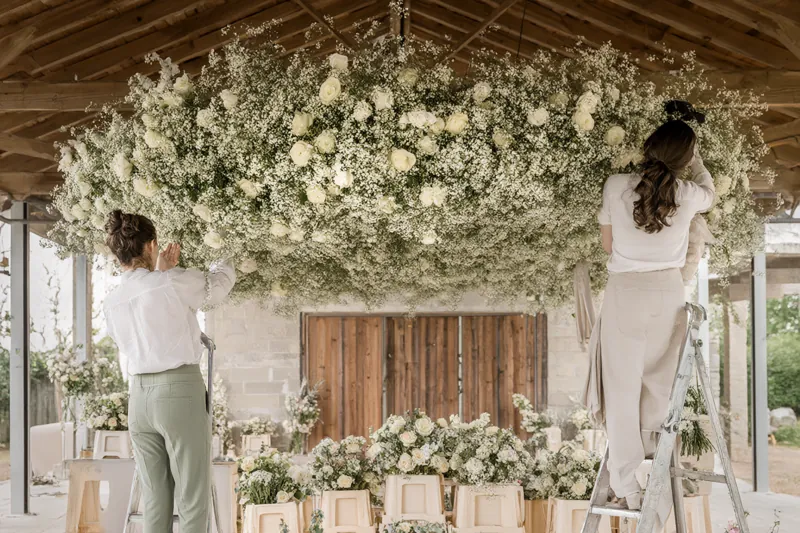
Tall arches, flower walls, hanging installations and flower ceilings take the work off the ground. Italy's consolidated law on health and safety at work (Legislative Decree 81/2008) has a part on work at height, meaning work with a risk of falling more than two metres from a stable surface. It requires a risk assessment, suitable equipment and training for whoever uses it. For the details, speak to your safety adviser.
In practice, before every installation:
- choose the right equipment: compliant ladders, mobile scaffolds, platforms, depending on the height and the weight to lift;
- ask the venue what is allowed, where you can hang things and whether documents or a site inspection are needed;
- check the anchor points: beams, hooks and ceiling structures must hold the weight, including the water in the flowers;
- work in pairs: one climbs and one holds, passes and checks;
- do not work at height when tired, in strong wind or in a rush to finish.
For hanging installations, read also our guide to suspended floral installations.
Organising the day
| Stage | Who is needed | What to prepare |
|---|---|---|
| Days before | Florist assistants in the studio | Incoming flowers, cool spaces, models to copy |
| Loading | Drivers, assistants | Load list, crates, protection |
| Set-up | The whole team | Floor plan, timeline, tools, ladders |
| During the event | One or two people on call | Touch-ups, moving flowers from ceremony to reception |
| Take-down | Crew, drivers | List of hired items to collect, rubbish bags, venue times |
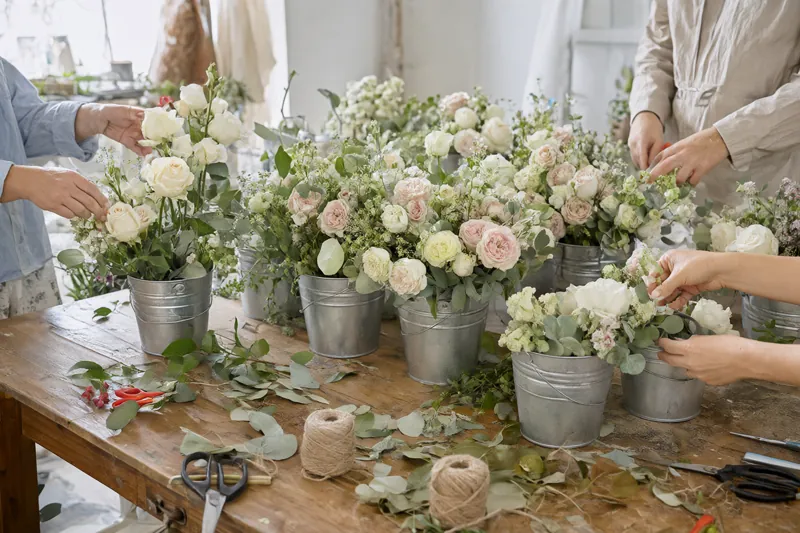
A reference model for each type of arrangement helps a lot: you make the first one, the others are made to match. Photos and measurements on the workbench reduce mistakes.
Building a stable network
The best freelancers are the ones who come back. Working with the same people means fewer explanations, fewer mistakes and less stress on the day. A few habits help: pay on the agreed date, share photos and models in advance, give feedback after every job, and call first those who did well. A stable network is also what lets you say yes to a big event without improvising.
Questions to ask yourself before calling in help
- How many hours of work are really needed, for prep, set-up and take-down?
- Which tasks can I delegate and which must I handle myself?
- Who coordinates on site if I am busy on a key piece?
- Do I have equipment and trained people for work at height?
- Is the working arrangement correct and covered by insurance?
- Does my quote to the client include these costs?
On that last point, many staff costs end up as unforeseen extras: read our guide to hidden extra costs in floral design.
To sum up
A reliable team is what lets a floral designer take on bigger events without risking quality. If you work in the sector, our page for floral designers explains how to present your work on the site. If instead you are organising an event and want to know whether a supplier has a suitable team, ask openly when you request a quote.
Sources
- Legislative Decree 9 April 2008, no. 81, consolidated law on health and safety at work, Normattiva: https://www.normattiva.it
- INAIL, Italian national institute for insurance against accidents at work: https://www.inail.it