In short
- To bring flowers and plants from outside the EU you generally need a phytosanitary certificate, even in your suitcase and in small amounts.
- Within the European Union things are simpler, but some plants travel with specific documents.
- Flowers packed in luggage or shipped often arrive tired, and can be stopped at border checks.
- For a wedding, a local Italian florist is almost always the better choice: they buy from wholesalers and guarantee freshness and substitutions.
This guide is for couples marrying in Italy who are thinking of sending or bringing flowers to Italy from home: a variety from their own country, flowers from a family garden, or a whole order from a florist abroad. It is also for guests and relatives who want to send flowers to a couple marrying in Italy. You will find the European rules in brief, the practical risks and the alternatives.
Why this question comes up so often
Many couples who marry in Italy come from other continents. It is natural to want something from home: a symbolic flower, a plant from a grandparent's garden, a trusted florist. But flowers are living plants, and plants travel under strict rules designed to protect farming from pests and diseases.
Before you decide, know that Italy has florists used to working with international couples and recreating a requested style. Browse our list of florists for destination weddings in Italy.
The European rules in brief
The European Union has common rules on plant health. The main text is Regulation (EU) 2016/2031, supported by implementing rules that list prohibited plants, plants subject to checks and specific requirements.
In plain terms, if you arrive from a country outside the EU (including the US, Canada, Australia and the UK):
- plants and plant products, including cut flowers, must as a rule travel with a phytosanitary certificate issued by the authority of the departure country;
- this also applies to travellers with small amounts in their luggage, apart from a few exceptions set by the rules (for example some fruits);
- some plants are prohibited from certain countries, whatever the certificate;
- at checks, anything that does not comply can be held and destroyed.
This is general information, not legal advice. Plant lists and requirements change over time and depend on the country of origin. Before travelling, check with the plant health authority in your own country and in Italy.
Within the European Union
If the flowers leave from another EU country, things are much simpler. Most of Europe's flower trade moves this way. For some plants, especially those meant to be planted, professional operators use a plant passport. A private person carrying a bunch of cut flowers usually does not need one, but check if in doubt.
Protected species and other checks
Some species, such as certain orchids and succulents, are covered by international agreements on trade in protected species and may need extra permits. Commercial shipments may also face import duties and VAT (IVA in Italy). Dried flowers, seeds and bulbs can be subject to rules too: do not assume they are exempt.
Practical risks, even when everything is legal
Say you have all the paperwork. Very real problems remain.
| Problem | What happens |
|---|---|
| Dehydration | Many hours without water, in the hold or a suitcase: flowers arrive tired or damaged |
| Temperature | Heat in a car or cold in the hold damages petals and stems |
| Checks | Delays, inspections, the flowers may be held |
| Luggage | Airline limits, liquids not allowed in the cabin, lost bags |
| Conditioning | Flowers must rest in water, in a cool place, before they can be worked |
| Responsibility | If flowers you bring are unusable, the florist cannot guarantee the result |
In practice, even in the best case, you risk arriving with flowers less fresh than those your florist would buy locally.
Why a local florist makes sense
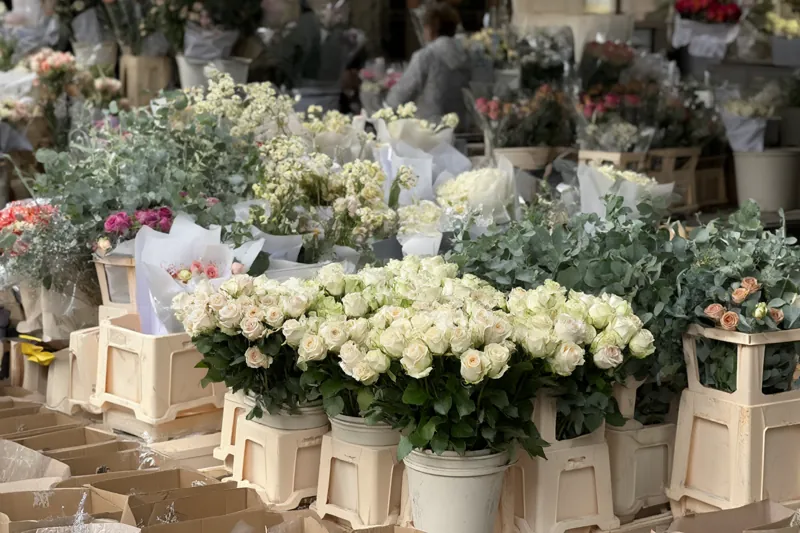
Italian florists buy from Italian growers and from wholesalers who import flowers every day from other countries, mainly in Europe, with logistics and paperwork already in order. Flowers arrive in cold rooms, are conditioned and are worked at the right moment.
What you gain:
- freshness: flowers arrive a few days before and are handled correctly;
- variety: non-Italian flowers are available too, when the season and the market offer them;
- substitutions: if a flower is missing, the designer proposes a similar one, as agreed in the contract;
- no customs risk for you;
- Italian seasonal flowers, often hardier and less expensive.
To learn where flowers in Italy come from, read our guide to Italian flower growing and markets. For seasonality, see seasonal flowers in Italy.
If you want a flower "from home"
Is there a flower that means something to your family? There are easier ways to bring it along.
- Ask for the same variety from your Italian florist: they can often find it or suggest something very close.
- Bring an object, not a plant: a ribbon from a grandmother's dress, some lace, a charm, a photo tied to the bouquet.
- Use an image of the flower on invitations, menus or place cards.
- Plant the flower at home after the wedding, as a keepsake, instead of bringing it to Italy.
If you want to send flowers to a couple in Italy
If you are a guest or a relative and want to send flowers to the couple, do not ship them from abroad. Order from an Italian florist near the venue, or ask the wedding florist to prepare a gift in your name. They arrive fresh, on time, and will not get stuck at customs.
Remember that venues and churches have delivery hours: agree the timing with the couple or with their planner.
What if your florist comes from abroad?
Some couples want to bring their own trusted florist to Italy. It is possible, but it is better for them to buy flowers in Italy, through local wholesalers, rather than bringing them along. They need to know the suppliers, and have a cool space to work, a van and people to help with set-up. Often they team up with an Italian florist who provides logistics, contacts and on-site help.
Clarify the paperwork too: invoicing, VAT and responsibility for hire items change depending on who sells and who works. Ask your planner how to handle it.
Questions to ask your florist
- Can you find the variety we would like in Italy?
- If not, which similar flower would you suggest?
- Where do your flowers come from? Italian or imported?
- Can we add a family object to the bouquet?
- Do you accept flowers we bring ourselves? On what terms?
- Who is responsible if flowers we bring cannot be used?
To sum up
Bringing flowers from abroad is only possible with the right documents, and it carries many practical risks. For a wedding, the safest route is a local florist, with a keepsake from home that is not a plant. For costs and travel, read our guide to budgeting flowers for a destination wedding.
Once you have a date and a venue, request a quote and mention any flower that matters especially to you.
Sources
- Regulation (EU) 2016/2031 on protective measures against pests of plants: eur-lex.europa.eu/eli/reg/2016/2031/oj
- Commission Implementing Regulation (EU) 2019/2072 establishing uniform conditions for the implementation of Regulation (EU) 2016/2031: eur-lex.europa.eu/eli/reg_impl/2019/2072/oj