In short
- Italy has a significant flower-growing industry, concentrated in a few districts: the Ligurian Riviera, Pistoia and Pescia, Campania, Puglia, Sicily.
- Many flowers at your wedding will be Italian, others imported: it depends on the flower, season and style.
- Florists buy from growers, wholesalers and wholesale markets, usually a few days beforehand.
- A flower that travels less often arrives fresher, but it is not always the cheapest.
When you look at a bouquet, you rarely wonder where the flowers came from. Yet origin explains a lot: why a flower costs more in certain months, why one lasts longer than another, why a florist suggests a substitution. This guide takes you through Italian flower growing and the supply chain, from the growing districts to your wedding day.
Flower growing in Italy
Italy grows cut flowers, cut foliage and ornamental plants in many regions. The mild climate of the coasts and the South allows production even in winter, when Northern Europe needs heated greenhouses. Some areas have a long tradition and form true districts.
Knowing the districts also helps you choose who to work with: a florist based near a growing area often has a direct relationship with the growers. You can start with our list of wedding florists across Italy and filter by region.
The main districts
| Area | What it mainly produces | Notes |
|---|---|---|
| Western Ligurian Riviera | Cut flowers (including ranunculus and anemones), cut foliage, potted herbs | Sanremo and its flower market, the Albenga plain |
| Pistoia | Nursery stock: trees, shrubs and ornamental plants | A large nursery district, with plants also sold abroad |
| Pescia and Valdinievole | Cut flowers | Long tradition of a flower market |
| Campania | Cut flowers and potted plants | Mainly in the provinces of Naples and Salerno |
| Puglia | Cut flowers and potted plants | Terlizzi near Bari, Leverano in Salento |
| Sicily | Ornamental plants, cut flowers, foliage | Several areas, including around Messina and Catania |
They are not the only ones: flowers and plants are grown in other regions too, often by small farms producing seasonal flowers for their area.
The Ligurian Riviera: the Riviera of Flowers
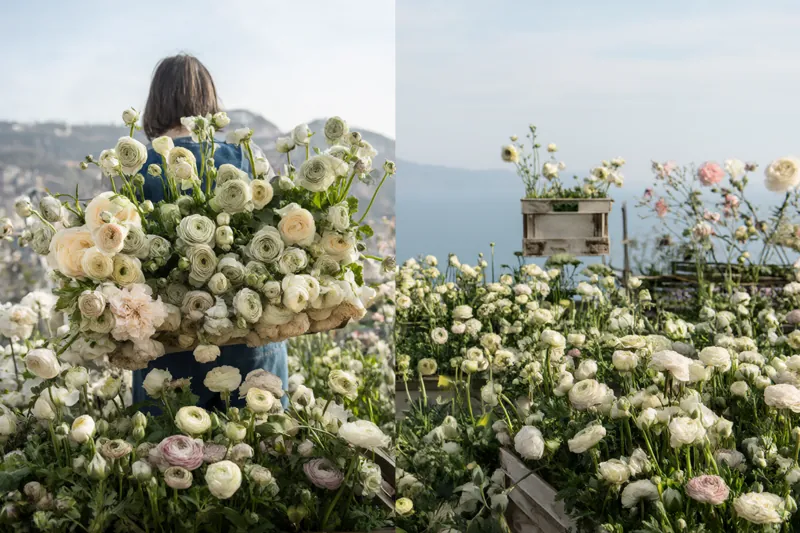
Western Liguria has long been tied to flowers, so much so that it is known as the Riviera dei Fiori, the Riviera of Flowers. The mild climate allows growing in the middle of winter. Many of the ranunculus and anemones you see between winter and spring come from here, together with foliage used all over Italy. The Albenga plain produces many potted herbs.
If you are getting married in Liguria, the link with local flower growing is an extra. We cover it in our guide to Liguria wedding flowers.
Tuscany: Pistoia and Pescia
In Tuscany two neighbouring districts have different callings. Pistoia is known for its nurseries: ornamental trees and shrubs grown in pots and in the ground, also sold abroad. Potted trees used in wedding decor often come from here or from similar districts. Pescia and the Valdinievole are associated with cut flowers and their market.
Campania, Puglia and Sicily
The South plays a growing role. In Campania, mainly in the provinces of Naples and Salerno, cut flowers and potted plants are grown. In Puglia, Terlizzi, near Bari, is known as the city of flowers, and Leverano, in Salento, has a strong flower-growing tradition. In Sicily the climate allows ornamental plants and flowers to be produced in several areas.
For a destination wedding in the South, this means many flowers can come from close by. Ask your florist which growers they work with.
Imported flowers
A large share of the flowers sold in Italy comes from abroad. The Netherlands is the great hub of the European flower trade, handling flowers grown in Europe and on other continents. Many long-stemmed roses come from East Africa and South America, where the climate allows year-round production.
Flowers and plants entering the European Union from non-EU countries are subject to plant-health checks. For couples planning a wedding, that is one more reason not to bring flowers from abroad yourselves: we explain why in our guide on bringing flowers into Italy from abroad.
Importing is not a flaw. It makes roses and other flowers available all year, sometimes at reasonable prices. But it means longer journeys and a well-managed cold chain.
The supply chain: from field to table
The typical journey of a cut flower:
- Growing and harvesting at the right stage, often in bud.
- Cool storage and transport, within Italy or from abroad.
- Wholesale: flower markets, wholesalers, sometimes direct purchase from the grower.
- The florist's studio: cleaning, hydration, controlled opening, storage in a cold room.
- Arranging in the days or hours before the event.
- Transport and set-up at the venue.
Every step matters for freshness. That is why florists usually buy a few days beforehand and work with cold rooms. Some flowers, in high season or from far away, are ordered further ahead.
Changing prices: holidays, weather, demand
The flower market is lively. Wholesale prices change from week to week, sometimes from day to day. Some recurring factors:
- holidays: around Valentine's Day red roses go up, around Mother's Day many flowers do, and at the start of November chrysanthemums (in Italy, the flower of All Saints' and All Souls' Day);
- weather: a frost, a heatwave or long rains reduce production;
- peak wedding season: between May and September some flowers are in very high demand;
- transport: costs and delays add most to the price of flowers from far away.
That is why a quote made many months ahead often gives ranges, possible substitutions or the option to update some items. It is an honest way of dealing with a market nobody fully controls. If you are paying from abroad, remember that prices in Italy are quoted in euros and usually include VAT (IVA in Italian): ask whether the figures you see include it.
Why origin matters to you
- Freshness: less travel often means more days of vase life.
- Price: it depends on season and market; an out-of-season Italian flower can cost more than an imported one.
- Availability: local production follows the seasons; imports fill the gaps.
- Sustainability: seasonal, nearby flowers reduce transport and heated greenhouses. We cover this in our guide to sustainable wedding flowers.
Questions to ask your florist
- Which flowers in my design are grown in Italy?
- Do you work directly with local growers?
- How many days beforehand do you buy the flowers?
- Do you have cold rooms to store them?
- If an imported flower does not arrive, what happens?
- Can we favour seasonal Italian flowers without changing the style?
- If prices rise sharply before the wedding, how do you handle the quote?
- Which flowers in the design do you order furthest ahead?
Final thoughts
Knowing where flowers come from helps you understand prices, substitutions and seasons, and read a quote with different eyes. It also gives you one more reason to choose a florist rooted in the area. For the flower calendar, see our guide to seasonal flowers in Italy.
Once you have a date and a venue, request a quote and ask which Italian-grown flowers the florist can use in your month.
Sources
- Regulation (EU) 2016/2031 on protective measures against pests of plants: https://eur-lex.europa.eu/eli/reg/2016/2031/oj