In short
- Choose the region and the venue first: light, climate and venue rules shape most of your flower decisions.
- Start 12 to 18 months ahead if you are aiming for high season, from May to September.
- Costs depend mostly on destination, date and guest count: the lakes, the Amalfi Coast and Venice sit at the top end.
- Paperwork depends on your nationality: only your consulate and the Comune can tell you exactly what you need.
- A local floral designer knows the growers, the seasons and the access routes: this usually works out better than bringing flowers from home.
Every year many couples from abroad plan a destination wedding in Italy: a villa in the hills, a terrace above the sea, a palazzo in a historic city. This guide is for you if you are planning from a distance. It also helps Italian couples marrying in a region they do not know. You will find how to choose where, how guests get there, when to go, what it costs, the order to do things in and what to know about paperwork. Then the guide moves on to your local team and the flowers. If you already want names, start with the list of floral designers for destination weddings in Italy.
Choosing the region
A region is more than a postcard. It changes the light, the climate, the type of venue, the flowers that do well in season and the logistics of the day. Style stays open: a Tuscan designer can create a minimal set-up and a Sicilian one a romantic one. The region sets the context, not a rule.
| Area | Typical venues | What affects the flowers |
|---|---|---|
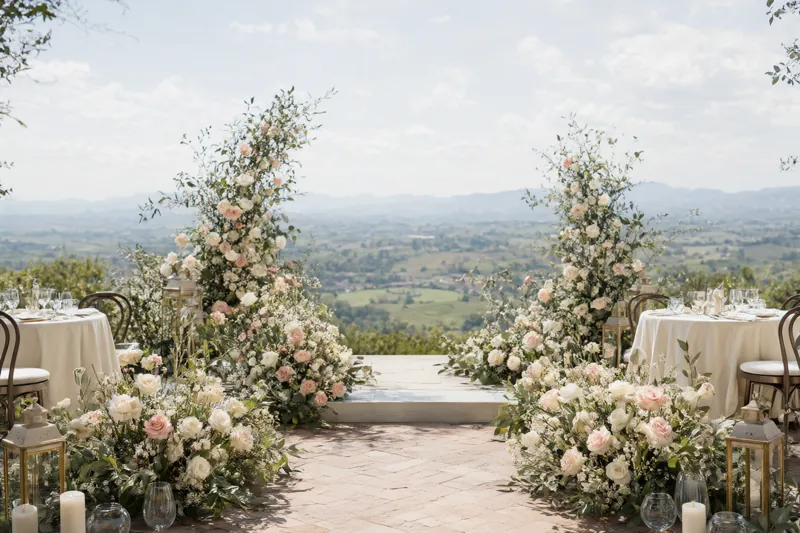
| Tuscany | Villas, hilltop villages, wine estates | Large outdoor spaces, summer sun, long country drives |
| Lake Como and Lake Garda | Historic villas, gardens, lemon houses | Humidity, access by water, villa rules |
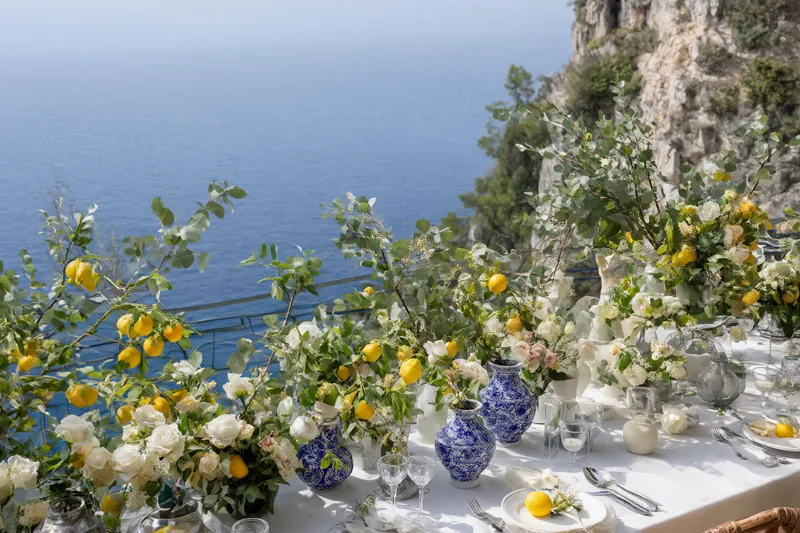
| Amalfi Coast and Capri | Terraces, hotels, seaside churches | Steps, narrow roads, difficult deliveries |
| Puglia | Masserie (fortified farmhouses), trulli, olive groves | Heat, wind, large spaces to fill |
| Sicily | Baroque palazzi, villas, islands | Heat, scirocco wind, transport to the islands |
| Rome and Venice | Churches, palazzi, terraces | Restricted traffic zones, permits, boat logistics in Venice |
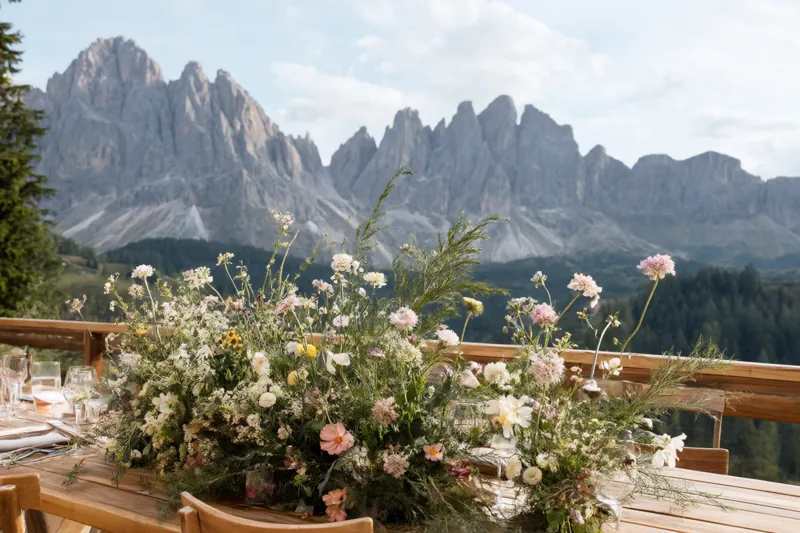
| Langhe, Umbria, Dolomites | Castles, villages, mountain huts | Autumn and altitude, changeable temperatures |
To go deeper into one area, read the guides on Tuscany, Puglia, Lake Como and Sicily.
Getting there and moving around
Italy has international airports close to most wedding areas: Milan and Bergamo for the lakes, Venice and Verona for Venice, Lake Garda and the Dolomites, Florence, Pisa and Bologna for Tuscany, Rome for Rome and Umbria, Naples for the Amalfi Coast, Bari and Brindisi for Puglia, Catania and Palermo for Sicily. High-speed trains link the main cities.
The last stretch is where planning matters:
- countryside venues in Tuscany, Umbria or Puglia need a car or a shuttle;
- lakes and coasts often add boats and ferries, with timetables and weather to check;
- historic centres have restricted traffic zones (ZTL) that limit cars and vans;
- mountain venues may involve cable cars, mountain roads and changeable weather.
Most couples book shuttles between the hotels and the venue and suggest one or two base towns to guests. The same access routes affect your suppliers, and often show up in their quotes.
The season
In Italy the wedding season runs roughly from May to October, with June and September in high demand. July and August are hot almost everywhere, especially in the south and in historic cities such as Rome, Florence and Venice. April and October can be lovely, with a higher risk of rain. Keep in mind that mid-August (Ferragosto, 15 August) is Italy's main summer holiday, when some suppliers close.
For flowers, the season changes everything. In spring you find ranunculus, anemones and then peonies. In summer, hydrangeas, garden roses and heat-tolerant flowers. In autumn, dahlias, foliage and berries. Dates are indicative and vary by year and area. You will find the month-by-month picture in seasonal flowers in Italy.
What a wedding in Italy costs
The total depends mostly on three choices: the destination, the date and the number of guests. Venue and catering are usually the largest items, followed by the planner, photography and flowers. Lake Como, the Amalfi Coast, Capri and Venice sit at the top end; the countryside of Tuscany, Umbria, Puglia and Sicily offers a wider spread. Saturdays in June and September cost more than weekdays or the shoulder months. Quotes are in euros and many are written before VAT (IVA, 22% standard rate): always ask.
For a breakdown by item, with sample budgets for 30, 80 and 150 guests and the differences between destinations, read how much a wedding in Italy costs.
For flowers, the indicative national ranges are roughly €1,800 to €4,000 for 60 guests with a civil or symbolic ceremony at a villa, and €3,500 to €8,000 for 120 guests with a church ceremony and a villa reception. In the best-known destinations, quotes usually fall in the upper part of these ranges. The detail is in how much wedding flowers cost in Italy and the flower budget for a destination wedding.
The order to plan in
Order matters, because each choice limits the next.
- Budget and guest count. A wedding for 30 and one for 150 need very different venues.
- Region and season. Decide whether you want heat, sea, hills or a city.
- Venue and date. Popular venues book early. Ask straight away about their rules on flowers, candles, timings and suppliers.
- Wedding planner, if you want one. When you plan from abroad, a planner often runs the whole show.
- Floral designer, photographer, caterer. Your florist needs to know the venue, the number of tables and the type of ceremony.
For booking windows in detail, read how far ahead to book your floral designer.
Paperwork, in brief
This is not a legal guide, but a few things are worth knowing before you choose your type of ceremony.
- Civil wedding. It takes place at the Comune (the town hall) or in a venue the Comune has authorised. Foreign citizens usually need a declaration or certificate of no impediment (nulla osta) from their own country. Requirements vary by nationality.
- Religious wedding with civil effect. For a Catholic ceremony you also need documents from your home parish. Each diocese and parish has its own rules, including rules on flowers.
- Symbolic ceremony. It has no legal value. Many couples marry legally at home and then celebrate in Italy with a symbolic ceremony, which gives more freedom on place, time and decoration.
Always check with your country's consulate in Italy and with the civil registry office of the Comune you have chosen. They are the ones who can tell you what you need and how long it takes. For a wider picture, read getting married in Italy as a foreigner and, if you are thinking of a ceremony just for the two of you, the guide to eloping in Italy.
The type of ceremony also changes the flowers. In church, parish rules apply. At the town hall, time slots are short. At an outdoor symbolic ceremony, sun and wind matter most. See church wedding flowers and flowers for a symbolic ceremony.
Your local team
When you plan from far away you need people on the ground you can trust. The team usually includes:
- a wedding planner, who coordinates suppliers, timings and the unexpected;
- a floral designer, who designs and installs the ceremony and reception flowers;
- the caterer and the venue, often linked to each other;
- a photographer, music and hire items (chairs, tables, lighting).
A floral designer who often works with international couples can explain proposals in writing, speaks English or other languages, accepts payments from abroad and knows the venues in the area. Always ask how many times they have worked at your venue or at similar places.
Planning flowers from a distance
Planning flowers you cannot see is possible. It usually works like this:
- First video call: style, colours, guest count, venue, rough budget.
- Mood board and proposal: reference photos, a list of pieces, flowers expected in that season.
- Written quote, with separate line items and clear terms.
- Mock-up of a centrepiece or the bouquet in photos or video, if included.
- Site visit, by you or your planner, when possible.
For the details, read working with a floral designer remotely. For money, you will find the typical cost items in the flower budget for a destination wedding. Italian quotes may be shown with or without VAT (IVA in Italian), so always ask which.
Local or imported flowers
You can find good Italian-grown flowers in many seasons: Italy has important flower-growing districts in Liguria, Tuscany, Campania, Puglia and Sicily. Some flowers do come from abroad, especially out of season. A good floral designer will tell you what is local and what is not.
Bringing flowers from your own country is almost always a bad idea. There are plant health controls, travel time ruins freshness, and you still need someone on site to install them. Read more in bringing flowers into Italy from abroad.
Italian customs worth knowing
If you come from abroad, some customs may be new to you. In Italy, chrysanthemums are linked to funerals and mourning, so they are usually avoided at weddings. Orange blossom is a traditional wedding symbol. Confetti in Italy are sugared almonds, not paper: they and the wedding favours (bomboniere) are a ritual of their own, often with a small dedicated display. Read flowers and traditions of the Italian wedding.
Questions to ask your floral designer
- Have you worked at our venue before? Do you know its rules on flowers, candles and timings?
- Which flowers will be good in our wedding month? Which are local and which imported?
- What language can we communicate in, and what language is the contract in?
- How do you handle payments from abroad? What deposits do you ask for, and when?
- Will you send us photos or video of a mock-up before the day?
- Who moves the flowers from the ceremony to the reception? Who clears up, and when?
- What happens if it rains or the wind is strong?
- Does the quote include travel, installation, hire and VAT?
Final thoughts
A destination wedding rests on a few choices made well and on a local team that talks to each other. Start with the venue, then look for the right floral designer for that area. If you are drawn to the coast, read the guide to the Amalfi Coast too.
Browse the wedding floral designers in Italy or use find your floral designer to narrow your choice. Once you have a date and a venue, request a quote: your request reaches professionals in the area and you can compare replies at your own pace.
Sources
- Italian Ministry of Foreign Affairs and International Cooperation: www.esteri.it