In short
- On Capri everything arrives by sea: flowers, hire items and the team all depend on ferries and weather.
- Traffic on the island is very limited: in the town centre goods travel on electric carts or by hand, through car-free lanes.
- There are two municipalities, Capri and Anacapri, with different rules and venues: check with the right one.
- The island's colours are blue, white, lemon yellow and bougainvillea, but your florist can work in any style.
This guide is for couples planning a Capri wedding, whether for an intimate ceremony or a large reception. You will find how flowers reach the island, which rules to check, how to choose colours and materials, and what to ask your florist before signing.
Why Capri is a special case
Capri is small and steep, with few roads and many pedestrian lanes. Marrying here means choosing one of the best-known places in the Mediterranean: views of the Faraglioni rock stacks, terraces, gardens of historic villas, strong light. Many couples come from abroad, especially from the United States and the UK.
For flowers, Capri is a logistics puzzle before it is a creative one. Every vase, every structure, every stem has to cross the sea and then climb. To find the people who work on the island, see our list of wedding florists on Capri and the one for the nearby Amalfi Coast, where many teams are based.
How flowers reach the island
The sea crossing
Capri is linked by ferries and fast boats to Naples, Sorrento and, at certain times of year, other ports along the coast. Flowers usually come from the mainland, where suppliers and wholesalers are. The crossing adds hours and extra handling.
The critical point is the weather. In rough seas, services can be reduced or cancelled. So florists who work on Capri often:
- bring flowers and materials over the day before or earlier;
- keep a cool space on the island to store everything;
- allow a time margin for a delay or a cancelled crossing.
On the island
From the harbour, narrow roads with hairpin bends climb to Capri and Anacapri. Vehicle access for non-residents is restricted, and rules can change with the season: check with the Comune (the town hall) what applies on your date. Goods vehicles are small and need authorisation.
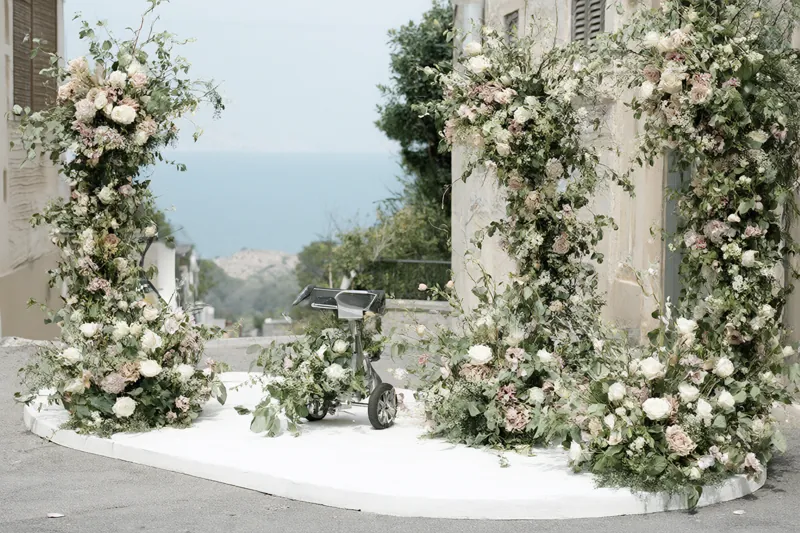
In the centre of Capri, around the Piazzetta, many lanes are pedestrian only. Luggage and goods move on electric carts or by hand. A tall arrangement or a large arch has to travel in pieces and be assembled on site.
What this means for your quote
Capri's logistics add to the price and should be written down. Items that often appear:
| Item | Why it costs more on Capri |
|---|---|
| Sea transport | Tickets for people and goods, several trips |
| Transport on the island | Authorised vehicles, carts, porters |
| Team accommodation | Overnight stays on the island, often in high season |
| Set-up hours | Slow routes, tight spaces, assembly in pieces |
| Flower storage | Cold rooms or cool spaces for one or more days |
| Breakdown | Often the same night or early next morning, with strict times |
| Rentals | Vases and structures travel to and from the mainland |
We give no figures here: they depend on venue, date, guest count and quantity of flowers. Ask for a quote with every item listed separately, and compare quotes that include the same things. Our guide on how to read a florist's quote will help.
Venues and rules
Weddings on Capri take place in historic churches, town hall rooms, hotels, villas and restaurants with terraces. Each place has its own rules.
Churches. Ask the parish priest or rector what can go on the altar and pews, whether petals or rice can be thrown as you leave, and how much time there is to decorate. Some churches are small: a few well-placed arrangements work better than many.
Civil ceremonies. Capri and Anacapri are two separate municipalities. Each has its own rooms and places for civil weddings. Availability, fees and rules on flowers must be checked with the Comune.
Hotels and villas. They often have preferred suppliers, precise access times and rules on candles, nails and installations. Ask whether an outside florist is allowed and on what terms.
Terraces. Wind and sun are strong. Low arrangements, heavy bases, and no open flames without the venue's permission.
Island colours and materials
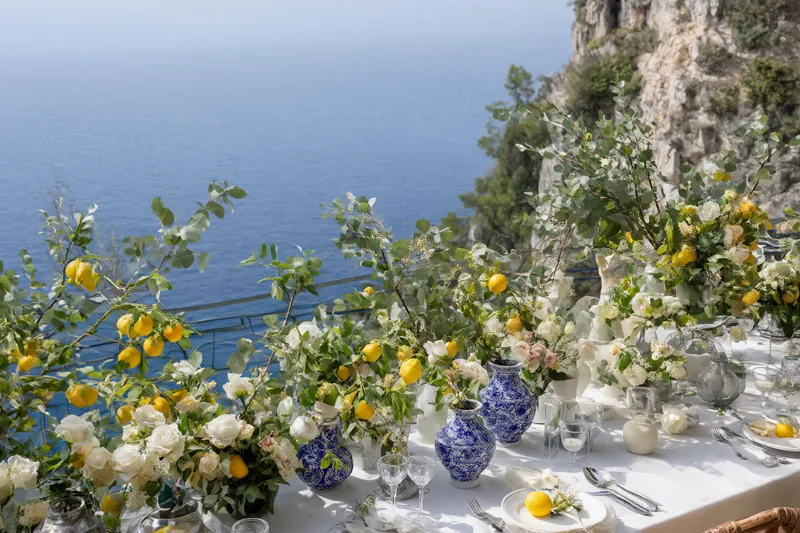
Capri has a recognisable palette: the blue of the sea, the white of the houses, lemon yellow, bougainvillea pink, the green of the Mediterranean scrub. Many couples pick it up. It is not compulsory: florists also work in neutrals, pastels or bold colour.
Materials that work well:
- lemons in pots or branches with fruit, on tables or at the entrance;
- olive and Mediterranean greenery, which stand up to heat;
- white flowers such as roses, hydrangeas in season, jasmine;
- blue tones from delphinium, agapanthus and cornflower, depending on the month;
- bougainvillea as an accent, knowing it is fragile once cut.
For citrus, read our guide to lemons, oranges and olive in wedding decor. For colour choices, see the one on wedding flower colour palettes.
Seasons and crowds
Capri is very busy from spring to autumn. The notes below are indicative.
| Period | What to expect |
|---|---|
| April to May | Mild weather, island already lively, spring flowers available |
| June | Very popular, hot, long days |
| July to August | Hot and very crowded, slower logistics |
| September to October | Sea still warm, soft light, dates in high demand |
| November to March | Many hotels and venues closed, fewer crossings |
In summer flowers suffer: late set-up, water-filled containers and heat-tolerant flowers help. In winter many places close and connections are less frequent.
Wind, sun and a plan B
Many Capri venues are terraces and gardens high above the sea. Wind often arrives without warning, and the summer sun is strong from early morning. For flowers this means:
- heavy bases and low arrangements on outdoor tables;
- arches and structures fixed in place, assembled in pieces and anchored on site;
- no open flames without the venue's permission: closed lanterns or battery lights are safer;
- scattered petals only where the wind will not blow them away and where someone will clear them up.
Agree an indoor plan B with the venue before you sign. On an island you cannot bring in a marquee or a second set of decor at the last minute. Ask your florist which pieces can move inside, how long it takes and whether the price changes. The same goes for the bouquet and personal flowers: in the heat they should be delivered as late as possible and kept cool until the ceremony, perhaps at the hotel where you are getting ready.
Questions to ask your florist
- Have you worked on Capri before? At which venue?
- Where are you based: on the island, on the Amalfi Coast, in Naples?
- When do you bring the flowers over? Where do you store them?
- What do you do if a crossing is cancelled?
- How do you get to the venue? Do you need carts or porters?
- Are structures assembled in pieces?
- Are team accommodation and transport included?
- What time must you clear the venue? Is breakdown included?
To sum up
On Capri the result depends on logistics. Choose a florist who knows the ports, routes and island rules, leave a time margin for the weather and ask for a quote that separates transport, accommodation and set-up. If you are still choosing your destination, read our guide to an Amalfi Coast wedding.
Once you have a date and a venue, request a quote and say whether the ceremony is in Capri or Anacapri.