In short
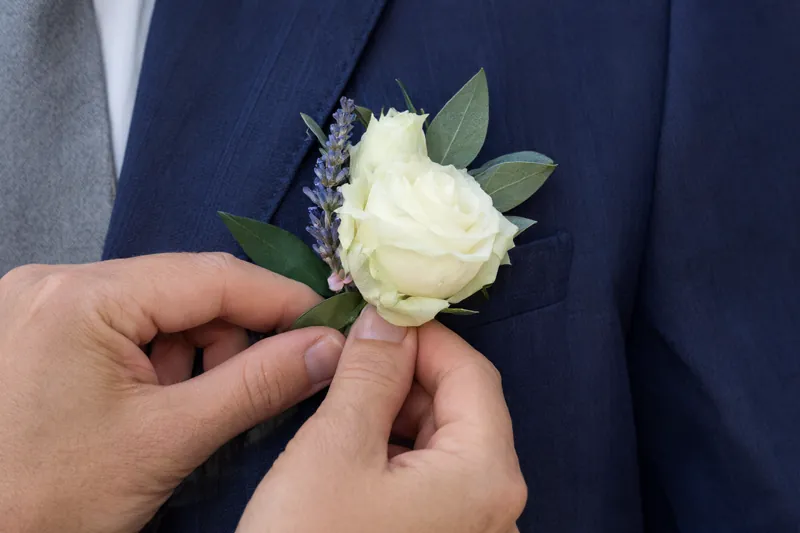
- The groom's buttonhole (boutonniere in the US) repeats a flower or some greenery from the bouquet, in miniature.
- Witnesses, fathers and grandfathers can wear a coordinated buttonhole, sometimes simpler than the groom's.
- Mothers and grandmothers usually wear a pinned corsage or a wrist corsage.
- You need hardy flowers: they stay out of water all day, close to the body.
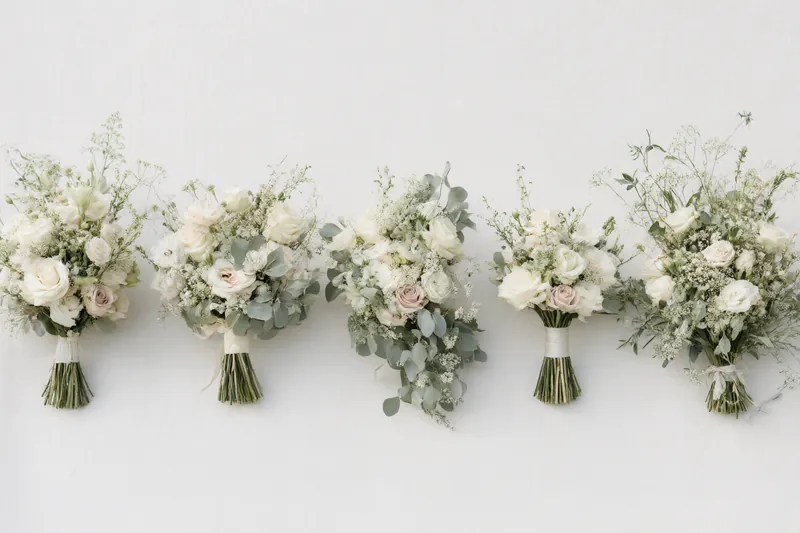
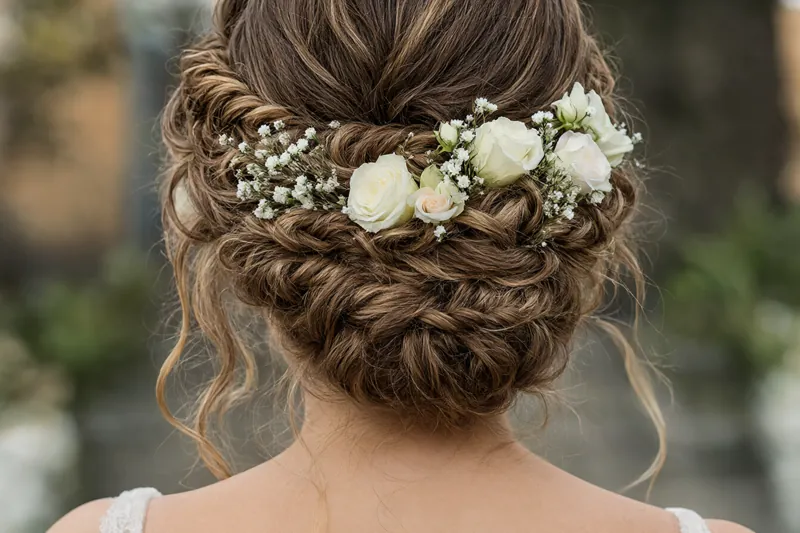
The bride's flowers are not the only ones of the day. Wedding buttonholes and corsages, worn by the groom, the witnesses, the parents and sometimes the grandparents, link them visually to the couple. These details show up in a great many photos. This guide is for anyone deciding who wears a flower, which one and how. You will find the most common options, colour pairings, suitable flowers and the questions to ask. If you are still looking for a professional for all your ceremony flowers, browse our wedding florists in Italy.
The groom's buttonhole
The buttonhole, called fiore all'occhiello in Italian, is worn on the left lapel of the jacket. Originally it was slipped through the lapel's buttonhole slit. Today it is often fixed with a pin behind the lapel or with a small magnet.
It is usually made of:
- one main flower, small or medium sized;
- one or two pieces of greenery;
- sometimes a dried detail, a berry or a sprig of herbs;
- a wrapped stem, with thread, ribbon or twine.
It should be in proportion to the lapel. On a narrow lapel a big flower looks oversized. On a tuxedo with satin lapels, a restrained flower works well, often white or green.
Which flower to choose
The simplest rule is to take a flower from the bridal bouquet. If the bouquet has garden roses, the groom can wear a rosebud. If it has ranunculus, a ranunculus. If the bouquet is mostly greenery, the buttonhole can be greenery with one small detail.
Some flowers are better suited than others because they last out of water:
| Flower or element | Durability | Notes |
|---|---|---|
| Spray carnation, small carnation | Good | Classic, many colours |
| Rosebud | Good if not too open | Choose a compact one |
| Ranunculus | Medium | Lovely, but suffers in the heat |
| Lisianthus | Good | Soft, elegant |
| Cotton flower, wheat, dried flowers | Excellent | Suits natural styles and summer |
| Olive, rosemary, myrtle | Good | Fragrant Mediterranean greenery |
| Small orchid | Good | More formal look |
| Hydrangea, peony | Low | Heavy and delicate, not really suitable |
These are general pointers. Your florist will know what holds up in your season and in the heat expected on the day.
Witnesses, fathers, grandfathers
There is no rule about who should wear a flower. Usually they go to:
- the groom's witnesses or groomsmen, and the bride's witnesses too if they are men (Italian weddings have official witnesses, testimoni, who often play the role of best man and maid of honour);
- both fathers;
- grandfathers, if they are there;
- brothers, older page boys or readers, if you want to single them out.
A common choice is a fuller buttonhole for the groom and a simpler version for everyone else, with the same greenery and a different or smaller flower. That way the groom stands out in group photos.
Make a list with names and give it to the florist. On the day the flowers often arrive in a single box, and knowing who gets which avoids confusion.
Corsages and wrist corsages for mothers and grandmothers
For the women of the family there are two main options.
A pinned corsage is a small flower or small arrangement fixed on the dress or jacket, at shoulder or chest height. It looks elegant, but on light fabrics such as silk or chiffon it can pull and leave marks. A magnet works better, or pin it to a jacket.
A wrist corsage, sometimes called a floral bracelet, is tied to the wrist with a ribbon or an elastic band. It does not damage the outfit and leaves the hands free. It suits mothers, grandmothers and adult bridesmaids.
Some families prefer a small posy to hold, or no flowers at all. Ask mothers and grandmothers first what they would like: not everyone enjoys wearing flowers.
Matching outfits and colours
A buttonhole has to work on different suits: navy, grey, black, beige, sometimes light colours in summer. A few pointers:
- on a navy or grey suit, white, green, blush or peach tones work well;
- on a beige or linen suit, greenery, dried flowers and warm tones look good;
- on a black tuxedo, a white or green flower is the safest choice;
- if the tie or bow tie is coloured, the flower can pick up its tone or stay neutral.
Send the florist photos of the outfits, or at least the colours. For corsages, they need to know the colour and fabric of the mothers' outfits.
Timing and keeping them fresh
Buttonholes and corsages are the first flowers to be put on and the last to come off. They have to last from getting dressed to the end of the party.
- They are usually made on the day or the evening before.
- They arrive in a box, sometimes with a water mister.
- Keep them cool and out of the sun until it is time to wear them.
- Put them on after the jacket, not before.
- During outdoor photos in summer, keep them shaded as much as you can.
Ask where they will be delivered: the bride's house, the groom's, the hotel. If you get ready in two places, you will need two deliveries or someone to act as courier. For the timing of all the flowers on the day, read our wedding flower timeline.
Artificial, dried or preserved flowers
If the groom wants a flower to keep, or if it will be very hot, you can use a dried, preserved or fabric flower. They last a long time and do not wilt. They do look different from fresh flowers, so check how they sit next to the bouquet. Our guide to dried and preserved flowers covers this.
Italian customs worth knowing
If you are marrying in Italy from abroad, a few local customs help you understand what Italian families may expect.
- By a widespread custom, the bouquet is a gift from the groom to the bride, and in many families the groom pays for it or arranges its delivery. It is not a rule, but a mother-in-law may well mention it.
- Orange blossom (fiori d'arancio) is the traditional symbol of marriage in Italy. A small sprig in a buttonhole or corsage is a nod Italian guests will recognise.
- Chrysanthemums are linked to mourning in Italy: leave them out of buttonholes too.
- Myrtle and olive are greenery often used in southern Italy and on the islands, buttonholes included.
For the full picture, read our guide to flowers and Italian wedding traditions.
Questions to ask your florist
- Which flowers from the bouquet can you repeat in the buttonhole?
- How do you fix it: pin, magnet, buttonhole slit?
- How long does it last out of water in the heat we expect?
- Can you make different versions for the groom, witnesses and fathers?
- For the mothers, do you recommend a pinned corsage or a wrist corsage?
- Where and when do you deliver? Do we need two deliveries?
- Do you label the boxes with names?
- Do you make a couple of spares in case one breaks?
Final thoughts
A few well-chosen flowers pull the family photos together. Decide on your list of people, match the flowers to the bouquet and think about how to keep them fresh all day. To start from the bride, read our guide to bridal bouquet styles. For the youngest members of the wedding party there is our guide to flower girl and page boy flowers.
Once you know your date and how many people need flowers, request a quote and ask for buttonholes and corsages to be itemised one by one.