In short
- There are five main shapes: round, cascade, asymmetric, posy and hand-tied. Each one suits a different dress.
- Choose the bouquet after the dress: its line, fabric and neckline tell you which shape works best.
- Proportion with your figure matters more than fashion: the bouquet should neither hide your waist nor disappear.
- Season, heat and the length of the day affect flowers and weight: talk to your florist early.
The bridal bouquet is the floral piece that ends up in almost every photo. You hold it during the ceremony, in portraits, sometimes for hours. This guide to bridal bouquet styles is for brides choosing the shape of their bouquet who want to arrive at the florist's with clear ideas. You will find the most common shapes, how to match them to your dress and figure, and the questions to ask before you decide. If you are still looking for someone to make it, start with our list of wedding florists in Italy.
The five main shapes
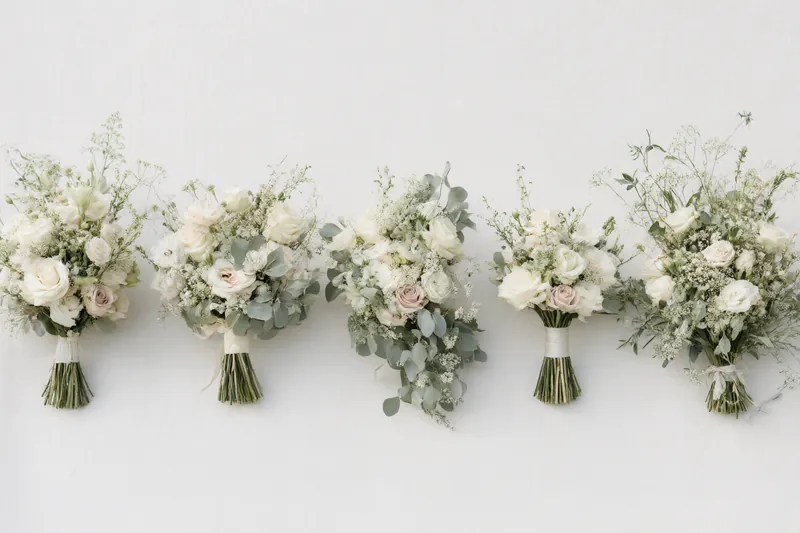
There are many variations, but almost every bouquet starts from one of five basic shapes. Knowing them helps you use the right words with your florist.
Round
The classic shape: a compact dome, with the flowers at the same height or nearly. It can be very dense, all roses or all peonies, or softer, with flowers of different shapes and some greenery. It looks neat, is easy to hold and works with almost any dress. The smaller, tighter version is often called a Biedermeier.
Cascade
The flowers fall downwards like a teardrop or a small waterfall. It was very popular in the past and has come back in lighter versions, with trailing branches, ivy, orchids or fine flowers. It creates drama and lengthens the figure. It takes more skill, more flowers and usually an internal holder.
Asymmetric
The shape you see most today at villa and outdoor weddings. The bouquet is wider on one side, with flowers at different heights, moving greenery and sometimes a few stems breaking the outline. It looks more natural. The risk is that it gets too big: it needs careful balancing.
Posy
A small, compact bunch held in one hand. Ideal for heavily embellished dresses that should not be covered, and for civil or intimate ceremonies. It is light and practical. It also works well with a single type of flower.
Hand-tied or loose
Long stems tied with a ribbon, with no rigid outline. It looks freshly picked. It can be a bunch of calla lilies, tulips, cultivated wildflowers or flowering branches. You carry it in your arms or along your side.
| Shape | Effect | Dresses it often suits | Watch out for |
|---|---|---|---|
| Round | Neat, classic | Full skirt, princess, A-line | Looking stiff |
| Cascade | Dramatic, lengthening | Long with train, mermaid, simple dresses | Weight and proportion with your figure |
| Asymmetric | Natural, soft | Flowing, slip, villa or garden dresses | Getting too large |
| Posy | Discreet, refined | Embroidered, short dresses, suits | Disappearing in group photos |
| Hand-tied | Relaxed, modern | Minimal, boho, soft dresses | Wet stems on the fabric |
These are broad guidelines, not rules. A good florist will suggest exceptions that work.
Matching the bouquet to your dress
The dress comes first. The bouquet goes with it and should not compete. Three things to look at.
The line. A full dress can carry a full bouquet. A fitted or mermaid dress calls for a more contained bouquet that does not break the silhouette. A soft, flowing dress goes well with loose shapes.
Fabric and details. On a bodice with lace or embroidery, a large bouquet covers exactly the most detailed part. On smooth crepe, by contrast, the bouquet can become the point of colour.
The colour of the dress. Bright white, ivory, blush and champagne all change how white flowers look. A pure white flower next to an ivory dress can make the dress look yellowish. Bring your florist a fabric sample or a photo in natural light.
Proportion with your figure
A bouquet is usually held at navel height, with relaxed arms. In this position it should not cover your waist or hide your upper body. Some practical pointers:
- if you are petite, choose compact shapes or short, light cascades;
- if you are tall, you can carry a wide asymmetric bouquet or a longer cascade;
- if your dress defines the waist, keep the bouquet small enough to show it;
- if you will hold it for a long time, go for a lighter bouquet.
Ask your florist for photos of their work with brides of a similar build. It gives a better idea than any measurement.
Ceremony style and venue
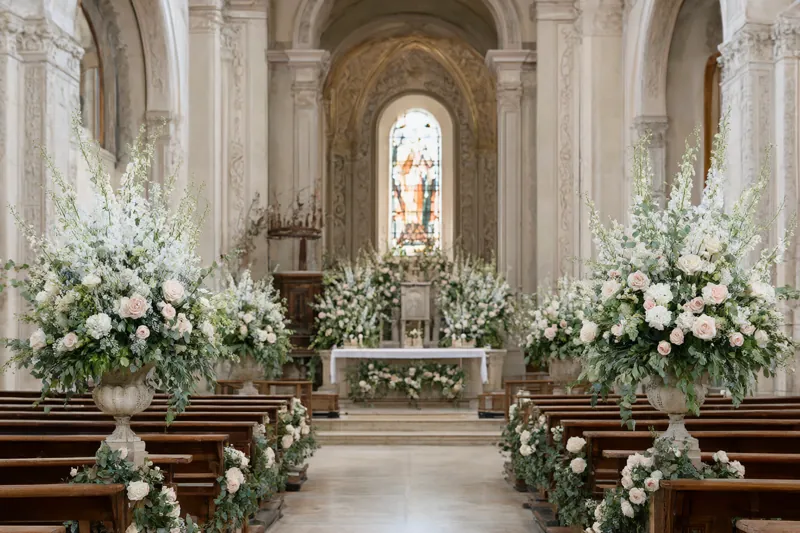
The bouquet shape also talks to the setting. In a Baroque church or a historic palazzo, a full round or a cascade has room to breathe. In a Puglia masseria (farmhouse), a vineyard or by a lake, a soft asymmetric bouquet or a loose bunch looks more natural. At a town hall, with tight timings and small rooms, a posy or a hand-tied bunch is practical. For the ceremony flowers as a whole, read our guide to church wedding flowers or the one on civil ceremony flowers.
The bouquet does not have to follow the style of the venue. But it should sit well with the rest of the flowers: the same palette or a deliberate variation, not something out of place.
Flowers, season and heat
The shape tells you how the flowers are arranged. Which flowers to use depends on the season, the budget and the weather on the day. In Italy, between June and September, many ceremonies take place in high temperatures. Some delicate flowers, such as hydrangeas and certain peonies, suffer if they stay out of water for long. Others cope better.
Your florist will choose with you flowers that are available in your month and suited to the length of the day. For more, read our guide to seasonal bridal bouquets.
The handle and details
How the stems are finished is part of the style.
- Satin or silk ribbon: classic, wraps the stems and keeps them dry.
- Exposed stems: more natural, tied with twine or a thin ribbon. Stems must be dried well so they do not mark the dress.
- Lace or dress fabric: sometimes an offcut of the dress or a family fabric is used.
- Charms and keepsakes: a photo, a medal, a handkerchief. Agree on weight and how it is attached.
Ask whether the bouquet will come with a stand or vase, so you can rest it during breaks without damaging it.
Toss bouquet and keepsake bouquet
Many brides do not throw their real bouquet. Your florist can make a second, smaller and lighter one for the toss. That way the original stays intact and you can keep it. If you plan to dry it, press it or set it in resin, say so beforehand: some flowers preserve better than others.
In Italy, by tradition, the groom chooses and gives the bouquet to the bride on the wedding morning. Many couples now choose it together. Our guide to Italian wedding traditions and flowers explains this and other customs.
Questions to ask your florist
- Which shape would you suggest for my dress, and why?
- Can you show me work with dresses similar to mine?
- Which flowers would you use in my month, and how well do they cope with heat?
- Roughly how much will the finished bouquet weigh?
- Is the bouquet hand-tied or made on a holder?
- How will the handle be finished?
- What time will it be delivered, and where do I keep it until the ceremony?
- Do you also make a toss bouquet and matching buttonholes?
- Can I see a trial or a photo of a sample bouquet?
To sum up
Choose the dress first, then the shape, then the flowers. In that order, the bouquet will suit you and the rest of the day. If you want to match the flowers for the groom and wedding party, read our guide to buttonholes and flowers for the groom. For an idea of costs, see how much a bridal bouquet costs.
Once you have a date, a venue and a photo of your dress, request a quote from one or more florists and compare their proposals.