In short
- Industry estimates often suggest between 5 and 10% of the wedding budget: it is a rule of thumb, not an obligation.
- The right number depends on your priorities and on how beautiful or furnished the venue already is.
- Flowers matter most where guests look for a long time and where photos are taken: ceremony, top table, tables.
- Give your florist a clear figure: they will design to it instead of making you cut later.
Before asking for quotes, it helps to set your wedding flower budget. This guide helps you find a starting figure: how to split the wedding budget, how to choose priorities and which floral elements count most in photos and in guests' memories. The examples refer to weddings in Italy, with prices in euros.
A starting share, not a rule
Industry estimates often put flowers at somewhere between 5 and 10% of the overall wedding budget. It is a way to begin, not a figure to respect. Two examples:
- at a historic villa with gardens, frescoes and furniture, fewer flowers are needed to fill the space: the share can stay low;
- in an industrial space, a field or under a marquee, flowers and foliage create the atmosphere: the share goes up.
If floral design is what interests you most, it is normal to move budget into it from other items. To see what professionals in your chosen area suggest, browse the list of wedding florists in Italy.
How to split the wedding budget
Every wedding is different. The table below is not a statistic: it is a rough guide to where the big items sit and where flowers fall among the others.
| Item | Rough share | Notes |
|---|---|---|
| Venue and catering | The largest part | Often half the budget or more |
| Outfits, hair and make-up | Medium | Depends a lot on personal choices |
| Photography and video | Medium | What remains after the wedding |
| Flowers and styling | About 5-10% | Higher if the floral design is central to the look |
| Music and entertainment | Medium to low | Band or DJ, ceremony musicians |
| Invitations, favours, stationery | Low | Very variable |
| Contingency | A reserve | Always worth keeping one |
With a budget of €40,000, a share of 5 to 10% means €2,000 to €4,000. With €80,000, it means €4,000 to €8,000. These are multiplications, not quotes. To see what these figures buy, read how much wedding flowers cost in Italy. Make sure you compare figures on the same basis: Italian quotes may show prices with or without VAT (IVA), so set your budget with VAT included.
When the share can go down or up
When it can go down
There are situations where spending less on flowers is the right choice, not a compromise:
- venues that are already rich, with frescoes, flowering gardens, lemon houses or sea views: the flowers accompany, they do not need to fill;
- small weddings, where few tables and a short bridal party reduce quantities;
- minimal style, with a single type of flower and plenty of empty space;
- generous seasons, such as spring, when Italian flowers are beautiful and plentiful.
When it can go up
On the other hand, plan for more when the venue is neutral and needs transforming, when you want hanging installations or a major ceremony design, when the wedding runs over several days, or when the flowers you want are out of season. Venues that are remote or hard to reach also increase the service share: transport, set-up, breakdown and team travel.
Start from your priorities
Before doing the sums, answer three questions:
- Which moment do you most want to remember? The ceremony, walking into the room, the dinner?
- Where will guests spend most time? Usually at the table, for three or four hours, and Italian dinners can run long.
- What do you like most in photos of other weddings? The arch, the table, the bouquet?
The answers tell you where to concentrate the budget. The rest can be simple, with foliage and seasonal flowers.
Where flowers matter most in photos
| Element | How much it shows in photos | Weight on cost |
|---|---|---|
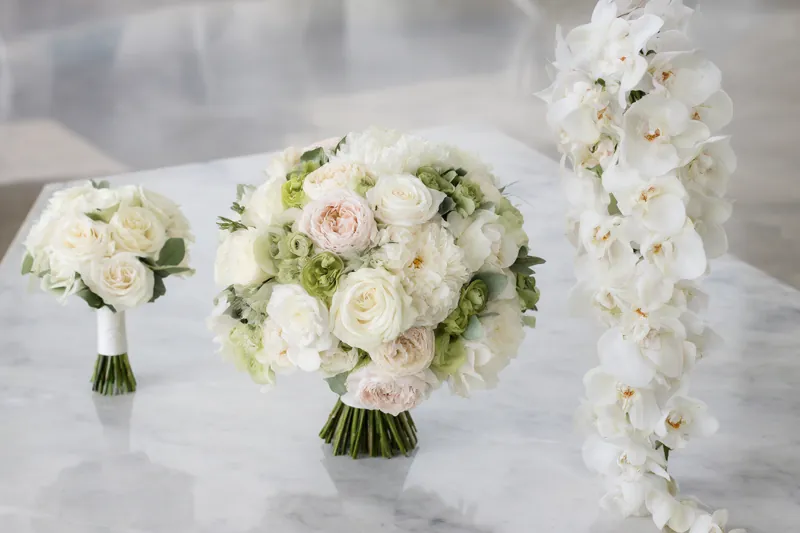
| Bridal bouquet | In almost all of them, from portraits to cutting the cake | Low |
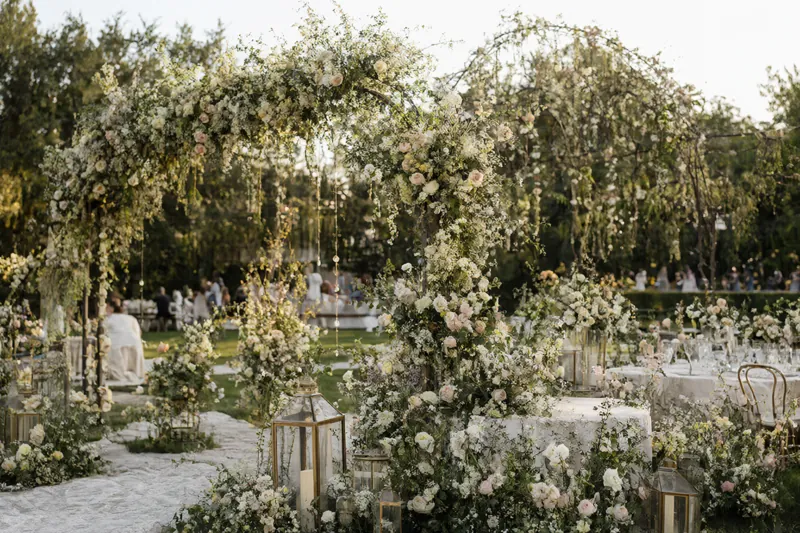
| Ceremony backdrop | In every ceremony photo | Medium to high |
| Top table | During speeches, toasts and cutting the cake | Medium |
| Guest tables | In wide shots and detail shots | High, multiplied by the tables |
| Entrance and seating plan | In few photos, but every guest passes by | Medium to low |
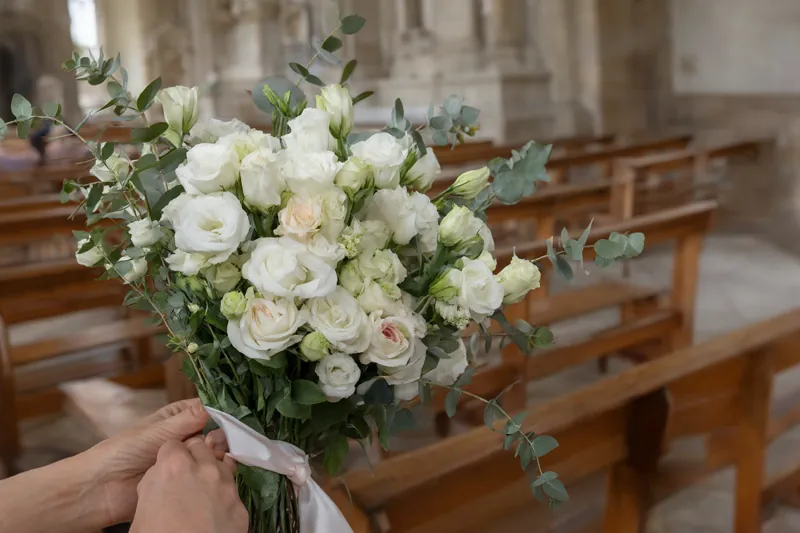
| Church pews | In aisle photos | Medium |
| Bathrooms, corridors, secondary corners | Almost never | Cut these first |
The bouquet has the best ratio between cost and presence in photos. The ceremony backdrop is behind every image of the vows. The tables are where guests spend most time. If you have to choose, start with these three. How to work with your photographer to show the flowers at their best is explained in the guide on flowers and wedding photography.
How to turn the share into a plan
- Set a figure with a small margin, VAT included.
- Count the tables and the bridal party: these are the quantities that drive the bill.
- Choose one or two priorities to concentrate the budget on.
- Ask two or three florists what they would suggest for that amount.
- Compare the proposals on quantities, sizes and items included, not just on the total.
For the last step, the method in the guide on how to read a florist's quote is useful.
If the budget is not enough
It happens often. Before giving up what you like, try these moves:
- reuse ceremony flowers at the reception;
- mix low and tall centrepieces;
- use more foliage and seasonal flowers;
- drop the corners nobody looks at.
You will find more in the dedicated guide to saving money on wedding flowers.
And for a destination wedding?
Couples marrying in Italy from another country often give flowers a larger share, because the floral design tells the story of the place: lemons on the Amalfi Coast, olive trees in Puglia, gardens on the lakes. But they also need to allow for travel and logistics, and for bank fees and exchange rates when paying from abroad. The specific items are in the guide to the flower budget for a destination wedding.
Questions to ask your florist about budget
- With this amount, VAT included, what would you suggest?
- Where would you concentrate the flowers for the most impact?
- What can we reuse between ceremony and reception?
- Which service items (transport, set-up, breakdown) are included?
- How much margin do you suggest keeping for the unexpected?
- If we add guests, how much does the quote grow?
Final thoughts
If after doing the sums the figure feels tight, start from the ideas on how to save on wedding flowers. A clear figure makes everything simpler: for you, because you know what to expect, and for the florist, who can design to it. Once you have decided, request a quote stating your budget, the number of tables and your two priorities: the proposals you receive will already be close to what you are looking for.