In short
- Flowers photograph best before guests arrive, with the tables complete and the right light.
- The photographer needs to know where and when the main arrangements will be ready.
- The flat lay of details needs planning: ask the florist for a few extra stems.
- The photographer's editing style changes colours: compare it with your palette.
Flowers last a day. Photos last for good. That is why many couples, looking back on their wedding, realise how much the images of the floral design matter. This guide helps you get your photographer and florist working together, so your wedding flowers look their best in the photos and actually make it into the album. If you are still looking for a florist, browse the wedding florists and look at how their work is photographed: it also tells you what kind of light and venue suits them best.
Two professionals who rarely cross paths
The florist sets up and often leaves before guests arrive. The photographer arrives with the bride or groom and follows the people. The typical result: beautiful tables nobody photographs calmly, or photographed once they are already covered in glasses.
The fix is simple: put them in touch. One email with these is enough:
- the schedule for the day;
- the list of main arrangements and where they will be;
- the time each space will be ready.
If you have a wedding planner, they usually act as the link.
What to photograph: the flower shot list
| Moment | Flowers to photograph | When |
|---|---|---|
| Getting ready | Bouquet, buttonholes, hair flowers, flat lay | Before leaving home or the hotel |
| Ceremony | Arch or altar, pews, entrance, aisle | Before guests come in |
| Portraits | Bouquet in hand, details with the dress | During the couple's session |
| Aperitivo | Welcome arrangements, buffet, signs | As it opens, before the crowd |
| Reception | Tables, couple's table, seating plan, cake | Before guests sit down |
| Evening | Tables with candles and lights | At sunset or just after |
Share this list with your photographer. Not every photographer asks for one, but almost all appreciate it.
The right light for flowers
Flowers look their best in soft light: early morning, late afternoon, a lightly overcast sky. Midday sun burns out whites and creates hard shadows. Darkness without dedicated lighting makes them disappear.
That leads to some practical choices:
- if the ceremony is at midday in summer, ask the photographer to find shade for the details;
- if the reception starts after sunset, have the tables photographed half an hour before, while there is still light;
- in the evening, make sure the tables have spotlights, not just candles.
For the lighting side, read the guide to lighting and flowers.
The detail flat lay
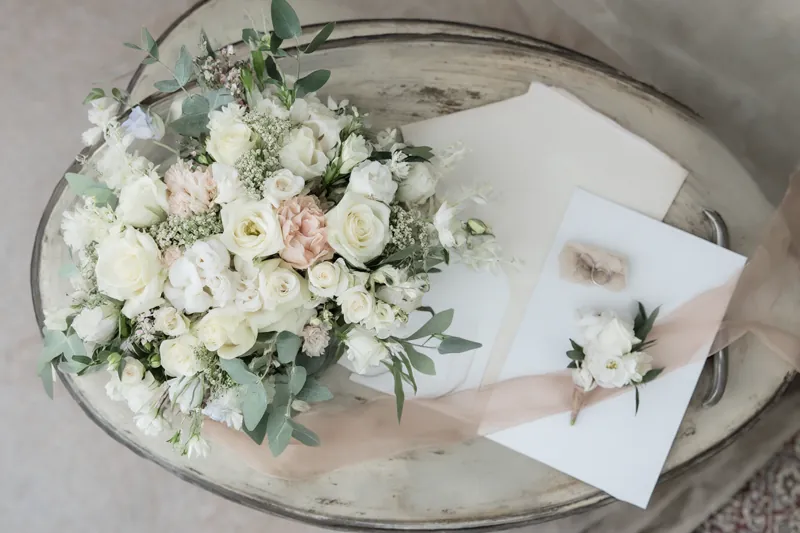
A flat lay is an overhead shot of small objects arranged with care: invitations, rings, earrings, perfume, shoes, ribbons. Loose flowers and a few leaves tie it all together.
To do it well:
- ask the florist for a few extra flowers and some greenery, delivered with the bouquet;
- put the objects in a box, ready in the morning;
- leave the photographer a free table and window light.
Many photographers bring their own bases and fabrics. Ask whether they need anything.
The bouquet in photos
The bouquet is the most photographed flower of the day. A few tips:
- hold it at waist height, not in front of your chest: it shows the dress and looks more natural;
- keep it in water between moments, so it does not wilt in the heat;
- have it photographed on its own, laid down or in hand, before the ceremony.
If the bouquet is large or a cascade, remember it is heavy. To choose a style, read the guide to bridal bouquet styles.
The couple's table
It is the backdrop to many photos: speeches, toasts, cutting the cake. The florist must know you will be photographed there often. Arrangements that are too tall hide faces. Front arrangements falling towards the floor, on the other hand, make a lovely frame.
Colours and editing
Every photographer has their own editing style. Some warm the tones, some go pastel, others favour strong contrast. This changes a great deal how the flowers look.
Before choosing a photographer:
- look at weddings in their portfolio with colours similar to yours;
- check how they render white, the hardest colour;
- ask whether they can keep colours true to life in detail shots, if you ask.
To build a palette that works in photos too, read the guide to flower colour palettes.
Photos for the florist
Many florists ask to use the wedding photos in their own portfolio. It is normal, but it needs managing:
- the photographer owns the images and sets the terms of use;
- if guests are recognisable, it is better to use only detail shots;
- you can ask that no photos showing you or your guests be published.
Talk to both of them and put it in writing if it matters to you.
The schedule for the day
The most concrete way to tie flowers and photos together is a timed schedule shared with every supplier. A simple version can include:
- delivery time for the bouquet and the getting-ready flowers;
- the time ceremony and reception will be complete;
- sunset time on your date (in Italy it varies a lot between June and October);
- fifteen or twenty minutes set aside for the photographer to shoot details before guests arrive.
If the ceremony and reception are in two different places, the photographer cannot be everywhere. Decide together whether to photograph the reception before the ceremony or during the aperitivo, perhaps giving details to a second shooter.
Flowers that last until the couple's portraits
The portrait session often comes after hours of heat, hugs and toasts. The bouquet must still be fresh by then. Ask the florist which flowers last best out of water, and give a trusted person the job of putting it back in a vase between moments. The same goes for the groom's buttonhole, which suffers in the sun more than people think.
Video and reels
If you have a videographer, the same applies. Movement shows off hanging flowers, petals and long aisles. Tell the videographer about the main installations and when they will be ready.
Flowers, photos and weddings from abroad
If you are coming from abroad to marry in Italy, you often know your photographer and florist only through video calls. In that case it is even more useful for them to write to each other directly, in a language they share. Put both in the same conversation, with the schedule, the venue map and your mood board. That way they know what to expect from each other without ever having met. To work well at a distance, read the guide on planning your flowers from abroad.
Questions to ask the photographer about flowers
- What time can you photograph the tables and design, before guests arrive?
- Do you want to do a flat lay? Do you need anything from the florist?
- How do you work in low light in the evening?
- Does your editing keep colours true to life?
- Would you like the florist's contact details to coordinate?
- Do you share some photos with the florist? On what terms?
Questions to ask the florist
- What time will each space be ready?
- Can you leave extra flowers for the detail shots?
- Which arrangements will be photographed most, and how are you designing them for the light?
- Do you have photos of your work in conditions similar to mine?
To wrap up
Well-photographed flowers are the result of two diaries talking to each other. Put them in the same email, with the schedule for the day. If you want your bouquet to last beyond the photos, read the guide on how to preserve your wedding bouquet.
When you have a date and a venue, ask for a quote and ask the florist how they work with photographers.