In short
- The "wildflower" look is almost always achieved with cultivated flowers that look wild.
- Picking wild plants is regulated by Italian regions and often forbidden in parks and protected areas.
- Many wild flowers last only a few hours once cut.
- The natural look needs more varieties and more work: it is not automatically the cheapest choice.
A wildflower wedding is a frequent request in Italy, especially in the countryside, the hills and the mountains. The idea is simple: a natural look, as if the flowers had just been gathered. The reality is more complex. This guide explains what you can and cannot pick, which cultivated flowers give the same effect and how to work with your florist to achieve it.
What we mean by "wildflowers"
In everyday use, "wildflowers" means a style more than an origin: light, flowing arrangements with many different small flowers, grasses and seed heads. Few of these flowers really come from a meadow. Most are cultivated, often by small farms growing seasonal cut flowers.
This style is much loved at masserie (fortified farmhouses in Puglia), agriturismi (working farms with guest rooms), hill towns, vineyards and mountain huts. If you are looking for someone who does it well, start with our list of wedding florists across Italy.
Picking wild flowers: what the law says
Picking flowers in a meadow seems harmless. It is not always.
- Wild flora is protected by the laws of Italy's regions (Regioni), which decide which species are protected and how much can be picked. The rules change from region to region.
- In national and regional parks and protected areas, picking is often forbidden.
- Some species, especially in the mountains, are protected at European level too.
- On private land you need the owner's permission.
If you are getting married in the mountains, be careful with alpine flowers: some are strictly protected. We cover this in our guide to weddings in the mountains and the Dolomites. If in doubt, ask the regional authority or the park authority: they set the rules.
The practical problem: wild flowers do not last
Even where it is allowed, picking wild flowers for a wedding works badly. Many wilt within hours. The wild poppy, symbol of May fields, drops its petals almost immediately. Other wild flowers have short, thin stems that are hard to arrange.
Flowers grown for cutting are selected for exactly this: longer stems, longer vase life, more even flowering.
Cultivated flowers that look wild
| Flower | Effect | Indicative season |
|---|---|---|
| Cornflower | Intense blue, small, light | Spring to early summer |
| Chamomile and feverfew | Small white daisies | Late spring to summer |
| Scabious | Round flowers on thin stems, soft colours | Summer to autumn |
| Cosmos | Light petals, white, pink, burgundy | Summer to autumn |
| Love-in-a-mist (nigella) | Pale blue flowers, then decorative seed pods | Late spring to summer |
| Ammi (bishop's flower) | White umbels, lace-like effect | Late spring to summer |
| Yarrow (achillea) | Compact umbels, pastel or warm colours | Summer |
| Delphinium and larkspur | Spikes in blue, pink, white | Late spring to summer |
| Zinnias | Bold colours, kitchen-garden feel | Summer to early autumn |
| Grasses and herbs | Movement and lightness | Summer to autumn |
Seasons are indicative and vary with region and year. Your florist will combine different flowers to give the feeling of a meadow.
Wildflowers in September
September is a popular month for this style, and a good one: late-summer growers offer cosmos, zinnias, scabious, asters, yarrow and plenty of grasses, which turn golden in autumn. Add berried branches and small fruit. The result is warmer and more golden than in spring. For the full calendar, see our guide to seasonal flowers in Italy.
What they really cost
The natural look can seem simple and cheap. It is not always:
- you need many different varieties, each in small amounts;
- some flowers from small farms have costs comparable to better-known flowers;
- an arrangement "that looks random" takes a lot of work not to look messy;
- delicate flowers need a late set-up, so more people in less time.
You can keep the cost down by using plenty of grasses, seed heads and greenery, and fewer premium flowers. For more ideas, see our guide on how to save on wedding flowers.
How to use them at your wedding
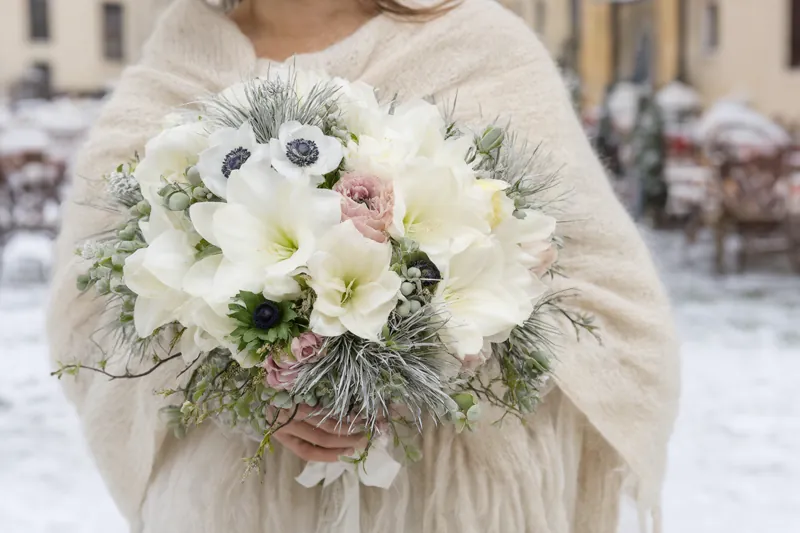
- Bouquet: loose, light, with stems of different lengths. Keep it in water until the last moment.
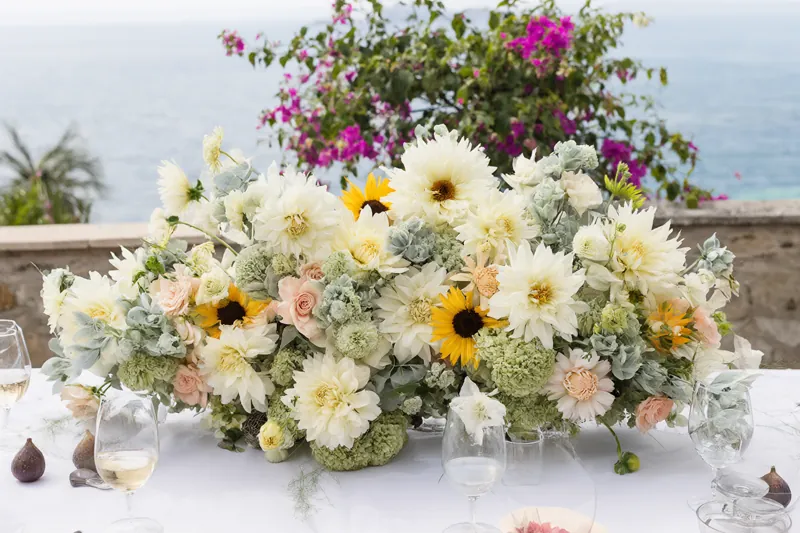
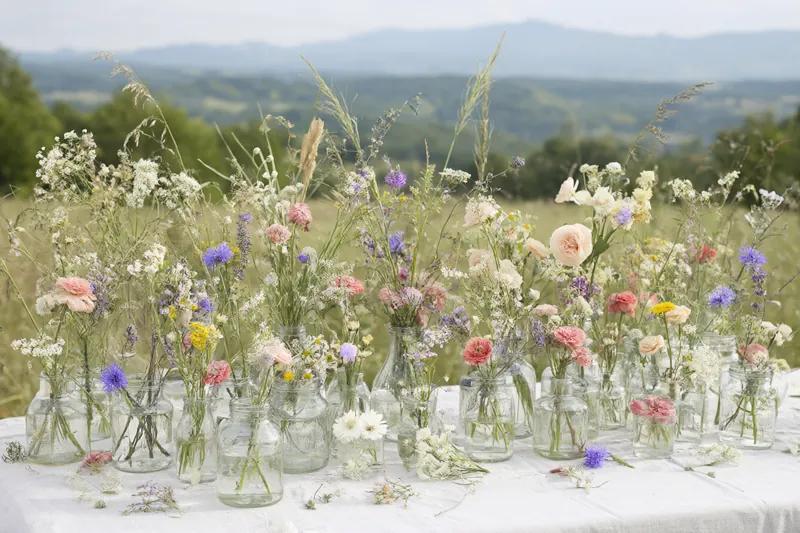
- Centrepieces: small mismatched vases and bottles grouped on the table, or a low garland along a banquet table.
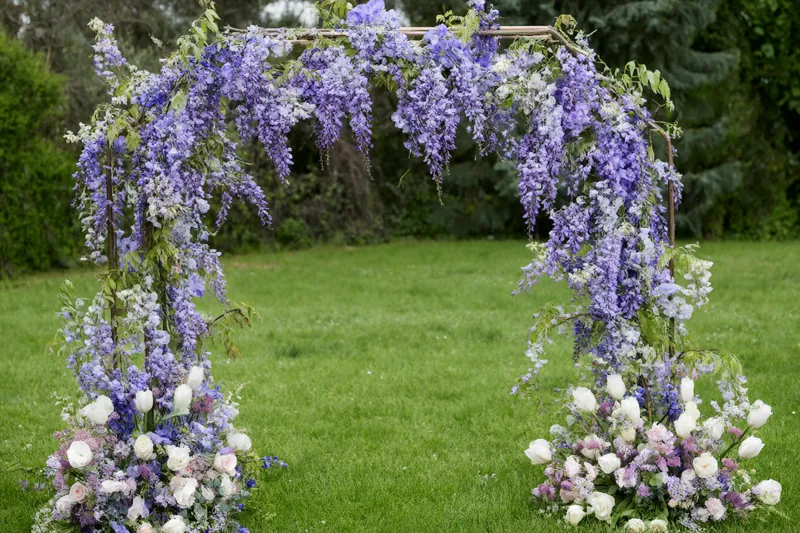
- Outdoor ceremony: arrangements on the ground along the aisle, as if the flowers were growing there.
- Church: they work on pews and altar, but in large spaces they can get lost. Better to concentrate them in a few spots.
Light flowers suffer in heat more than others: for outdoor summer ceremonies, choose shaded positions and ask for hardy varieties.
The style changes with the landscape
The natural look works best when it echoes what is around it. You do not need to copy the landscape, but a connection helps:
- in the hills and countryside, among vineyards and villages, wheat, cornflowers, chamomile and cosmos recall the fields;
- in the mountains, florists use cultivated flowers in fresh colours, grasses and branches, avoiding protected alpine flowers;
- by the sea and in the South, aromatic herbs, lavender, olive branches and pale grasses are added, as they cope better with wind and sun;
- at an elegant villa, the style can be more composed, with fewer varieties and a tighter palette.
Wind matters for every outdoor ceremony: light flowers move a lot and small vases tip over. They need heavy bases and discreet fixings.
Allergies and insects
Many flowers in this style belong to the daisy family, which can bother some people. Grasses can also be a problem for anyone with pollen allergies. Outdoors, nectar-rich flowers attract bees and other insects. We cover this in our guide to fragrant flowers and allergies.
Questions to ask your florist
- Where do the flowers you use for this style come from? Are they cultivated?
- Do you work with small local flower farms?
- Which varieties can you find on my date?
- How long will the arrangements last in the expected heat?
- How do you avoid a messy look?
- If a flower is not available, what will you replace it with?
- How do you secure small vases if it is windy during an outdoor ceremony?
- Can the arrangements be given to guests at the end of the party?
Final thoughts
Wildflowers are a style, not a harvest. The best result comes from carefully grown flowers arranged by expert hands, with respect for wild plants. If you want a real connection with the place, ask your florist whether they work with small farms near your venue: sometimes you can visit the fields a few months ahead, perhaps on a planning trip to Italy, see what will be in bloom on your date and choose colours and varieties together. It is also a way to understand how much work lies behind an effect that looks effortless.
Once you have a date and a venue, request a quote and ask your florist which seasonal flowers they will use for the natural look you want.
Sources
- Council Directive 92/43/EEC on the conservation of natural habitats and of wild fauna and flora: https://eur-lex.europa.eu/eli/dir/1992/43/oj