In short
- In the mountains the weather changes fast: temperature swings, afternoon thunderstorms in summer, frost in winter.
- Many alpine flowers are protected: they must not be picked in the wild. Florists use cultivated flowers with a similar effect.
- Chalets, mountain huts, alpine dairy farms and hotels offer very different venues, often with difficult access and small spaces.
- Cable cars and mountain roads have timetables and seasons: flower logistics are built around them.
This guide is for couples planning a Dolomites wedding or another mountain wedding: in the Dolomites across Trentino, South Tyrol (Alto Adige) and the Veneto, or elsewhere in the Italian Alps. You will find what altitude changes for flowers, the rules on protected species, the typical venues and the questions to ask your florist.
Why marry in the mountains
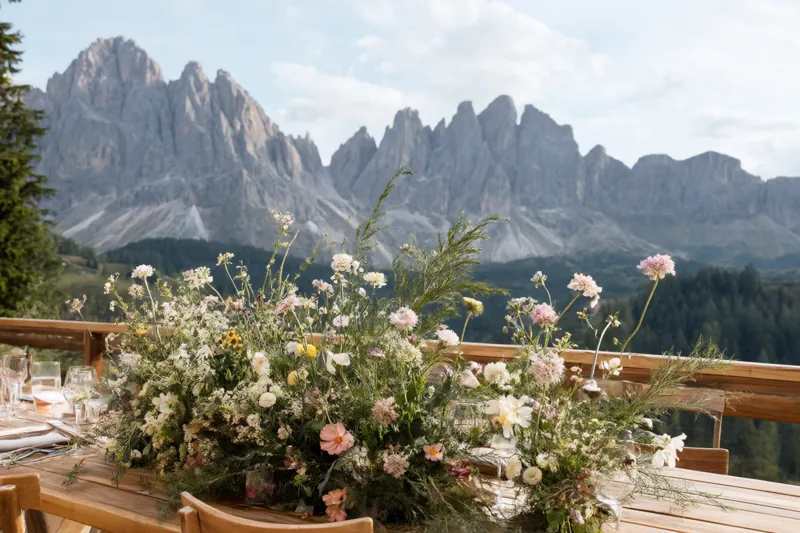
The Dolomites are a UNESCO World Heritage Site for their landscape. Rock walls, flowering meadows, forests of spruce and larch, alpine lakes. More and more couples, Italian and foreign, choose them for something different from the usual seaside or countryside wedding. Many arrive from German-speaking countries too: in South Tyrol both Italian and German are spoken.
In the mountains the landscape takes the lead. Flowers have to support it and cope with weather that can turn within a few hours. To find professionals in the area, start with our list of wedding florists in Trentino and the Dolomites.
Altitude changes everything
Every extra hundred metres of altitude lowers the temperature. A wedding in the valley and one at a hut near 2,000 metres are two very different events.
| Aspect | Valley floor | High altitude |
|---|---|---|
| Summer temperatures | Warm by day, cool at night | Cool by day, cold at night |
| Sun | Strong in the middle of the day | Very intense, even in cool air |
| Wind | Variable | Often stronger and steadier |
| Access | Normal roads | Mountain roads, gravel tracks, lifts |
| Usable season | Longer | Shorter, tied to the lifts |
For flowers, cool air is an advantage: many varieties last longer than in lowland heat. But high-altitude sun dries them out quickly. Arrangements with a water reserve, set up close to the ceremony time, remain the best choice.
Mountain weather
Summer
Summer is the most popular season. Days are long and the meadows are in flower. But thunderstorms often build in the afternoon, sometimes violent, with wind and hail. Many couples move the ceremony to late morning or keep a plan B ready.
Autumn
In late September and October the larches turn gold and the light is low and warm. Nights are cold, and the first snow can fall at altitude. Many lifts and huts close at the end of summer: check the dates.
Winter
A wedding in the snow is possible in hotels and chalets with road access. The main problem for flowers is frost: a few minutes outdoors below zero can ruin an arrangement. You need sheltered transport, indoor set-up, and bouquets taken outside only for photos. See also our guide to winter wedding flowers.
Spring
From April to June there can still be snow at altitude while the valleys are in spring. Many places close between the winter and summer seasons. It is the hardest period to organise.
In every season you need an indoor plan B. Our guide to a rain plan and marquees explains how to prepare flowers that can be moved.
Alpine flowers: what is allowed and what is not
Edelweiss, gentians, mountain lilies, wild orchids: these are the flowers many people picture for a wedding at altitude. But many alpine species are protected by regional and provincial law. Picking them in the wild is banned or tightly limited, with fines. Rules differ from province to province and can also cover mosses, lichens and other woodland plants.
What to do:
- pick nothing along trails and meadows, not even "just a few flowers";
- ask your florist for cultivated flowers with the same look, such as small white blooms, thistles, yarrow, ornamental grasses;
- consider preserved or dried flowers, for buttonholes and small details;
- use woodland greenery bought from legal suppliers: fir, mountain pine, larch, pine cones.
To find out what is protected where you are marrying, ask the relevant provincial or regional office, or the park authority if the venue is in a protected area. For a wild look with cultivated flowers, read our guide to wildflower-style wedding flowers.
Mountain venues
| Venue | Features | What it asks of the flowers |
|---|---|---|
| Alpine hotel | Large rooms, panoramic terraces, spa | Hotel rules, access times |
| Chalet (baita) | Wood, fireplace, cosy spaces | Warm-toned designs, care with flames and heat |
| Alpine dairy farm (malga) | Pastures, converted barns, local food | Rustic decor, gravel roads |
| Mountain hut (rifugio) | Open views, small spaces, reached on foot or by cable car | Light materials, few pieces, tight timings |
| Mountain chapel | Small, often isolated | A few arrangements, the priest's rules |
| Alpine lakeshore | Water, woods, reflected light | Permits, wind, no vehicle access |
Wood and stone suit warm-toned flowers or, at the other end, very simple whites and greens. In chalets with a fireplace, keep flowers away from heat sources: they wilt fast.
Logistics: lifts, roads and transport
In the mountains kilometres matter little. Height gain, roads and timetables matter more.
- Cable cars and chairlifts have opening hours and seasons. Carrying materials must be agreed with the lift operator.
- Some mountain roads are tolled, restricted or closed at certain hours. Check with the local town hall (Comune).
- Dairy farms and huts are often reached by jeep or 4x4: arrangements must be sturdy and well secured.
- In winter, suppliers' vans also need snow tyres or chains.
All this adds set-up time and people. Ask for transport and timings to be written into the quote.
If you are coming from abroad
The Dolomites can be reached from several airports in northern Italy and also from Austria. Guests will need shuttles and clear directions. Many foreign couples plan their flowers entirely from home. In that case it matters even more to see photos of real mountain weddings in your chosen season. Read our guide on planning your flowers from abroad.
Questions to ask your florist
- Have you worked at altitude, or at this venue?
- Which flowers cope with high-altitude sun and cold?
- How will you replace protected alpine flowers?
- How do you carry flowers on a cable car or along gravel roads?
- What happens if there is a storm or snow?
- In winter, how do you protect flowers from frost?
- Are travel, accommodation and special transport included?
- Who handles permits for roads or lifts?
To sum up
A mountain wedding needs hardy flowers, respect for nature and precise logistics. Do not pick protected flowers, choose your season with lifts and weather in mind, and work with someone who knows the mountains. For a wider view, see our list of florists for destination weddings in Italy.
Once you have a date and a venue, request a quote and include the altitude and how the venue is reached.
Sources
- UNESCO, The Dolomites: whc.unesco.org/en/list/1237