In short
- The table is a three-way job: florist, caterer and venue must all work from the same plan.
- A centrepiece must leave a clear line of sight between guests and room for service.
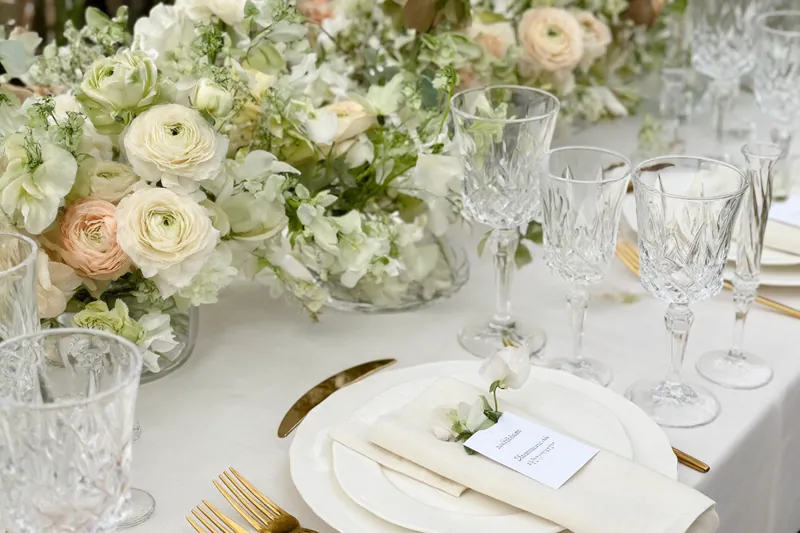
- Linens, plates and glasses are the colour base that the flowers build on.
- Ask for a table mock-up, or at least the real measurements of the place settings.
The table is where guests spend the most time. It is also where flowers, plates, glasses and waiters all compete for the same space, so a wedding table setting has to be planned as a whole. This guide is for anyone who wants a table that looks good and is comfortable too: couples, a company hosting a dinner, or whoever has to get suppliers talking to each other. If you are still choosing who will do the flowers, look at the wedding florists and ask for photos of fully laid tables, not just arrangements.
Who brings what to the table
Before talking about style, it helps to clarify roles. At most events in Italy, the table usually breaks down like this:
| Item | Usually supplied by | Coordinate with |
|---|---|---|
| Tables and chairs | Venue or hire company | Florist, for shape and size |
| Tablecloths, runners, napkins | Caterer, venue or hire company | Florist, for colours |
| Plates, cutlery, glasses | Caterer or venue | Florist, for space |
| Charger plates | Caterer or hire company | Florist, for style |
| Centrepieces and flowers | Florist | Caterer, for footprint and timing |
| Candles and holders | Florist or venue | Venue, for flame rules |
| Place cards and menus | Stationer, designer or florist | Everyone, for the set-up order |
These are habits, not rules. Some florists also offer linens and chargers, others work with a hire company they trust. For the bigger picture, read the guide on getting flowers, catering and venue to work together.
Room for service
A dinner with several courses and several wines puts a lot of glasses, cutlery and side plates on the table. Italian wedding dinners are often long, with a separate wine for different courses. If the flowers take up too much space, waiters have to move them or struggle to serve.
Before designing the centrepieces, ask the caterer:
- how many glasses per place there will be (water, white, red, sparkling);
- whether there is a bread plate, butter or olive oil;
- whether bottles stay on the table or waiters pour;
- how service works: plated, buffet, silver service, or platters on the table.
With "family style" service, where sharing platters go in the middle, the space for flowers shrinks a lot. In that case low, narrow arrangements, small scattered vases or flowers along the table edge work best.
Line of sight between guests
The practical rule is simple: people sitting opposite each other must be able to see and talk. There are two solutions.
- Low arrangements, kept below eye level.
- Tall, slim arrangements, on stands or candelabras, with the flowers well above head height and a narrow stem in between.
The middle ground, a wide arrangement at mid-height, is the one that gets in the way most. For ideas on shapes and heights for every type of table, read the guide to wedding centrepieces.
Round tables and long tables
| Table | What works | Watch out for |
|---|---|---|
| Round | One arrangement in the middle, low or on a stand | Diameter: a narrow table leaves little room |
| Long banquet (imperial) | A continuous garland, vases in a row, candles | Leave gaps for bottles and platters |
| Square | One central arrangement or four small vases | Proportion to the sides |
| Couple's table | A front arrangement that falls towards the floor | Do not hide the couple in photos |
On long tables, the greenery garland is very popular, but it also takes up the most space. Work out with the caterer where the middle stays free for bread and bottles.
Tablecloths and colours
The tablecloth is the base for everything. It completely changes how you see the flowers.
- White or ivory: neutral, makes every colour stand out, works almost anywhere.
- Natural or raw linen: warm and rustic, suits vineyards, masserie (Apulian farmhouses) and the countryside.
- Solid colours (sage, terracotta, blue): add character but limit the flower palette.
- Bare table: wood or stone on show, with a runner or nothing at all, if the table is beautiful and the venue allows it.
Bring the florist a fabric sample or a photo taken in daylight. Colours on screen are misleading. To build the full palette, read the guide to flower colour palettes.
Glassware, plates and chargers
Coloured glasses, gold chargers or patterned plates are as much part of the design as the flowers. If you choose amber glassware, white flowers will look warmer. If you choose metal chargers, candlelight reflects off them and changes the evening effect.
Ask the caterer what they have in stock and send photos to the florist. A combination decided together is better than a surprise on the morning of the event.
Candles on the table
Candles complete the flowers, especially in the evening. But the venue makes the rules. Some historic villas ban open flames, others require candles inside closed glass, others accept only LED candles. Always ask first and get the answer in writing.
Flowers and food on the same table
Flowers sit a few centimetres from the plate. So:
- avoid flowers that shed a lot of pollen or petals;
- keep very fragrant flowers off the dining tables, where they compete with the food;
- ask that flowers touching tableware be untreated or kept separate on a base;
- if you want flowers on the plates, the caterer chooses and prepares them.
For details, read the guide to flowers near food and edible flowers.
The set-up order
Who goes first: the place settings or the flowers? There are two ways:
- Flowers first, then place settings. The florist places the centrepieces and the caterer lays the table around them. This works if the florist knows exactly how much room to leave.
- Place settings first, then flowers. The caterer lays the table and the florist finishes it. It is safer for space, but the two teams need to be in the room together or in a tight sequence.
Agree on this beforehand, with times in writing.
Tables for corporate events
For a company dinner the rules are the same, with a few extra points: colours linked to the brand, understated arrangements that do not distract from speeches, and often very tight set-up times between one event and the next in the same room.
The table mock-up
The best way to avoid mistakes is to see a real table, fully laid, with a sample centrepiece. Some florists include this, others charge for it. If you are planning from abroad and cannot attend, ask for photos or a video call. At the very least, ask for:
- a photo of a similar table they have already done;
- the dimensions of the centrepiece (base and height);
- a simulation using the caterer's place-setting measurements.
Questions to ask the florist and the caterer
- How wide is the usable table once it is laid?
- How many glasses per place will we have?
- Who supplies tablecloths and napkins? In which colours?
- Does the centrepiece go on before or after the place settings?
- Will waiters have to move the flowers during service?
- Does the venue allow candles? Which kind?
- Is a table mock-up included? At what cost?
To wrap up
A beautiful table comes from a conversation, not an inspiration photo. Put your florist and caterer in touch, table plan in hand, and ask both to confirm sizes and timings. If the reception is in a garden or on a terrace, also read the guide to lighting and flowers.
When you know your table count and venue, ask for a quote and ask what the table design includes.