In short
- Set-up time depends on spaces, access and structures: ask for an estimate after the site visit.
- The florist's timings must match those of the venue, church and caterer.
- Reusing ceremony flowers needs dedicated people and time: put it in the running order.
- Breakdown and the return of hire items are part of the job: decide when and how.
Behind every floral design there are hours of work guests never see: unloading, conditioning, placing, moving, taking down. If those timings are not planned, the wedding day becomes a race. This guide explains how wedding flower set-up and breakdown are organised, how flowers move between church and reception, and what happens to hire items at the end of the party.
The stages of the work
| Stage | When | What happens |
|---|---|---|
| Preparation | Days before | Flowers arrive, are conditioned and arranged in the studio |
| Transport | On the day or the evening before | Vans loaded, journey, unloading |
| Ceremony set-up | Hours before the ceremony | Altar, pews, entrance, arch |
| Personal flowers delivered | Before the couple get ready | Bouquet, buttonholes, corsages |
| Reception set-up | Alongside or after the ceremony | Centrepieces, top table, buffet, table plan display |
| Moves | After the ceremony | Reused arrangements taken to the reception |
| Breakdown | End of party or next day | Flowers, hire items and structures collected |
If you are still choosing a florist, ask each one how they handle these stages. You can start from our list of wedding florists in Italy.
What the timings depend on
There is no standard time. What counts:
- number of spaces: ceremony, drinks, dinner, after-dinner;
- number of tables and type of centrepiece;
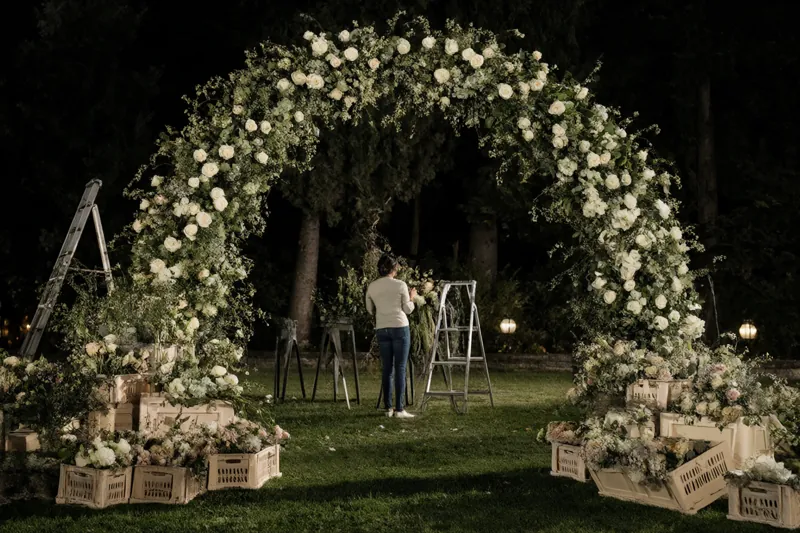
- structures: arches, hanging installations, columns, garlands;
- access: stairs, ZTL limited-traffic zones, islands, terraces, long walks on foot;
- team size: how many people the florist brings;
- weather: in the heat, flowers should be placed as late as possible.
After the site visit, ask for a written estimate. See our guide to the site visit with your florist.
Venue and church timings
The florist does not decide alone when to start. It depends on:
- the venue: what time it opens, whether set-up is possible the day before, whether there are other events;
- the church: services, other weddings on the same day, sacristy hours;
- the Comune (local council): civil ceremony rooms often run on tight slots;
- the caterer: when they lay the tables, because centrepieces usually go on after the tablecloths and before or after the place settings, as agreed.
Ask for all timings in writing and pass them on to the florist. To help the teams work well together, read our guide to coordinating flowers, catering and venue.
If two couples marry in the same church
It happens, especially in the busiest months. Some Italian parishes ask couples to agree to share the decorations, which saves both of them money. In other cases the first florist must clear everything before the second arrives. Ask the parish priest how it works.
On the day
From church to villa: who moves the flowers
Reusing ceremony arrangements at the reception is one of the most sensible budget choices. But someone has to:
- wait for the end of the ceremony, sometimes until the couple have left and the photos on the church steps are done;
- quickly remove the arrangements being reused, leaving the church tidy;
- load and transport them;
- put them back in place before guests arrive or during the drinks reception.
It works well when:
- the pieces are designed to travel: stable vases, compact arrangements;
- the distance between church and venue is reasonable;
- there is a dedicated person with nothing else to do at that moment;
- everything is in the running order of the wedding planner or coordinator.
The move is usually a line in the quote. Ask about it. For more ideas, read our guide on how to save on wedding flowers.
Setting up in the heat
In an Italian summer, flowers suffer within the first few hours. To limit the damage:
- set up as close as possible to the start of the event;
- use arrangements with a water reservoir;
- have a cool, shaded space to keep flowers before placing them;
- choose heat-tolerant flowers for outdoor spaces.
More in our guide to summer weddings and flowers that cope with heat.
Breakdown
Breakdown is as much part of the job as set-up. There are three common approaches:
| Approach | Pros | Cons |
|---|---|---|
| End of party, at night | Spaces cleared straight away, no risk to hire items | Higher cost, team needed late at night |
| The next day | Often cheaper, calmer | Needs the venue's permission and someone to open up |
| Mixed | Structures and valuable hire items taken at once, the rest later | Needs a precise agreement |
The choice depends mainly on the venue. Many villas and hotels have another event the next day and ask for everything to be cleared overnight. Ask before signing with the florist.
Special cases: historic centres, islands, busy churches
Some places need more time and more people:
- historic centres with ZTL zones and pedestrian streets: access permits and loading times are needed, and sometimes flowers are carried by hand for long stretches;
- islands and places reached by sea (Capri, the Aeolian Islands, villas on Lake Como reachable by boat): flowers travel by ferry or boat, with timetables to respect and the risk of delays in rough water;
- hill towns and terraces with stairs: every vase is carried by hand;
- churches with several services on the same day: the time for set-up may be very short.
In these cases, ask the florist how they organise it and whether the quote includes the extra people and hours. Traffic permits are issued by the Comune: florists who work often in the area already know how to get them.
Getting hire items back
Vases, stands, candelabra, arches and structures usually belong to the florist and must be returned. The most common problems:
- guests taking vases home along with the flowers;
- venue staff moving or stacking items without knowing whose they are;
- breakages during the party or the clear-up.
To avoid them:
- decide what guests can take: flowers yes, vases no, for example;
- tell the venue and the caterer;
- check in the contract who is liable for breakages and losses, and with what security deposit.
The clauses are explained in our guide to the wedding florist contract.
What is left afterwards
At the end of the party many flowers are still lovely. They can be given to guests, left with the venue or donated. Decide beforehand, because breakdown happens in a tight window. You will find ideas in our guide on what to do with your flowers after the wedding.
Questions to ask your florist
- How many people will you bring, and how long do you need to set up?
- Will you set up the day before, or only on the day?
- Who moves the flowers from the church to the reception, and what does it cost?
- Is breakdown at the end of the party or the next day? Does the cost change?
- What can guests take home?
- Who is responsible for hire items during the party?
- If the venue asks us to clear out earlier than planned, how will you manage?
To close
A well-organised set-up is invisible, and that is exactly the right result. To put everything in the calendar, use our wedding flower timeline. Once you have timings and a venue, request a quote, including the access times: the proposals will be more precise.