In short
- Flowers at a corporate event should speak the brand's language, by colour family rather than exact colour codes.
- Foyer, stage and tables have different needs: welcome, visibility of speakers, room for service.
- Timings are tight: night set-ups, conference centre hours, multi-day events that need maintenance.
- In the quote always ask about set-up, breakdown, hire items and what happens to the flowers afterwards.
A conference, the opening of a new office, a client dinner or the end-of-year party: at work too, corporate event flowers make the first impression. This guide is for people who organise corporate events in Italy (marketing teams, executive assistants, agencies, incentive and conference planners working from abroad) and need to know what to ask a florist, how to brief them on the brand and how to read timings and costs.
If you are already looking for professionals, start with our list of event florists in Italy: you will find those who work on conferences, gala dinners and trade fairs.
How it differs from a wedding
The craft is the same, the context is not. At a corporate event:
- more than one person decides: the organiser, whoever approves the budget, whoever looks after the brand;
- flowers serve the message: logo, stage, screens and speakers come first;
- spaces are technical: conference centres, hotels, showrooms, offices, with rules on access, hours and materials;
- invoicing and payment terms follow company procedures, often with a purchase order.
That is why it helps to name one contact person who talks to the florist and gathers internal approvals.
The brand in flowers: colour and style
Flowers do not have colour codes. An exact corporate red rarely exists in nature, and the same flower changes tone from one batch to the next. Three approaches work:
- Neutral base and accents: greenery, white or natural tones with a few flowers close to the brand colour.
- Style instead of colour: a minimal brand calls for minimal arrangements, a brand rooted in a place calls for Mediterranean greenery, citrus, olive.
- Colour in the materials: vases, ribbons, fabrics and lighting carry the exact colour, the flowers support it.
Send the florist your brand guidelines, or at least the logo, palette and a few photos of past events you liked. To understand how a palette is built, read our guide to flower colour palettes: it applies beyond weddings too.
The spaces: from foyer to stage
| Space | What is usually needed | Watch out for |
|---|---|---|
| Entrance and foyer | Large arrangements or plants, visible from a distance | Clear walkways, emergency exits, registration desk |
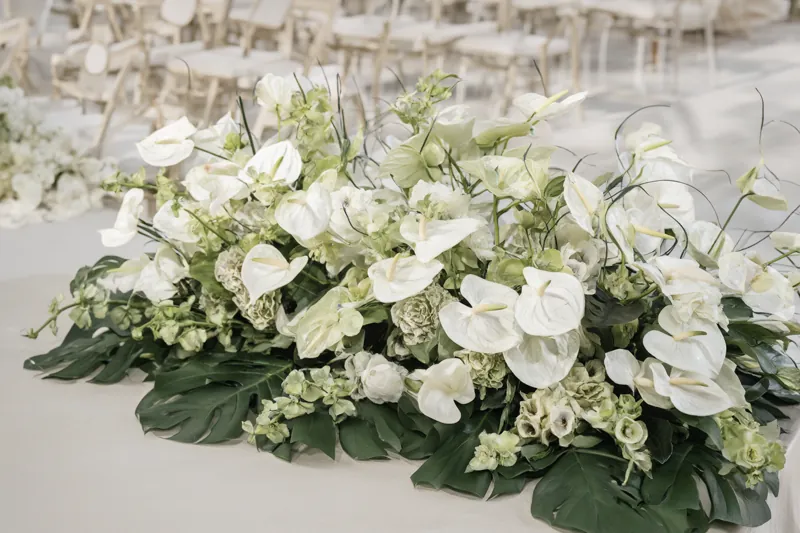
| Stage | Low, long arrangements along the edges or in front of the lectern | Do not hide speakers, screens, microphones or speakers |
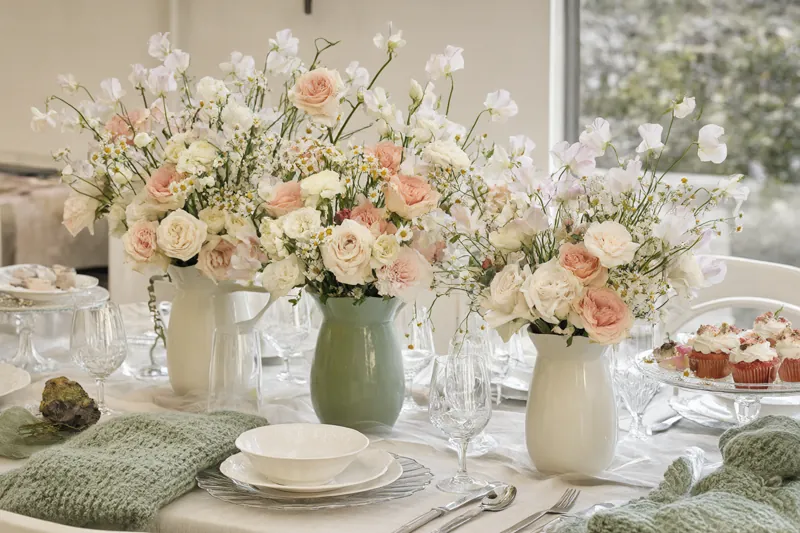
| Lunch or dinner tables | Low centrepieces, or tall and slender ones | Room for plates, glasses and materials |
| Networking and coffee break areas | Small arrangements, potted greenery | Flowers away from food, little pollen |
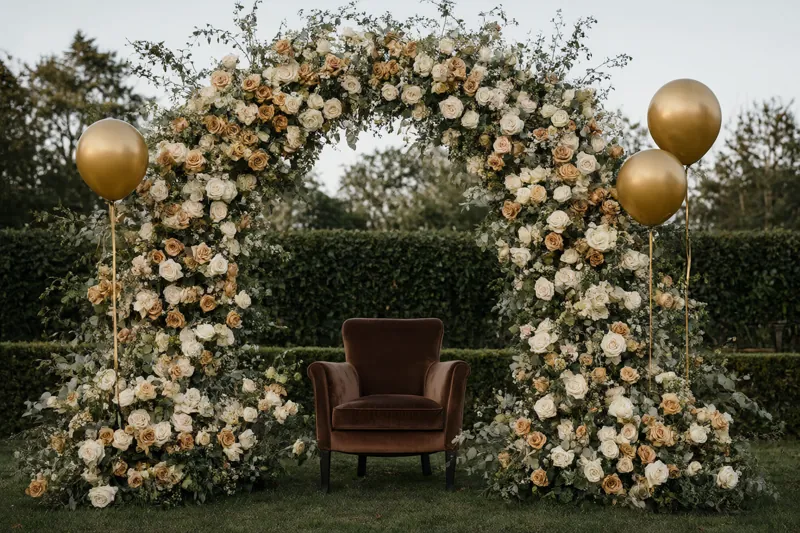
| Photo wall and press area | Green or floral panel with the logo | Lighting for photos, stability of the structure |
| Toilets and service areas | Small vases | Often forgotten, they make a difference |
The stage deserves a site visit
On stage, flowers are seen mostly on video and in photos. Ask your florist to talk to the audio and lighting team: stage lights are hot, can shift colours on camera and should light people, not arrangements. Floor arrangements must not get in the way of cables or of people going on and off stage.
Timings: tight set-ups and multi-day events
In hotels and conference centres rooms are often freed up just before the event. You may need to set up the evening before, overnight or in the early morning. Ask the venue:
- from what time the room is available and which goods entrance to use;
- whether badges, a list of staff names or registered vehicles are required;
- until what time breakdown is allowed and whether there is a storage area.
For a multi-day event the flowers have to last. Air conditioning dries arrangements out, stage lights warm them. Ask for a daily maintenance visit: water, removal of fallen petals, replacement of tired pieces. On long events potted plants and greenery last better than delicate flowers.
Safety and venue rules
Corporate venues have precise regulations. The most common concern:
- materials for structures: for panels, arches or hanging installations the venue may ask for fire-reaction certificates for the materials and a rigging plan;
- candles and naked flames: often banned or allowed only in closed containers; LED candles are the usual alternative;
- escape routes: no arrangements in front of emergency exits, fire extinguishers or signs;
- flowers near food: if the caterer serves a buffet or coffee break, agree on distances.
Rules change from venue to venue: always check them with the venue's technical manager. For installations above guests' heads, also read our guide to hanging floral installations.
What goes into the quote
There is no standard price: it depends on spaces, quantities, flowers chosen, structures and hours. Rather than a figure, it is worth understanding the items.
| Item | What it covers | Question to ask |
|---|---|---|
| Design | Proposal, mood board, any sample | Is the sample included or extra? |
| Flowers and greenery | Raw material | What happens if a flower is unavailable? |
| Hire items | Vases, stands, structures, plants | Deposit and cost of breakages |
| Labour | Preparation, set-up, breakdown | How many people and how many hours? |
| Out-of-hours work | Nights, public holidays, waiting time | Hourly rate beyond what was planned |
| Transport | Vehicles, loading and unloading | Goods access and distance from parking |
| Maintenance | Visits during the event | How many times a day? |
Ask for a quote that shows VAT (IVA in Italy) and uses the correct billing details, so your purchasing department does not send it back. To go through the items calmly, see our guide on how to read a florist's quote.
Sustainability: something companies ask for
More and more companies want events with less waste. With flowers this means concrete choices: seasonal flowers grown in Italy, no floral foam, hired plants, arrangements designed to be given away or donated at the end. You can write it into the brief as a requirement. Details are in our guide to sustainable floral design.
Questions to ask the florist
- Have you worked at this venue or at similar conference centres?
- How would you translate our brand colours into the flowers available in that period?
- Can you send a sample arrangement or a photo of one?
- Who talks to the audio, lighting and catering teams?
- How many people are needed for set-up and how long will it take?
- For a multi-day event, is daily maintenance included?
- Do the materials for structures have the certificates the venue may ask for?
- What happens to the flowers afterwards: gifts, donation, collection?
- How do you invoice, in which currency and with what payment terms?
- If we are briefing you from abroad, who on your team speaks English?
To sum up
A well flowered corporate event is noticed not for the flowers but for the atmosphere: a welcoming entrance, a clean stage, attractive and practical tables. Sending the florist a clear brief (dates, spaces, number of guests, colours, venue constraints) saves everyone time.
If the event is a formal evening, also read our guide to gala dinner flowers; if it is a trade fair, the one on flowers for stands and product launches. For high-profile events see our florists for high-end events. Once you have a date and venue, request a quote from several professionals with the same brief.