In short
- A hanging installation needs structure, anchor points and a weight calculation.
- Many historic venues do not allow drilling: you need freestanding structures or existing points.
- Working at height takes teams, equipment and time: build it into the schedule.
- It is one of the highest items in the flower budget: ask for a quote with items listed separately.
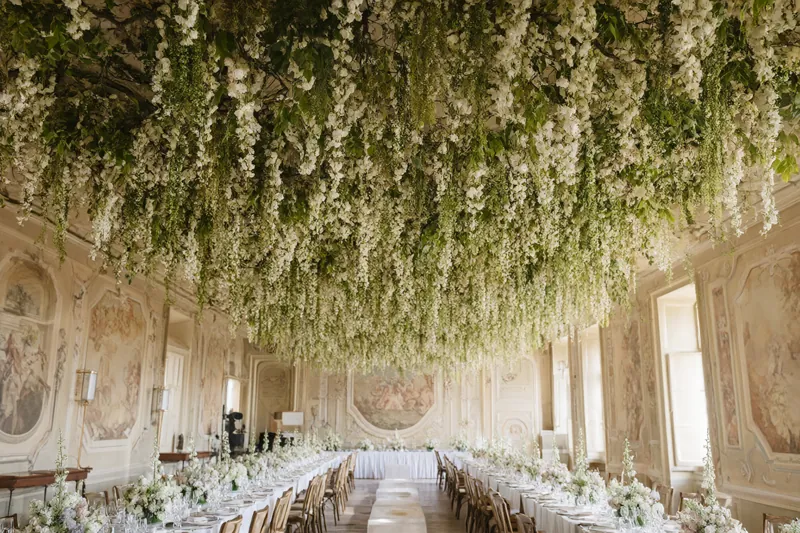
A ceiling of wisteria above the banquet table, a flower chandelier in the middle of the room, clouds of greenery over the dance floor. Hanging floral installations are among the most striking wedding set-ups. They are also among the most complex to build. This guide explains how they work, which permissions you need, what the risks are and how to read the quote.
What a hanging installation is
These are arrangements that sit above the guests' heads, hung from a structure or the ceiling. The most common are:
| Type | How it looks | Where it is used |
|---|---|---|
| Flower ceiling | Flowers and greenery covering part of the ceiling | Above a long banquet table, under pergolas |
| Floral chandelier | Round or hoop-shaped arrangement, often with lights | In the centre of rooms and marquees |
| Cloud | A soft volume of fresh or dried flowers | Over the dance floor, top table, entrance |
| Cascade | Flowers falling at different heights | Staircases, entrances, ceremony |
| Hanging hoop | Metal or wooden ring with flowers | Top table, photo corner |
Installations are typical work for the professionals on our page of floral installations and large-scale designs. Not every florist builds them: ask to see similar projects they have already done.
The structure: what holds the flowers up
A hanging installation always has three layers:
- Anchor: the fixed point everything hangs from (beams, existing hooks, truss, floor structure).
- Frame: the base the flowers are fixed to (mesh, grids, metal hoops, branches).
- Floral material: fresh flowers, greenery, dried or preserved flowers, sometimes lights.
More fresh material and more water mean more weight. The florist must estimate the total weight and check that the anchor can take it.
Freestanding structures
When nothing can be hung from the ceiling, floor-based structures are used: trusses (the aluminium frames common at events), gateways, poles, wooden frames. They are more flexible, but they take up floor space and need to fit into the room plan.
Safety: who decides and what to check
A heavy object above your guests' heads is a safety matter. In practice:
- the venue decides whether and where things can be hung, and often has its own technician or trusted supplier;
- the anchor points must be suitable for the weight, with safety margins;
- work at height (ladders, scaffold towers, lifts) follows specific safety rules for workers;
- lights and cables built into the flowers must be suitable and installed by someone qualified;
- dried materials are flammable: no open flames nearby.
Ask your florist how they work at height, whether they own their equipment or rent it, and whether they hold suitable public liability insurance. Check the rules with the venue and, if needed, with its safety manager.
Venue permissions
The rules vary a great deal:
- Historic houses and listed palazzi: they often forbid holes, nails and hooks in frescoed ceilings or old beams. The work is done with freestanding structures or existing points.
- Churches: hanging installations are rare and must be agreed with the parish priest.
- Hotels and conference centres: they often have rigging points and technical staff, with their own rules and costs.
- Marquees: they may have hooks designed for lights and decorations, with a stated maximum load. Read our guide to marquees and a plan B.
- Outdoor spaces: pergolas and trees are not always able to take weight. Wind is a factor.
Get the rules in writing before you approve the design.
Set-up and breakdown times
A flower ceiling takes hours of work, sometimes days. You need to know:
- from when the room is available for set-up;
- whether set-up can start the day before, and who looks after the flowers overnight;
- what time the party ends and how long there is to take everything down;
- whether overnight breakdown carries extra costs.
Coordinate everything with the venue and the caterer. Read our guide to set-up and breakdown.
Flowers that work, and flowers to avoid
Hanging flowers do not have the water of a vase. Florists often choose:
- hardy greenery: ruscus, eucalyptus, ivy, smilax;
- sturdy flowers: orchids, carnations, some roses, hanging amaranthus;
- artificial or preserved wisteria, where you want the wisteria look out of season;
- dried and preserved flowers, which are light and long-lasting.
Hydrangeas and peonies are harder, because they drink a lot and wilt fast without water. They can be used with water tubes or water systems, which add weight. To learn more, read our guide to dried and preserved flowers.
What goes into the quote
We do not give figures, because every installation is different. These are the items that make up the cost:
| Item | What it covers |
|---|---|
| Design | Site visit, measurements, drawing or rendering, weight calculation |
| Structure | Frames, trusses, rigging, rented or custom-built |
| Floral material | Flowers, greenery, dried and preserved material |
| Built-in lighting | Bulbs, cables, power, technician |
| Equipment | Scaffold towers, lifts, ladders |
| Labour | A team for work at height, often several people |
| Breakdown | Often overnight, possibly at a higher rate |
| Transport | Vans, several trips for large structures |
Remember that Italian quotes may show prices with or without VAT (called IVA in Italy): always check which. To read a quote properly, use our guide on how to read a florist's quote.
Simpler alternatives with a similar effect
If the venue does not allow anything to be hung, or the budget cannot stretch to a full ceiling, there are in-between solutions:
- tall candelabra topped with flowers, which bring the flowers up to eye level and above;
- raised stands and vertical arrangements on the banquet table;
- floor-standing arches and gateways, which move from the ceremony to the reception;
- freestanding flower walls, used as a backdrop for the top table or the photo corner;
- garlands hung from existing pergolas or beams, if the venue allows it.
Concentrating the effect in a single spot, for example above the top table, is often enough to give the whole room character.
Questions to ask your florist
- Have you built similar hanging installations? Can I see photos of the set-up?
- How much will the installation weigh, and how do you check the anchoring?
- Do you use your own structures or rented ones? Who installs them?
- How do you work at height? Do you have public liability insurance?
- How long do set-up and breakdown take?
- Which flowers would you use so they do not wilt?
- Do you handle the built-in lighting yourself or through a technician?
To sum up
A hanging installation can transform a room, but it needs a design, permissions and an experienced team. Start from the venue's rules, then leave the florist to work out weight, timings and materials. For other large-scale designs, look at our page on high-end events.
Once you have a venue and its rules, request a quote with structure, flowers, set-up and breakdown listed separately.