In short
- At a gala dinner flowers should look good but not get in the way of conversation: low, or very tall and slender.
- Long tables call for garlands and repeated arrangements; round tables for a central focal point.
- The evening runs on artificial light and candles: choose colours for night, not daylight.
- Sponsors, auctions and donations change the design: tell the florist from the start.
A gala dinner is a long, seated evening with many guests in the same room. The flowers are in everyone's view for hours, in photos and in videos. This guide to gala dinner flowers is for people organising an elegant corporate dinner, a fundraising event or an association's evening in Italy, perhaps in a historic villa or palazzo, and who want to plan the flowers without waste.
If you are looking for professionals used to this kind of evening, see our florists for high-end events and those specialising in corporate events and galas.
Start from the floor plan
The table layout comes before the flowers. Ask the venue or agency for a floor plan showing:
- shape and size of the tables (round, rectangular, long banquet tables);
- number of guests per table;
- position of stage, lectern, screens and auction desk;
- waiters' routes and emergency exits.
With the plan, the florist can work out how many arrangements are needed, what size, and where they will be seen best. Without it the quote remains approximate.
Long tables and round tables
| Table | Common solutions | What to check |
|---|---|---|
| Long banquet table | Greenery garland with flowers, repeated low arrangements, candles at intervals | Room for bottles and serving dishes, visual continuity along the whole table |
| Round | One low central arrangement, or a tall one on a slender stem | Line of sight between guests seated opposite |
| Top table | Front-facing arrangement, fuller | Must not hide the people seated there or the lectern behind |
| Mixed tables | Same style in different sizes | Consistent colours and materials |
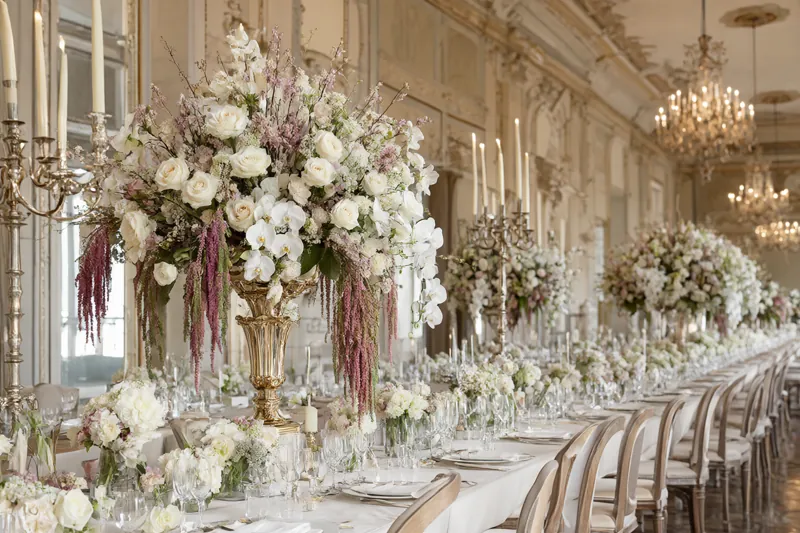
On a long banquet table a garland is the most common choice: greenery (such as olive, ruscus or eucalyptus) with flowers set at intervals. It looks impressive but takes up room: check it against the caterer's table setting.
Heights: the conversation rule
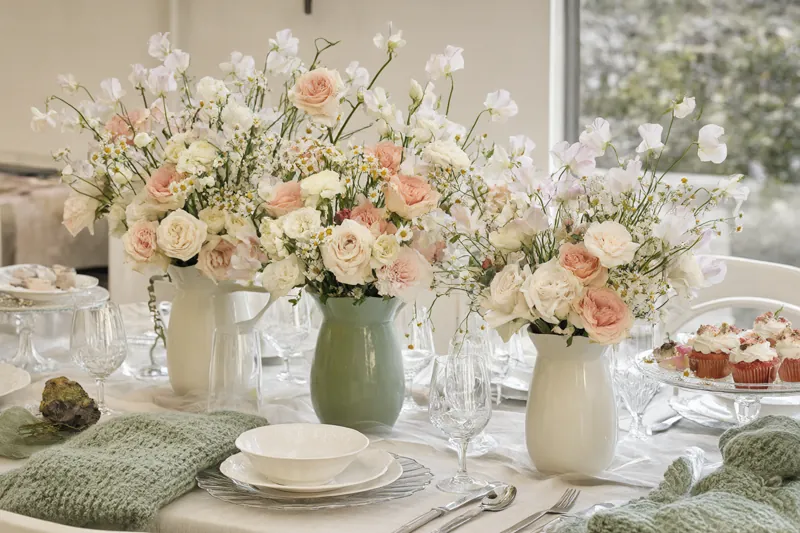
The practical rule is simple. Arrangements should stay below the eye line of seated guests or above their heads, on a slim stand that leaves the view clear. The middle zone, at eye level, splits the table in two.
Alternating tables with low and tall arrangements gives the room movement, especially in spaces with high ceilings, which are common in Italian historic venues. For ideas on shape, much of what is done at weddings applies: our guide to wedding centrepieces has useful examples.
Evening light and candles
A gala almost always takes place in the evening, under artificial light. This matters:
- dark colours (burgundy, deep purple) get lost at night and need pale accents or dedicated lighting;
- white and pastels reflect candlelight and stay readable;
- stage lighting can alter colours in photos: the florist should discuss it with whoever handles the lighting.
Candles make half the atmosphere. But the decision belongs to the venue: many rooms allow flames only in glass containers closed at the top, others ban them. LED candles are a good alternative with no restrictions. More in our guides to flowers and candles and lighting and flowers.
Sponsors, auctions and charity
Fundraising evenings have extra needs.
Sponsors
Sponsors want visibility. Flowers can support it, not replace it. What works:
- a panel at the entrance with greenery or flowers and printed logos;
- menus or place cards with the logo next to a small arrangement;
- a lead colour agreed with the main sponsor.
Logos pushed into centrepieces can look improvised. If a sponsor is providing the flowers, agree how they should be credited.
Auctions and centrepieces to take home
At some evenings centrepieces are auctioned or given to each table. If so:
- vases must be owned, not hired, or their cost must be budgeted;
- arrangements must survive the journey in a car;
- someone needs to hand them over in the right order at the end of the night.
Keeping costs down without losing impact
At a charity evening every euro saved goes to the cause. You can ask for: plenty of greenery and seasonal flowers, arrangements concentrated where they are seen (entrance, stage, top table), reuse of flowers from another event the same day if the venue allows. Some florists agree to act partly as an in-kind sponsor: ask clearly, without taking it for granted.
Set-up and breakdown times
Galas are often held in rooms that host other events during the day. Ask the venue when the room will be free and coordinate with the caterer: usually tables and linen go in first, then flowers, then the table setting. Breakdown may be in the small hours: check whether the quote covers that time or whether flowers can be collected the next day. For details, read our guide to set-up and breakdown.
What it costs, in practice
There are no fixed rates. The cost depends on the number of tables, type of arrangement, flowers chosen, structures, candles, hours and transport. A gala with many tables is driven mainly by quantity: a small difference on one centrepiece is multiplied across every table. That is why it is worth seeing a sample arrangement before confirming. Quotes in euros may be shown with or without VAT (IVA): check which.
The standing reception before dinner
Many galas start with a standing drinks reception, in a foyer or a garden. Flowers work differently here: guests move around, look down from above, gather around high tables. Large arrangements in a few spots (entrance, bar, staircase), small vases on high tables and greenery along the routes work well. On the bar and near the food, the usual rules apply: no pollen, no falling petals, distance from serving trays.
Questions to ask the florist
- Have you worked in this room before? Do you know its rules on candles and structures?
- How many arrangements do you suggest, and at what height, table by table?
- Can you prepare a sample arrangement on a fully laid table?
- How will the colours look in evening light?
- How will you handle sponsor logos and materials?
- Are the vases hired, or can they be given away with the flowers?
- Who sets up, at what time, and who clears at the end of the night?
- What happens to the leftover flowers?
What to send the florist with your enquiry
A complete enquiry saves a round of emails and leads to comparable quotes. Always include: date and times of the evening, name and address of the venue, number of guests and tables with their shape, any top table, theme or colours, sponsors and any auction, the room's rules on candles and structures, an indicative budget. If you have photos of previous evenings in the same room, attach them: they show light, ceilings and space better than any description.
To sum up
A successful gala dinner has flowers that stand out at the entrance and then let the guests talk. The floor plan, the venue's rules and the goals of the evening are the three things to give the florist from the first contact.
If the dinner is part of a larger event, read our guide to corporate event flowers. Once you have a date, room and number of tables, request a quote from several florists with the same information.