In short
- The choices that matter most are seasonal flowers grown close by.
- Foam-free design: no floral foam, which is plastic and does not break down.
- Reusing flowers from the ceremony at the reception cuts waste and the number of arrangements.
- Plan the afterwards in advance: gifts, donations, compost, hired vases and structures.
More and more couples want sustainable wedding flowers, as part of a wedding that is kinder to the environment. Flowers are one of the areas where your choices show most: where they come from, how they are arranged, what happens the day after. This guide explains in practical terms what makes wedding flowers sustainable, what to ask your florist and how to avoid vague promises.
What "sustainable" really means for flowers
There is no single label. In practice you look at four things:
| Aspect | Question to ask | More careful choice |
|---|---|---|
| Origin | Where do the flowers come from? | Grown in Italy or nearby |
| Season | Are they flowers of the month? | Seasonal varieties, no forcing |
| Technique | How are they held in place? | No floral foam, reusable materials |
| End of life | What happens afterwards? | Reuse, gifts, compost, hire |
No design is perfect on all four. The aim is to make better choices wherever you can. To find florists who work this way, see our page of sustainable flower designers.
Italian-grown and seasonal flowers
Italy has a long flower-growing tradition. There are important growing areas in Liguria (the Riviera dei Fiori, around Sanremo), Campania, Tuscany, Puglia, Sicily and Lazio. Many flowers, however, also come from abroad, through the large northern European markets or from outside Europe.
Choosing seasonal flowers is the simplest way to increase the share of local flowers:
- in spring: ranunculus, anemones, tulips, wildflowers, flowering branches;
- in summer: roses, hydrangeas, lavender, sunflowers, agapanthus;
- in autumn: dahlias, roses, berries, leaves;
- in winter: hellebores, anemones, branches, greenery and conifers.
This is indicative. For a fuller calendar, read our guide to seasonal flowers in Italy, and to see how florists buy their stock, the one on Italian flower markets.
No floral foam: going foam-free
Floral foam is the green block that is soaked in water and used to hold stems. It is convenient, but it is a plastic material: it crumbles into tiny fragments, does not break down and ends up in general waste or, worse, in drains.
The alternatives florists use:
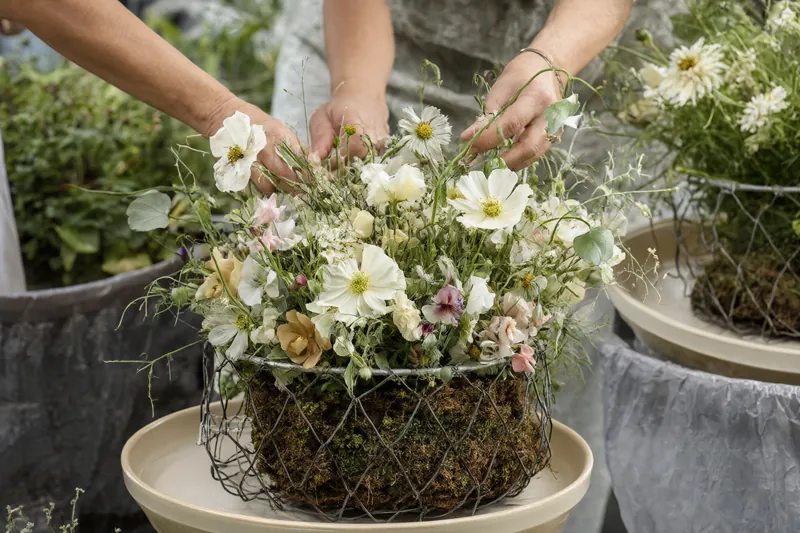
- chicken wire shaped inside vases or structures, reusable;
- pin frogs (kenzan, the Japanese spiked holder) at the bottom of low vases;
- vases and water tubes;
- moss and woven branches;
- reusable wooden or metal structures for arches and installations.
Some arrangements are harder without foam, for example very precise or angled shapes. Ask your florist which techniques they use and what changes in the result.
Reuse: one arrangement, two moments
Reuse cuts the number of arrangements and therefore flowers, transport and waste.
- The altar or civil ceremony flowers become arrangements for the buffet or the top table.
- The ceremony arch moves behind the top table or to the photo corner.
- The bridesmaids' bouquets go into vases on the top table.
- The table arrangements become gifts for guests.
Reuse needs people and time to move everything: build it into the schedule and the quote. Read our guide on coordinating flowers, catering and venue.
Hiring vases and structures
Vases, candlesticks, arches, columns and stands can be hired instead of bought. It is practical and more sustainable, because the same items serve many events. Many florists have their own stock. Read more in our guide to hiring vases and floral structures.
Potted plants instead of cut flowers
For some set-ups, especially corporate or informal ones, you can use potted plants: herbs, small citrus trees, olive trees, ferns. After the event they are given away or replanted. Watch out for the rules on moving some live plants: ask your florist where they come from.
Transport and logistics
Travel counts too. A florist who works near the venue drives fewer miles, knows local growers and can make site visits without high costs. For a destination wedding this is not always possible, but it is worth asking:
- where the studio is based and how many trips set-up and breakdown take;
- whether flowers and structures arrive together or in separate deliveries;
- whether transport can be shared with other suppliers.
To find professionals near your venue, use find your florist.
The sustainable bouquet
The bouquet can follow the same choices: seasonal flowers, tied with string or cotton ribbon instead of synthetic ribbon, no foam in the handle, and flowers that can be dried afterwards. If you want to keep it, choose varieties that dry well, such as roses, lavender, eucalyptus and statice. Read our guide on how to preserve your bridal bouquet.
Telling your guests
If you have made careful choices, you can say so discreetly: a line on the menu or the seating plan ("today's flowers are seasonal and will be donated"), a card on the arrangements guests can take home. Avoid claims you cannot check, such as "zero impact".
What to do with the flowers after the wedding
Decide beforehand, not at midnight:
- give arrangements to guests;
- take them to a church, a care home or a hospital, only if they accept and with arrangements made in advance;
- reuse them for a brunch or lunch the next day;
- dry the bouquet and some of the flowers;
- compost the plant material, separated from ribbons, wire and plastic.
Read our guide on what to do with the flowers after the wedding.
Beware of surface-level "green"
Some choices look sustainable but are not entirely so:
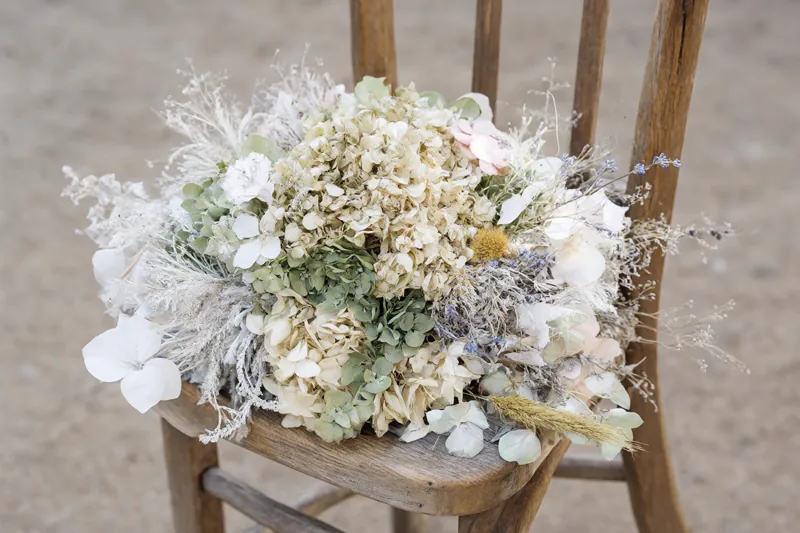
- dried flowers may be imported, bleached and dyed, and therefore not compostable;
- preserved flowers are chemically treated;
- "biodegradable" confetti is not always accepted by venues;
- a toss of fresh petals is better than plastic, but still needs cleaning up.
For dried flowers, read our guide to dried and preserved flowers.
Common mistakes
- Asking for out-of-season flowers and a sustainable design at the same time: the two clash.
- Forgetting the afterwards: without a plan, the flowers end up in the bin at the end of the night.
- Confusing dried with natural: many dried flowers are dyed and imported.
- Multiplying arrangements instead of reusing them between ceremony and dinner.
Questions to ask your florist
- Where do the flowers you propose come from? How many are Italian-grown?
- Do you work without floral foam? With which techniques?
- Which arrangements can be reused from the ceremony at the reception?
- Are the vases and structures hired?
- How do you handle the material after the event: compost, waste, recovery?
- Which flowers in my month are grown near the venue?
To sum up
A sustainable design is not a poor design. It is a design that pays more attention to season, origin, technique and end of life. The most effective choices are also simple: flowers of the month, no foam, reuse and hire. To see how this fits into the different styles, read our guide to wedding flower styles.
Once you have a date and venue, request a quote and write in your request that you want a foam-free design with seasonal flowers.