In short
- At a fair, set-up time is short and regulated: hours, access and badges are set by the exhibition centre.
- Over several days plants and greenery last better; cut flowers belong in key spots and need daily care.
- Hiring plants and green walls avoids buying and throwing away.
- At a product launch the flowers should serve the product, not hide it.
A trade fair stand has a few seconds to stop people walking past. Trade show booth flowers and plants help: they make the space welcoming, add colour and create a spot people want to photograph. This guide is for companies and stand builders who want to use flowers and plants at a fair, in a showroom or at a launch event in Italy, without problems over timing and freshness. It is also useful if you are exhibiting at an Italian fair from abroad and need local suppliers.
If you are looking for professionals used to these timeframes, see our florists for corporate events and trade fairs.
Fair, showroom, launch: three different situations
| Situation | Typical duration | What matters most |
|---|---|---|
| Trade fair stand | Several days | Durability, maintenance, exhibition centre rules |
| Product launch at a venue | A few hours | Impact in photos and video, stage, press area |
| Showroom or pop-up store | Weeks | Potted plants, regular replacements, subscription |
For spaces that stay open a long time, the subscription model applies: we cover it in our guide to flowers for hotels, restaurants and offices.
The fair's regulations come first
Every exhibition centre publishes technical regulations for exhibitors and stand builders. They usually set:
- days and hours for set-up and breakdown, often very tight;
- vehicle access and loading and unloading areas;
- named badges or passes for everyone working on set-up;
- rules on materials: fire reaction of panels and structures, maximum heights, rigging;
- bans: naked flames almost always, sometimes open water or loose soil.
Send the regulations to the florist together with the stand plan. A green wall or an installation over three metres high may need drawings or declarations that must be prepared in advance. Rules change from fair to fair: check them with the organisers, do not assume. If your team is abroad, ask whether the regulations are available in English and who on your side will handle them.
Fast set-ups: how to prepare
At a fair nobody works at a leisurely pace. The stand is often under construction until the last minute, with other suppliers around. To save time:
- arrangements arrive ready made, to be placed and finished on site;
- the florist goes in after floors, walls and lighting, but before final cleaning;
- heavy pots and large plants are unloaded close to the stand, on trolleys;
- you need a water point: ask the stand builder whether the stand will have one or whether water must be brought in.
Agree a precise time slot and a contact person on the stand who can open up, lock up and sign for the delivery.
Durability: dry air, lights and visitors
Exhibition halls are hard on flowers. Air conditioning, hot spotlights, doors opening, visitors touching things. A few tips:
- choose sturdy flowers and foliage, asking the florist what lasts in the season of the fair;
- keep arrangements away from spotlights and from counters where bags and materials are put down;
- plan replacements halfway through the fair for the most delicate parts;
- use plenty of greenery as a base, with colour concentrated in a few places.
To see which foliage lasts longest, read our guide to greenery in floral design.
Plant hire
For stands and showrooms, hiring is often the most sensible choice. You can hire:
- potted plants, large and small, green or flowering;
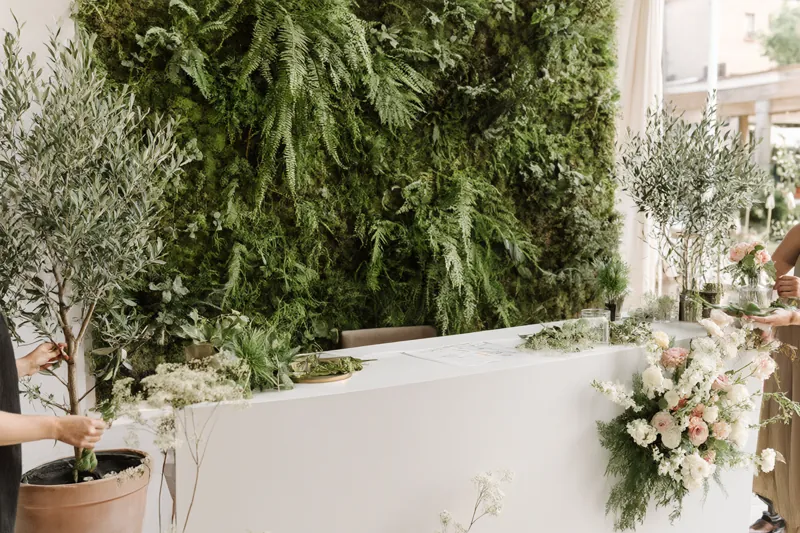
- green panels and walls, living or preserved;
- pots and containers to match the stand;
- trees in pots, such as olive or citrus, which give an instant Mediterranean look.
Ask what the hire includes: delivery, placement, care during the fair, collection. And clarify what happens if a plant comes back damaged or does not come back at all. Our guide to hiring vases and floral structures explains deposits and breakages.
The product launch: flowers that serve the product
At a launch, flowers have a precise role: to frame. A few pointers:
- colours that do not compete with the product or its packaging;
- low heights near the product, so it is not hidden in photos;
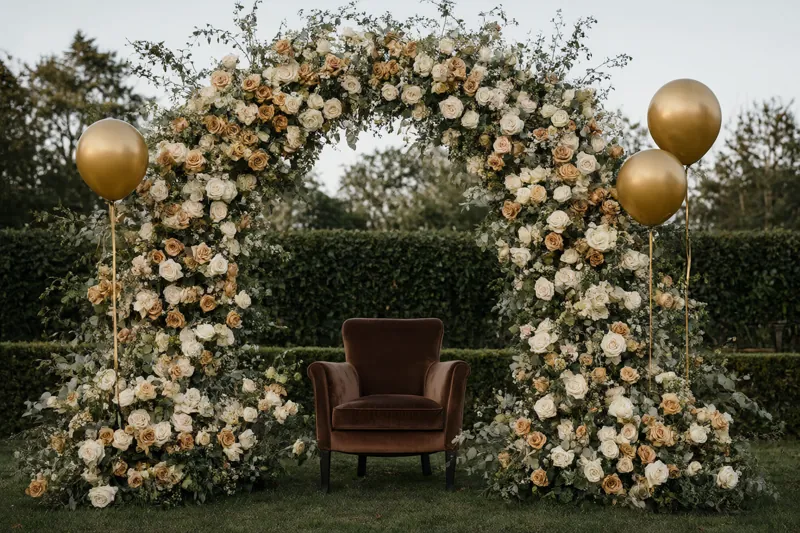
- a photo spot with greenery or flowers, designed for press and social media;
- no pollen or falling petals near pale products, fabrics or food.
If the product is food or cosmetics, watch out for strong scents: they can confuse people tasting or testing.
What goes into the quote
| Item | What to ask |
|---|---|
| Flowers and greenery | What is included, what is replaced during the fair |
| Plant and pot hire | Cost for the period, deposit, damage |
| Structures and panels | Documentation required by the fair |
| Transport | Distance, access to the hall, waiting time |
| Set-up and breakdown | Number of people, hours set by the fair |
| Maintenance | How many visits and on which days |
| Badges and paperwork | Who applies and at what cost |
There are no standard prices: stand size, duration, flowers chosen and distance to the fair all count. If the fair is in another city, the team's travel costs can add as much as the flowers. Prices in Italy are quoted in euros and VAT (IVA) may be shown separately.
What to do with flowers and plants after the fair
On the last day breakdown is fast and crowded. Deciding in advance what happens to the flowers avoids waste and arguments on the spot. There are several options:
- hired plants go back to the supplier, who cares for them and reuses them;
- cut flowers still in good shape can be given to clients, visitors or stand staff in the last hours;
- some arrangements can be donated to organisations that accept them, if someone takes them there;
- the rest is disposed of as organic waste, separating pots, ribbons, plastic and foam.
If your company has sustainability goals, write them into the brief: the florist can design from the outset arrangements without floral foam, in reusable containers, with plants that go back to the nursery. It is something you can also tell visitors, with a discreet sign on the stand.
International fairs and foreign visitors
Many Italian fairs draw trade visitors from all over the world. Flowers can help tell a story about place: olive and citrus trees for a company from the South, Italian-grown flowers for a brand that stresses its origins. Be careful with meanings, though: in Italy chrysanthemums are linked to mourning, and in other countries some colours carry different associations. If the stand is aimed at a particular market, ask the florist to take it into account.
Questions to ask the florist
- Have you worked at this exhibition centre before? Do you know its regulations?
- What do you suggest so the stand looks fresh on every day of the fair?
- Are the plants hired? What does the hire include?
- Who handles water and replacements during the fair?
- Do the structures come with the documentation the fair may ask for?
- Can you set up within the time slot we have been given?
- What happens to flowers and plants at closing time?
To sum up
At a fair, the stands that work are easy to set up, sturdy and cared for every day. Regulations, stand plan and timings are the starting point for any serious quote.
For events in a room or hall, also read our guide to corporate event flowers. If you want to cut waste after the fair, see our sustainable florists. Once you have dates and stand dimensions, request a quote.