In short
- In the evening, flowers only exist if someone lights them: think about light from the design stage.
- Aim for warm, diffused light, with a few stronger points on backdrops and installations.
- Candles and open flames follow the venue's rules: ask in advance.
- Involve your photographer: they know what light they need for photos after sunset.
In Italy many weddings run from late afternoon into the night. The ceremony is in the sun, dinner by candlelight, the party in the dark. All the work on the flowers risks disappearing exactly when guests are sitting at the table. This guide gathers wedding lighting ideas for your flowers and tells you who to ask. If you are looking for someone who handles installations and lighting along with the flowers, start with floral installations and backdrops.
Why light matters as much as flowers
A white centrepiece at noon is bright. The same centrepiece at ten at night, with no light, is a grey blur. Dark colours (burgundy, purple, blue) look almost black. Greenery disappears.
That is why a florist who knows dinner will be outdoors or in a dim room already works with light in mind: choosing paler flowers, adding candles, asking where the sockets are. If they do not ask, raise it yourself.
Who does what
| Element | Usually supplied by | Notes |
|---|---|---|
| Candles and holders | Florist or venue | Subject to flame rules |
| Lanterns and decorative lights | Florist or lighting company | Check batteries or sockets |
| Spotlights on tables and backdrops | Lighting company | Needs a plan and power |
| Ambient light on trees and façades | Lighting company or venue | Often already in place at villas |
| Dance floor lighting | Music or lighting company | Coordinate with dinner |
| Church lighting | Parish | Rarely changed |
Some florists work regularly with a lighting company and can offer a single package. Others prefer not to get involved. Either way, someone has to direct it all, often the wedding planner. Read the guide on florists and wedding planners to see how tasks are usually split.
Colour temperature
This is not a technical detail. Cold white light makes flowers look flat and faces pale. Warm light flatters them.
- Warm light (like candles or old filament bulbs): the most used for dinners and parties. It softens pink, peach and ivory tones.
- Neutral light: useful for working or service areas, not ideal on the table.
- Cold light: avoid it on flowers, unless you want a deliberate stage effect.
Ask the lighting company to use the same temperature everywhere. Lights of different colours in the same room look messy, and the photographer will struggle to correct it.
The most common solutions
Candles
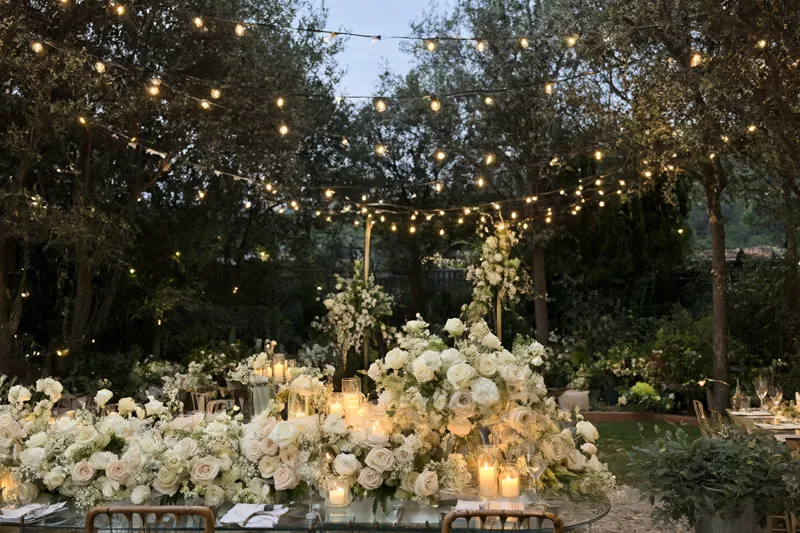
They are the first thing people think of, and they work. But on their own they give little light: they create atmosphere, not visibility. On a long banquet table you need a lot of candles to give real light. To choose types, heights and protection, read the guide on flowers and candles.
Spotlights
Small LED spotlights, often hidden in the greenery or fixed up high, aim light at the centre of each table. This is what makes the difference in photos: the flowers light up and the rest of the room stays soft.
String lights and festoons
Strings of bulbs over the tables or between trees give diffused light and an outdoor-party feel. They combine well with candles on the table. You need fixing points and a nearby socket, or a generator.
Lighting backdrops
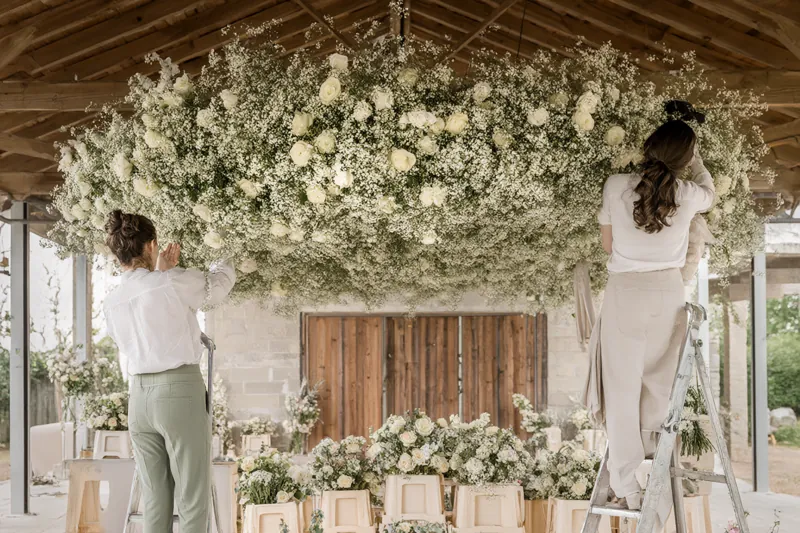
Arches, hanging installations and flower walls need their own light, or they vanish in the evening. If you have invested in a backdrop, invest in lighting it too.
Light and photography
Your photographer is your best ally here. After sunset they work with little light and need to know where the lit areas will be. Ask them:
- whether they use flash or continuous light;
- whether they need more light on the couple's table;
- what time they want to photograph the laid tables, ideally before guests arrive and with some daylight left.
For all the questions to ask your photographer about flowers, read the guide on flowers and wedding photography.
The venue: power, fixings and rules
At the site visit, check:
- sockets: where they are and how much power they can take;
- fixing points: beams, trees, pergolas, and whether you are allowed to attach anything;
- existing lighting: many villas already light their gardens and façades;
- open flame rules: candles, torches, fire pits;
- switch-off time: some venues stop music and outdoor lights at a fixed hour, partly out of respect for neighbours.
Fire rules are set by the venue, which is responsible for the safety of its spaces. In church, the parish decides. Do not take anything for granted: ask and get the answer in writing. For general fire prevention information you can look at the website of the Italian national fire service (Vigili del Fuoco), but the rule that applies to your event is the venue's. For everything to check in advance, read the guide to the venue site visit.
Choosing flowers that show up at night
Flower choice can help the light. If you know dinner will be after sunset, ask the florist to take it into account.
| Flower colours | In the evening, under warm light | Tip |
|---|---|---|
| White, ivory, cream | Stay bright and reflect light | Great for outdoor tables |
| Peach, pale pink, soft yellow | Warm up and soften | Work with candles and string lights |
| Red, burgundy, purple | Darken a lot | Need spotlights |
| Blue and dark green | Tend to disappear | Pair them with paler tones |
| Silvery green (eucalyptus, olive) | Reflects light well | Useful for volume |
This does not mean giving up dark colours. It means lighting them well, or pairing them with paler flowers that bring light into the arrangement.
Flowers and heat
LEDs give off little heat and can sit among the flowers. Candles cannot. A flame close to thin petals or dry greenery makes them wilt and can be dangerous. Dried flowers, grasses and pampas are the most vulnerable. Always use tall glass around the flame and keep a distance from the flowers.
Timing and set-up
Lighting is often installed in the same hours as the flowers. Coordinate the schedule:
- who arrives first, the lighting company or the florist;
- when the system is tested, ideally in the dark or at least with the room darkened;
- who lights the candles and at what time;
- who switches off and packs up at the end of the evening.
Light through the day
A good rule is to plan light in time slots. During a daytime ceremony, natural light is nearly always enough. At the aperitivo, around sunset, you need the first string lights and lit candles. At dinner, the lit points on the tables. At the party, the light moves to the dance floor and the tables can stay dimmer. Write this sequence into the running order and share it with the lighting company, the florist and the photographer.
Questions to ask about the lighting plan
- Are candles allowed? Which kind?
- Who supplies string lights, lanterns and spotlights?
- Are there enough sockets, or do we need a generator?
- Where can lights and festoons be fixed?
- What time is sunset on our date?
- Does the photographer have specific lighting needs?
- Who switches lights on, and who switches them off?
To wrap up
Lighting is the part of the design people think about last, and the one that changes the evening most. Build it into the plan from the first meeting. If the reception is outdoors, also think about a rain plan B: marquees have lighting needs of their own.
When you have a date and a venue, ask for a quote and say whether you also need lighting for tables and backdrops.