In short
- In January the flowers in season are mostly anemones, ranunculus, hellebores, amaryllis and spring bulbs, with plenty of greenery and citrus.
- The technical risk is frost during transport and, at the other extreme, the dry heat of heated rooms.
- It is low season: dates and florists are easier to find, but out-of-season flowers stay expensive.
- The South is milder and already smells of citrus; the North means fog, snow and short days.
January is not a wedding month for everyone, and that is exactly its advantage. Venues have free dates, florists have more time for you, and the flower market offers something quite different from summer. If you are flying in from the UK, the US or Australia, it is also a quiet month in Italy: the Christmas season ends with the Epiphany holiday on 6 January, and after that cities and venues calm down. This guide to January wedding flowers is for couples marrying in the first month of the year who want to know what is really available, how it copes with the cold and what moves the price.
The flower seasons given here are indicative: they shift with the year, the area and greenhouse growing. For the whole year, see our guide to seasonal flowers in Italy month by month. If you are already looking for someone to work with, start from our list of wedding florists across Italy.
What is in flower in Italy in January
Very little flowers outdoors in January. Most of what reaches the florist's bench comes from Italian greenhouses (Liguria, Campania, Sicily, Lazio, Tuscany) or from imports.
The flowers you will see most often:
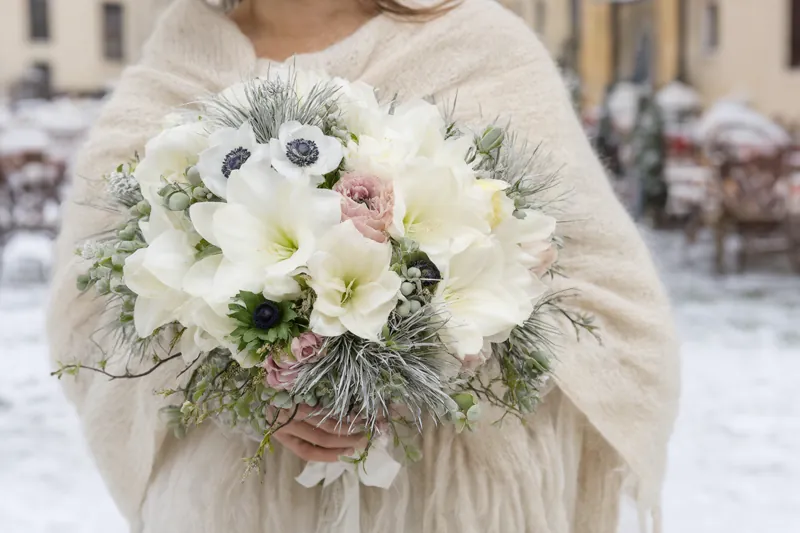
- anemones, in white, red, purple and two-tone, with the dark centre that photographs so well;
- ranunculus, at the start of their season, still smaller than in spring;
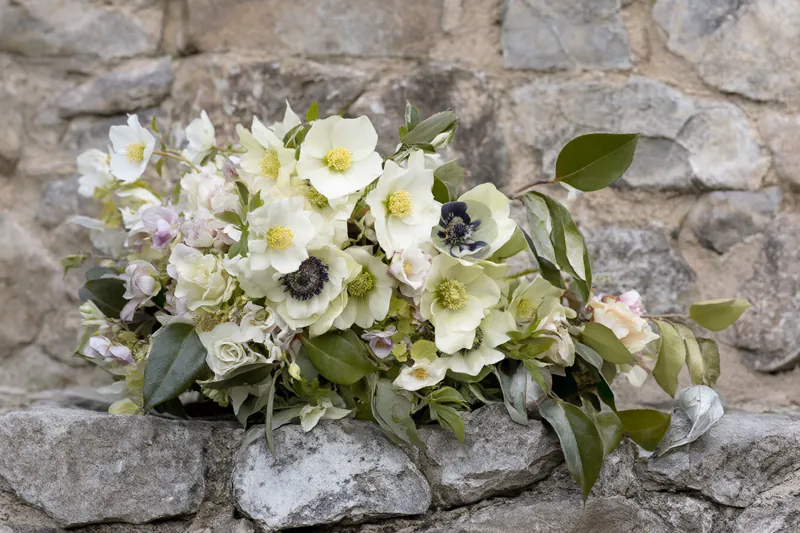
- hellebores, known in Italy as the "Christmas rose", delicate, in green and mauve tones;
- amaryllis, large and striking, very good in tall arrangements;
- bulbs: tulips, hyacinths, grape hyacinths (muscari), narcissi (the last mostly from the South);
- calla lilies, roses and orchids from greenhouses, available all year round.
Two of the most useful winter flowers have their own guide: ranunculus and anemones.
January flowers at a glance: availability, cost and colours
This table brings together the flowers and greenery you are most likely to find in January, in line with our seasonal flower calendar. Cost is relative to the other flowers of the same month and only indicative: it changes with the area, the supplier, quantities and the year. For indicative price bands per piece, see our guide to wedding flower costs in Italy.
| Flower | Availability in Italy | Relative cost | Typical palette | Best used for |
|---|---|---|---|---|
| Anemones | peak season (Italian greenhouses) | medium | white, red, purple, two-tone with a dark centre | bouquets, low centrepieces |
| Ranunculus | early season (Italian greenhouses) | medium | white, cream, peach, pink | bouquets, buttonholes, centrepieces |
| Hellebores | peak season | medium | white, green, mauve | low centrepieces, small bouquets |
| Amaryllis | peak season (greenhouse) | high | red, white, burgundy | tall arrangements, church, entrance |
| Tulips, hyacinths, grape hyacinths | greenhouse | low | white, pink, lilac, dusty blue | centrepieces, low vases |
| Narcissi | peak season in the South | low | white, yellow | centrepieces, table details |
| Roses and calla lilies | greenhouse, all year | medium | white, cream, blush | bouquets, church, top table |
| Peonies and hydrangeas | imported | high | pink, white, blue | only a few accents, if you really want them |
| Conifers (pine, fir, cedar) | peak season | low | dark green | church, garlands, base for centrepieces |
| Eucalyptus, ivy, bay | all year | low | silver green, glossy green | table runners, bouquets, centrepieces |
| Citrus branches with fruit | peak season, especially in the South | low | orange, yellow, glossy green | centrepieces, buffet, entrances |
Costs beyond the flowers themselves, such as dates, logistics and structures, are covered in the cost section further down.
Greenery, branches and fruit
In January greenery does half the work. A well-designed winter set-up often uses more foliage and branches than flowers, which also helps the budget.
- Conifers: pine, fir, cedar, cypress. They smell good and last.
- Eucalyptus in several forms, ivy, bay, olive.
- Bare or budding branches: birch, corkscrew willow, hazel, wintersweet (which flowers in winter and is fragrant).
- Citrus: this is the month for oranges, mandarins, clementines, lemons and kumquats. Branches with leaves and fruit add colour without flowers.
- Berries and pine cones, with care: some berries are toxic and should not go near food or children.
Some wild species, such as holly and butcher's broom, are protected in several Italian regions. A reliable florist uses cultivated material: if you love them, ask where they come from.
North, Centre and South: three different Januaries
Italy is long, and January feels very different from the Alps to Sicily.
| Area | Typical weather | What works well | Watch out for |
|---|---|---|---|
| North (plains, lakes, Alps) | Cold, fog, possible snow | Conifers, amaryllis, greenhouse roses, candles where allowed | Frost in transport, mountain roads, early darkness |
| Centre (Tuscany, Umbria, Lazio) | Damp cold, clear days alternating with rain | Anemones, olive, citrus branches, villa fireplaces | Large, cold rooms to heat, humidity |
| South and islands | Milder, rain and wind | Fresh citrus, narcissi, the first almond blossom in Sicily at the end of the month | Wind on terraces, rough seas for the smaller islands |
In the North, January is a mountain month: chalets, mountain huts and Alpine hotels call for warm designs with wood and greenery. If that is your plan, read our guide to the winter wedding. In the South, a January wedding can sometimes include lunch on a terrace on a sunny day, as long as there is an indoor plan B.
Cold, heating and how long flowers last
Moderate cold is an ally: cut flowers last longer at low temperatures. Frost is not. An uninsulated van, a courtyard below zero where arrangements wait, a door left open onto the snow: a few minutes are enough to leave petals translucent and dark.
The second problem is the opposite one: heated rooms. Radiators, fireplaces and warm lamps dry out ranunculus, anemones and hellebores. Anemones also open wide in the warmth and tend to flop.
What to ask:
- how the flowers will be transported, and at what time;
- where the arrangements will wait between set-up and the guests' arrival;
- whether centrepieces can stay away from fireplaces and warm-air vents;
- whether the flowers from the church ceremony (churches are often cold) can be moved to the reception.
Short afternoons and low light
In January it gets dark early, around 5 pm in much of Italy. That changes the design. A 3 pm ceremony ends close to sunset, and the reception happens entirely under artificial light. Pale flowers (white, cream, peach, green) read well in low light, while dark burgundy and purple can disappear.
Candles help a great deal, but the venue's and the church's rules on naked flames and wax always apply. Before you fall for a hundred lit candles, read our guide to flowers and candles.
What tends to cost less, and more, in January
We do not give figures here: the cost depends on quantities, types of arrangement, venue and labour. We can say what tends to cost more or less this month.
| Tends to cost less | Tends to cost more |
|---|---|
| Greenery, conifers, branches, eucalyptus | Peonies, hydrangeas, imported summer flowers |
| Citrus, especially in the South | Large statement flowers out of season |
| Italian anemones and ranunculus | Difficult transport to the mountains or islands |
| Midweek dates in low season | Lots of candles and hired structures |
January is low season for weddings, so it is often the month when a florist has the most availability. That is not an automatic discount: it is room to talk things through calmly. Some flowers already feel the pull of Valentine's Day in mid February, red roses above all: if you marry at the end of January, ask whether another variety makes more sense.
Colour palettes that work in January
- White and green: white anemones, hellebores, eucalyptus, pine. Clean, wintry, perfect by candlelight.
- Citrus and cream: orange and lemon branches, cream ranunculus, glossy leaves. Ideal in the South and in villas.
- Burgundy and gold: dark red amaryllis, black-centred anemones, brass and velvet. Balance it with warm light.
- Dusty blue and silver: grape hyacinths, hyacinths, silver eucalyptus. Good in the mountains and with snowy landscapes.
Questions to ask your florist
- Which Italian flowers can you source reliably in my week of January?
- What would you advise me to avoid because it would come from far away or suffer in the cold?
- How do you transport flowers if there is snow or ice on the road?
- Will the arrangements survive six or seven hours in a well-heated room?
- Can we lean more on greenery and citrus to keep the budget in check?
- Are candles allowed in the church and at the venue? Who checks?
If you are planning from abroad, also ask whether the florist has worked at your venue before, which languages they speak, and how they will show you the design (photos of samples, a mock-up, a video call).
January and the rest of the year
If your date is not fixed yet, compare January with the following month: in February mimosa and more spring bulbs arrive, but so does Valentine's demand. If you have just moved your date from the Christmas period to January, our guide to December wedding flowers shows what changes after the holidays.
Once you have a date and a venue, ask for a quote and ask straight away which January flowers the florist can guarantee.