In short
- February is the month of ranunculus, anemones, spring bulbs and mimosa, with the first blossoming branches in the South.
- Around Valentine's Day roses, especially red ones, cost more: choose something else or move the date.
- If your date falls in Lent, ask the parish what is allowed on the altar.
- The North is still in deep winter; in Sicily and Liguria spring is already in the air.
February is a month of transition. In the North the mornings are frosty, while in Sicily the almond trees are in flower and the hills of Liguria turn yellow with mimosa. If you are marrying this month, the choice of flowers is wider than you might expect, but there are two dates to watch: Valentine's Day and the start of Lent. This guide to February wedding flowers in Italy tells you what you can find, how the flowers hold up and what moves the price.
Seasons are indicative: the year, the area and greenhouses can shift them by a few weeks. The full calendar is in our guide to seasonal flowers in Italy. If you are looking for a professional, browse our wedding florists across Italy.
What is in flower in February
This is the heart of the season for Italian greenhouse flowers, grown mainly in Liguria, Campania, Lazio, Tuscany and Sicily.
- Ranunculus: larger and fuller than in January, in a huge range of colours. The base of many winter bouquets.
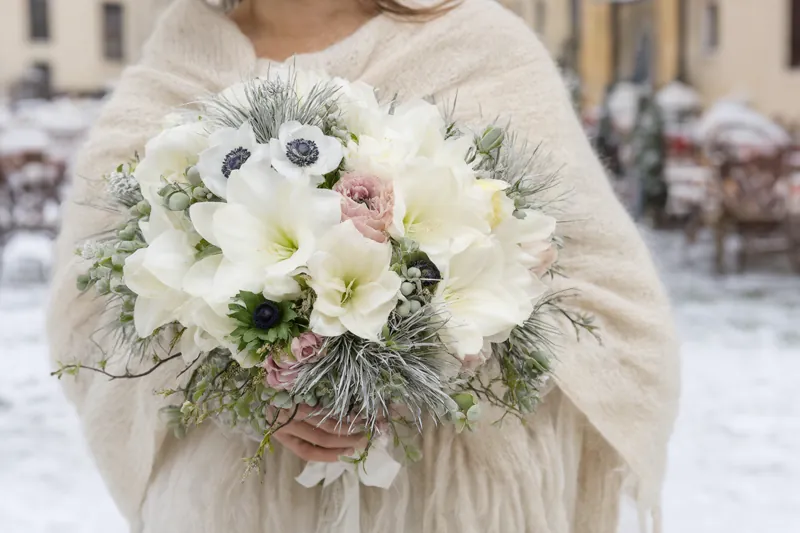
- Anemones: still in great shape, especially the white ones with a black centre.
- Tulips, hyacinths, grape hyacinths, narcissi: spring bulbs bring freshness and scent.
- Freesias: fragrant and light, good for bouquets and buttonholes.
- Mimosa: typical of February and early March, especially in Liguria and along the coast.
- Hellebores and camellias: towards the end of winter, very good in low arrangements.
- Blossoming branches: almond, peach, blackthorn, depending on the area and the year.
Ranunculus and anemones have their own guide: ranunculus and anemones.
February flowers at a glance: availability, cost and colours
This table brings together the flowers and greenery you are most likely to find in February, in line with our seasonal flower calendar. Cost is relative to the other flowers of the same month and only indicative: it changes with the area, the supplier, quantities and the year. For indicative price bands per piece, see our guide to wedding flower costs in Italy.
| Flower | Availability in Italy | Relative cost | Typical palette | Best used for |
|---|---|---|---|---|
| Ranunculus | peak season (Italian greenhouses) | low | white, peach, blush, yellow, red | bouquets, centrepieces |
| Anemones | peak season | low | white with a black centre, purple, red | bouquets, low centrepieces |
| Tulips, hyacinths, grape hyacinths | peak season | low | white, pink, purple, blue | centrepieces, low vases |
| Narcissi | peak season | low | yellow, white | centrepieces, lunch tables |
| Freesias | peak season (greenhouse) | medium | white, yellow, lilac | bouquets, buttonholes |
| Mimosa | peak season (Liguria and the coast) | low | yellow | large vases, entrances, details |
| Hellebores and camellias | late winter | medium | white, pink, green | low arrangements, top table |
| Blossom branches (almond, peach, blackthorn) | early season, first in the South | medium | white, pink | large vases, church, entrance |
| Roses | greenhouse, all year | high for red around Valentine's Day, medium for other colours | cream, peach, blush, red | bouquets, top table |
| Peonies and hydrangeas | imported | high | pink, white | only a few accents |
| Eucalyptus, pittosporum, bay, olive | all year | low | green, silver green | table runners, base for arrangements |
| Citrus with branches and leaves | peak season in the South | low | orange, yellow, glossy green | centrepieces, buffet |
Costs beyond the flowers themselves, such as dates, logistics and structures, are covered in the cost section further down.
Greenery and fruit
The greenery is still wintry, with fewer conifers and more glossy leaves: eucalyptus, pittosporum, bay, olive, ivy, magnolia. Citrus is still at its best: lemons, blood oranges, mandarins, kumquats. In Sicily, Calabria and Campania you can find branches with fruit and leaves in excellent condition.
An idea that works well in February: almond blossom branches in large vases, with a few bulbs at the base. They last only a few days and drop petals, so they need to be cut close to the date and placed where falling petals will not be a nuisance.
North, Centre and South in February
| Area | Typical weather | Flowers and materials that work | Typical problems |
|---|---|---|---|
| North | Cold, morning frost, snow at altitude | Bulbs, ranunculus, greenhouse roses, greenery | Frost in transport, Carnival crowds in some historic cities |
| Centre | Damp cold, changeable days | Anemones, mimosa, olive, camellias | Rain, cold historic venues |
| South and islands | Mild, the first warm spells | Almond blossom, citrus, narcissi, freesias | Wind and sudden rain, ferries in rough seas |
In Venice, Carnival brings crowds, higher hotel prices and more complicated deliveries on the busiest days. If you are marrying there in February, talk to your florist early. In Sicily the almond blossom makes the month very photogenic; remember, though, that blossoming branches are fragile and must be transported with care.
Valentine's Day and the flower market
Around 14 February the market changes. Demand for roses, especially red ones, goes up and wholesale prices tend to follow. Tulips and other "romantic" flowers feel the demand too.
If your date falls that week:
- consider roses in less requested colours (cream, peach, blush) or spray varieties;
- build the design on ranunculus, anemones and bulbs, which are in season;
- ask your florist to order early anything you cannot do without;
- bear in mind that some florists are busy with Valentine's deliveries in the days just before.
Lent and church weddings
If you are planning a Catholic church wedding, it helps to know the calendar. Lent begins on Ash Wednesday, which falls in February or March depending on the year. During this period the liturgy calls for restraint and many parishes limit flowers on the altar or ask for simpler decorations. Others are more flexible, especially for arrangements at the entrance or along the aisle.
There is no single rule: each parish decides, following the diocese's guidance. Before you design anything, ask the parish priest what is allowed, where, and whether there are other weddings or services on the same day. For everything else, see our guide to church wedding flowers.
Cold outside, warm inside
In February flowers suffer from sudden changes in temperature. Ranunculus and anemones handle the cool well but open quickly in the warmth. Mimosa loses its yellow pompoms in a warm, dry room. Tulips keep growing and bending after cutting: a good florist knows this and puts them in place at the last moment.
Ask where the arrangements will be kept before set-up and whether the venue has cooler areas for bouquets and buttonholes.
February for couples coming from abroad
If you are planning from outside Italy, February has a practical advantage: flights and hotels often cost less than in spring and summer, and historic cities such as Rome and Florence are easier to enjoy. One cultural note: in Italy mimosa is the flower of International Women's Day on 8 March, so at the end of February you will see it everywhere, in shops and on the street. It has no negative meaning, but Italian guests will associate it with that day.
What tends to cost less, and more, in February
Figures depend on too many factors to give them in the abstract. This is what tends to cost more or less.
| Tends to cost less | Tends to cost more |
|---|---|
| Italian ranunculus, anemones and bulbs | Red roses in Valentine's week |
| Mimosa and blossom in the areas where they grow | Imported peonies and hydrangeas |
| Greenery and citrus | Transport to islands and mountain resorts |
| Midweek dates, low season | Set-ups in Venice during Carnival |
February is still low season for weddings. If your date is flexible, avoiding Valentine's week is often the simplest move.
Colour palettes for February
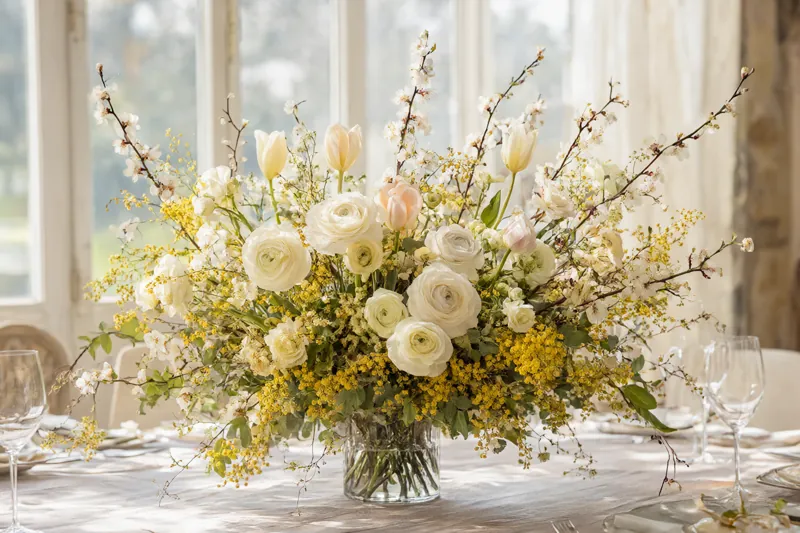
- Yellow and white: mimosa, narcissi, white ranunculus. Bright, perfect for grey days.
- Blush and peach: ranunculus, spray roses, freesias. Romantic without relying on red roses.
- Black and white: panda anemones, eucalyptus, hellebores. Graphic and wintry.
- Purple and blue: hyacinths, grape hyacinths, purple anemones. Lovely with silver and velvet.
Questions to ask your florist
- Which Italian greenhouse flowers can you source best in my week?
- Does Valentine's Day affect my quote? What should I swap?
- Have you worked in this church during Lent? What was allowed?
- How do you keep mimosa and blossom branches intact until the day?
- If the day is cold and wet, what changes in the set-up?
- Can we reuse the ceremony flowers at the reception?
Before and after February
If you are still deciding on the month, see how the picture changes in January, colder but with more free dates, and in March, when spring really arrives in central Italy too.
Do you have a date and a venue? Ask for a quote and say straight away if the date is close to Valentine's Day or falls in Lent.