In short
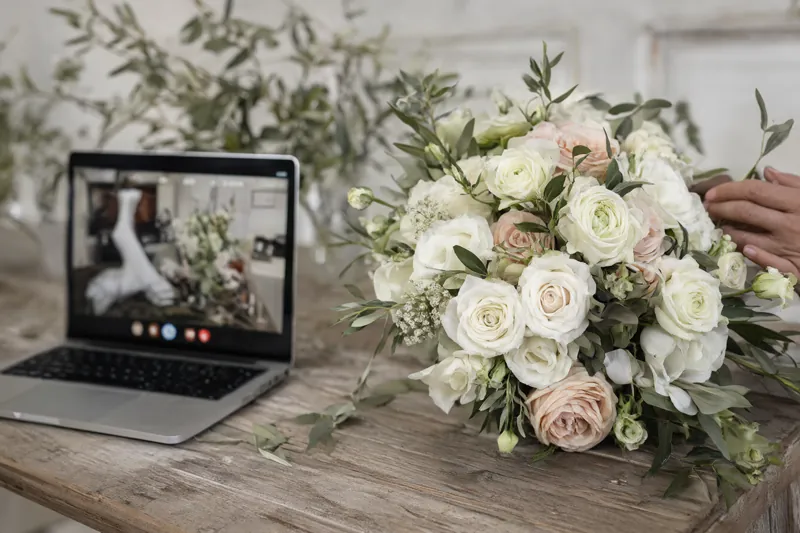
- Working remotely works well with regular video calls, a shared mood board and a mock-up shown in photos or video.
- Time zones matter: set a regular call slot and a single channel for decisions.
- Pay in euros, with written due dates. Agree on bank fees and exchange costs.
- Ask for a contract in a language you understand and check which version prevails.
This guide is for couples planning a wedding in Italy from abroad: from the UK, the US, Australia, Canada or Ireland, including Italians living abroad, and for anyone who cannot follow everything in person. You will find a method for choosing a florist, communicating, approving the design, paying and signing without surprises.
Why remote planning can work well
Many Italian florists work every year with couples they will not meet until the week of the wedding. They have tried-and-tested processes: calls, shared documents, sample photos. The secret is not technology but clarity.
Step one is finding someone used to international clients. Our list of florists for destination weddings in Italy includes professionals who work in other languages and travel across the country.
Choosing without meeting
When you cannot visit a studio, you need other ways to judge. Ask for:
- real weddings, not only styled shoots: full galleries, ideally in your region and your season;
- references from international couples you can contact;
- an introductory video call of 30 to 60 minutes;
- a detailed quote with each item listed separately;
- the languages spoken by the designer and by the team who will be there on the day.
Be wary of anyone who sends only heavily edited images or gives vague answers on logistics and set-up.
Communicating: channels, rhythm and time zones
Time difference is the first practical hurdle. These are the most common gaps with Italy. They are indicative: they shift during the weeks when one country is on summer time and the other is not.
| Where you are | Usual difference from Italy |
|---|---|
| UK and Ireland | 1 hour behind |
| US East Coast | 6 hours behind |
| US West Coast | 9 hours behind |
| Eastern Australia | 8 to 10 hours ahead, depending on the time of year |
A few rules that make life easier:
- agree one time slot for calls that suits both sides;
- choose a single channel for decisions, usually email, and use chat only for quick things;
- after every call, ask for a written summary of what was decided and what is still open;
- if you have a wedding planner, decide who talks to the florist. Our guide on florists and wedding planners explains how to split the roles.
Mood board and design proposal
At a distance, words are not enough: you need images. Build a mood board with a few well-chosen photos and explain what you like about each one: the colour, the shape, the amount of greenery, the height. Pictures found online often show out-of-season flowers or very expensive set-ups. Your florist will tell you what is realistic. Our guide on creating a wedding flower mood board can help.
The designer usually replies with a proposal: sketches, reference photos, a flower list, palette and quantities. Check that it states:
- which flowers are planned and which substitutes will be used if they are unavailable;
- the sizes of the main arrangements;
- where each piece goes at the venue;
- what moves from the ceremony to the reception.
The mock-up: seeing your flowers in advance
A mock-up is a trial: a centrepiece, a bouquet or a corner of the set-up made in advance. From abroad you see it in photos, video or on a call.
What to know:
- it is often charged separately, or included only for larger orders;
- it should be done in the right season, otherwise the flowers will be different;
- ask for photos in natural light, with an object for scale;
- use it to decide heights, colours and fullness, not individual stems.
To know when it is worth asking for one, read our guide to the flower mock-up.
The site visit, even a virtual one
If you can, plan a trip to Italy some months before the wedding: venue, church or civil ceremony room, florist, caterer. If you cannot, ask the florist to visit the venue and send photos and video, at the same times of day as the ceremony and dinner. The light changes a lot.
The visit helps the florist too: measurements, access, power sockets, venue rules. If it is charged or has travel costs, that should be in writing.
Payments and contracts from abroad
Italian florists usually invoice in euros. Agree on these points early:
- how to pay: bank transfer, sometimes card;
- from where: from the eurozone a SEPA transfer is usually simple; from the UK, US, Australia or Canada, an international transfer may carry bank and exchange fees;
- who pays the fees: have it written down, so the florist does not receive less than the amount due;
- due dates: deposit on signing, any instalments, balance before or after the wedding;
- the invoice: whose name it is in, VAT (IVA in Italy), the details you need to provide.
One important point: in Italian contracts an acconto (a part payment) and a caparra (a deposit that works as a guarantee) are not the same, and they have different effects if either side withdraws. Ask which term the contract uses and what happens if you cancel. For your overall budget, read our guide to budgeting flowers for a destination wedding.
A contract in a language you understand
You will sign remotely, often with an electronic signature. The contract should be clear, in a language you read well. Check:
- whether there is an English or bilingual version, and which one prevails;
- which law applies and where any dispute would be settled;
- the rules on flower substitutions, bad weather, cancellation and date changes;
- what is included: travel, set-up, breakdown, hire items;
- the deadline for final table and guest numbers.
Wedding week
When you arrive in Italy, only a few days remain and most things are decided. This is the time to check in person, if you can.
- Book a meeting with your florist as soon as you arrive, ideally at the venue.
- Go through the list of pieces: bouquet, buttonholes, flowers for the mothers, ceremony, tables, extras.
- Hand over personal items to include in the bouquet or decor, such as ribbons or photos.
- Confirm the times for delivery of personal flowers, set-up and breakdown.
- Name a contact who is not you for the wedding day: a witness, your planner or the venue manager.
Avoid changing the design at the last minute. The flowers are already ordered and often already delivered. Small tweaks are possible; big changes cost money and put the team under pressure. If something does not feel right, say so straight away and ask what can be done with the flowers already available.
Questions to ask your florist
- Have you worked with couples living abroad before?
- Which languages do you work in? Who on the team speaks ours on the day?
- How often will we talk? On which channel?
- Is a mock-up included? How will you show it to us?
- How do we pay from abroad? Who covers the fees?
- Is there an English version of the contract? Which version prevails?
- Who is our contact during the wedding week?
- What happens if we cannot come to the site visit?
To sum up
Remote planning works when everything is in writing: design, substitutions, payments, timings. Choose a florist used to international clients, set a steady rhythm of communication and ask for a mock-up before final decisions.
Once you have a date and a region, request a quote and tell us which country you are planning from.