In short
- A symbolic ceremony has no legal value in Italy, but it gives you complete freedom of place, time and design.
- The key elements are backdrop, aisle, seating and ceremony table: you do not need them all.
- Outdoors, sun, wind and ground matter as much as the flowers you choose.
- Always prepare an indoor plan B and agree how late you can decide.
An outdoor ceremony is a common choice for weddings at a villa, a masseria (a fortified farmhouse in Puglia), on a lakeshore or by the sea, and it is almost always the setting for a symbolic wedding in Italy. Free from many of the rules of churches and town halls, it does ask you to think about things that do not matter indoors: sun, wind, the lawn, shade. This guide is for anyone planning a symbolic or outdoor civil ceremony in Italy who wants to decorate it with flowers in a way that is both lovely and practical. If you are looking for professionals used to this kind of set-up, see our florists for symbolic weddings and vow renewals.
What a symbolic ceremony is
A symbolic ceremony has no legal effect. It is led by an officiant chosen by the couple: a friend, a professional celebrant, a relative. It can include readings, vows you write yourselves and symbolic gestures such as a sand ceremony or handfasting.
It is popular with:
- couples from abroad who marry legally at home and celebrate in Italy;
- couples already married at the town hall who want a party with a proper ceremony;
- couples of different faiths, or none;
- anyone who wants a ceremony somewhere a civil wedding is not possible.
For the flowers it means one thing: freedom. You can choose place, time and design following only the rules of the venue.
The elements of the set-up
| Element | Purpose | Common options |
|---|---|---|
| Backdrop | Frames the couple and the officiant | Arch, frame, ground arrangements, potted trees |
| Aisle | Leads the bride in | Floor vases, petals, lanterns, flowers on chairs |
| Seating | Welcomes guests | Flowers on end-of-row chairs, ribbons, decorated benches |
| Ceremony table | Holds symbolic objects and rings | Small low arrangement, green runner |
| Entrance | Greets guests | Welcome sign with flowers, large urns |
You do not need to decorate everything. In a beautiful garden or in front of the sea, a light backdrop and a few touches along the aisle are enough.
The backdrop
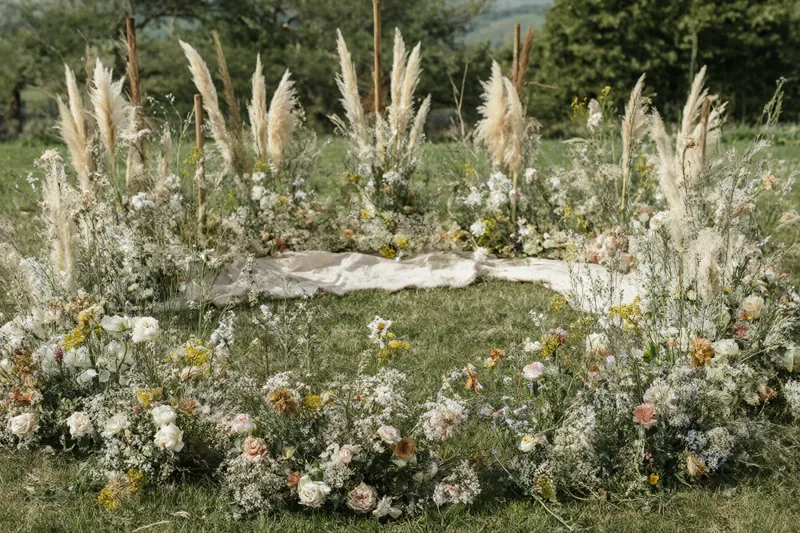
It is the background to your ceremony photos. It can be an arch, two ground arrangements, a row of potted olive or lemon trees, a frame dressed with greenery and flowers. In front of a view, a low option that frames it without hiding it is best. Shapes and technical issues are explained in our guide to ceremony flower arches.
The aisle
The aisle is the bride's path. It can be marked by:
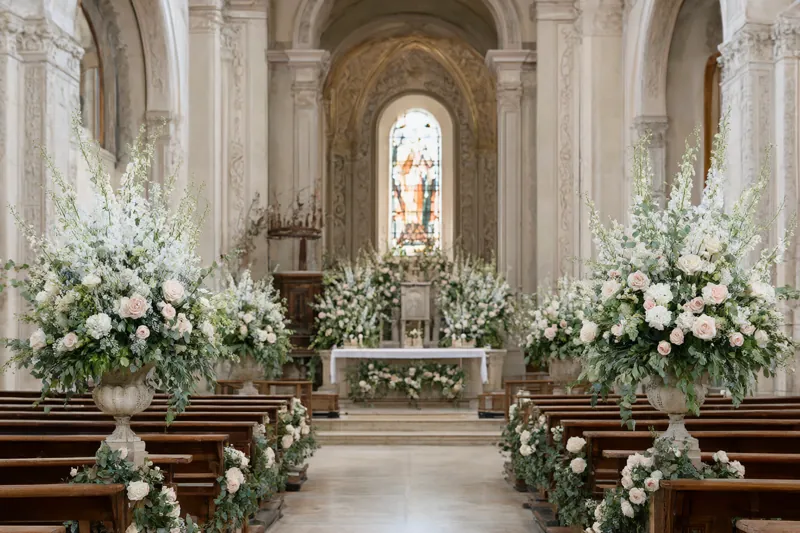
- ground arrangements along the sides, tall or low;
- flowers on the chairs at the start of each row, tied with ribbon or clips;
- petals on the ground, where the venue allows them;
- lanterns with LED or real candles, according to the venue's rules;
- a rug or runner, useful on gravel and uneven lawns.
Keep the aisle wide enough: the bride may have a full dress and walk beside someone. And check that floor vases do not get in the way of older guests or wheelchair users.
The seating
Chairs often come from the venue or a hire company. Flowers can decorate just the aisle chairs, every other row or all of them. A practical idea is to reserve the front rows for family with a floral detail or a sign. Wooden benches, found at some country venues, look good dressed with branches and greenery.
The ceremony table
If the ceremony includes symbolic gestures, you need a small table for sand, a candle, ribbons or the rings. A low, long arrangement is enough. If there is a candle, the wind can blow it out outdoors: a glass holder is safer.
Sun, shade and timing
In summer, across most of Italy, a midday ceremony is hard on guests and flowers alike. A few pointers:
- choose a time with the sun low, usually late afternoon;
- face the seating so guests are not looking into the sun;
- provide shade, natural or with umbrellas or awnings, where possible;
- offer water, fans or parasols on arrival;
- ask your florist to add the most delicate flowers as late as possible.
Flowers such as hydrangeas, ranunculus and fully open peonies suffer in the sun. Others cope better. Our guide to summer weddings and flowers in the heat explains which to choose.
Wind and ground
Wind is the main enemy of outdoor set-ups. It knocks over vases, scatters petals, blows out candles and makes tall arches sway. In exposed places:
- use heavy bases and low vases;
- tie arrangements to chairs securely;
- choose dried petals or none at all where the wind is strong;
- avoid open candles: go for closed lanterns or LED lights.
The ground changes everything: a soft lawn takes stakes, a stone terrace does not, sand needs wide bases. Show the ground to the florist during the site visit.
Candles and flames
Candles add warmth to sunset ceremonies. Outdoors, though, wind and dry grass make them a risk. Many venues have strict rules on open flames, especially in summer. Check with your venue what is allowed and follow its guidance. For more, read our guide to flowers and candles.
From ceremony to aperitivo
A symbolic ceremony is often just a few steps from the aperitivo, the Italian drinks-and-nibbles hour before dinner. Many elements can be moved:
- aisle arrangements go onto the buffet or the high tables;
- the backdrop becomes the backdrop for the couple's table;
- chair arrangements decorate the seating plan or the dinner entrance.
You need a team to do it during the aperitivo, without disturbing guests. It should be in the quote.
Plan B
Every outdoor ceremony needs an indoor alternative: a room, a portico, a marquee. Ask the venue which space is available and ask the florist:
- which elements move easily;
- how long it takes to reset;
- how late you can decide.
For details, read our guide to a rain plan for wedding flowers.
Ideas by setting
Each Italian landscape suggests different choices. They are not style rules, just starting points.
- Vineyard or hillside: olive branches, cultivated wildflowers, grasses, wooden seating. Often windy.
- Villa garden: ground arrangements along the paths, garden roses, hydrangeas in the shade.
- Lakeside terrace: low designs that do not block the water, pale colours that hold up in reflected light.
- Beach or clifftop: a few well-anchored pieces, dried petals or none, Mediterranean greenery, wide bases on sand.
- Masseria or courtyard: potted citrus or olive trees, bougainvillea where it grows, pale stone that sets off the green.
Remember that beaches and public areas may need permits from the Comune or other authorities. Ask the venue or the Comune before planning.
Questions to ask your florist
- Have you set up ceremonies at this venue before?
- Which backdrop would you suggest for my setting and my view?
- How will you secure vases and arrangements on this ground?
- Which flowers will cope with the sun at ceremony time?
- Can petals and candles be used here?
- What will you reuse at the aperitivo and dinner? Who moves it?
- What is the plan B, and how late can I decide?
Final thoughts
A successful outdoor ceremony starts with the place and the time, not the flowers. Choose the right spot, the right hour and a few well-secured pieces. The flowers will do the rest. Once you have your venue and time, request a quote with photos of the ceremony spot and your guest numbers.