In short
- The arch frames the couple during the ceremony: it is the backdrop to almost every ceremony photo.
- There are many shapes: round arch, rectangular frame, moon gate, columns, ground arrangements.
- Outdoors, wind, sun and ground matter: the frame must be stable and anchored.
- A well-designed arch can be reused at the reception, if take-down and transport are planned.
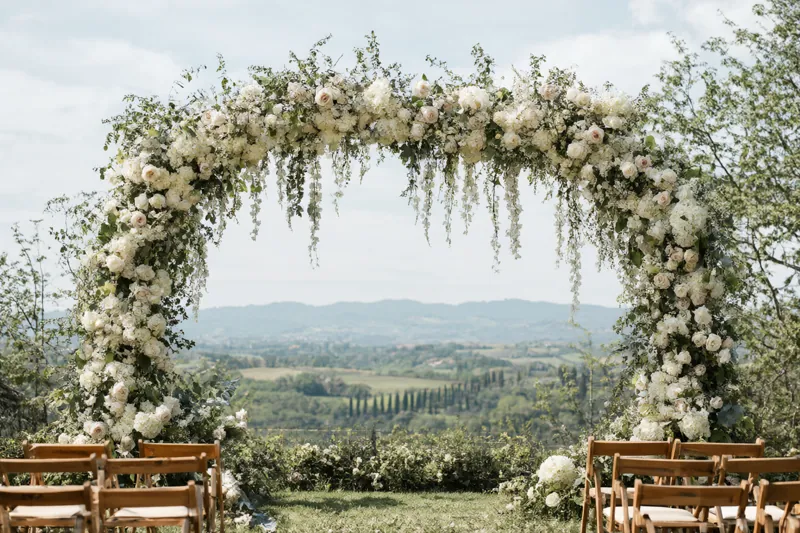
Wedding arch flowers have become a popular choice at outdoor ceremonies and at civil and symbolic weddings. It marks out the couple's space, creates a backdrop and gives guests a focal point. This guide is for anyone considering an arch or a ceremony installation in Italy who wants to understand shapes, materials and practical issues, especially outdoors. If you are looking for professionals who build structures and large pieces, see our list of floral installations and backdrops.
What an arch is for
An arch is not essential. It is useful when the ceremony takes place somewhere without a natural focal point: a lawn, a terrace, a beach, a garden. In a church the altar is already the backdrop. At a villa with a handsome façade or in front of the sea, a ground arrangement is sometimes enough.
Ask yourself what guests will see behind you. If it is a view over a lake, the sea or the hills, the arch should frame it, not hide it. If it is a blank wall or a car park, the arch becomes the real backdrop.
The main shapes
| Shape | Effect | Where it works | Watch out for |
|---|---|---|---|
| Round arch | Classic, soft | Gardens, lawns, terraces | Height and width to suit the couple and the celebrant |
| Rectangular frame | Clean, architectural | Villas, courtyards, modern venues | Can look stiff without well-spread flowers |
| Hexagonal or geometric arch | Contemporary | Beaches, minimal venues | A very recognisable style |
| Half circle or moon gate | Light, striking | In front of views | Securing the base |
| Two columns or plinths | Elegant, pared back | Churches, rooms, narrow terraces | Small footprint, less of a frame effect |
| Ground arrangements | Natural, keeps the view open | Seaside, hills, windy spots | Visibility for guests in the back rows |
| Asymmetric arch | Flowers on one side or two corners | Almost anywhere | Balance in photos |
You do not have to cover the whole frame in flowers. Many arches today have flowers on two opposite corners, with the rest left bare or covered in greenery. It is also a way to keep costs down.
Ground arrangements
An increasingly popular option is a ground-level installation: two large low arrangements either side of the couple, or a half circle of flowers and greenery rising from the floor. It does not block the view, copes better with wind and is easier to move. It suits clifftops, viewpoints, vineyards and open spaces.
Materials and frames
The most common frames are metal, wood or bamboo. Florists usually own them and hire them out together with the flowers. Sometimes they source them from a specialist hire company. The frame matters for three reasons:
- stability: the heavier the base, the better it resists wind;
- transport: some come apart, others do not, and not all fit through narrow doors or up stairs;
- look: gold metal, raw wood or white lacquer change the style.
As for the flowers: arrangements are made with a water supply, floral foam or, more and more often, foam-free techniques using chicken wire and water tubes. Ask which technique your florist uses. To see what can be hired and on what terms, read our guide to hiring vases and floral structures.
Wind, sun and ground
Outdoors, the arch has to deal with the weather. Many ceremony spots in Italy are exposed: cliffs on the Amalfi Coast, hills in Tuscany, lakeside terraces, beaches in Puglia and Sardinia.
Wind. A tall arch full of flowers acts like a sail. It needs weighted bases, stakes in the lawn or anchoring to fixed structures. The arrangements must be firmly secured. In the most exposed spots, a low arch or a ground installation is better.
Sun. Where the sun is at ceremony time matters. If you face the sun, you squint. If it is behind you, the photographer works against the light. Discuss it with the photographer and the florist during the site visit. Direct sun also wilts flowers: in summer the arch should go up as late as possible.
Ground. Lawn, gravel, sand, stone or decking all need different anchoring. On sand you need deep posts or wide bases. On stone nothing can be driven in, so weights are used. On a terrace, load limits and venue rules need checking.
Arches in church and at religious ceremonies
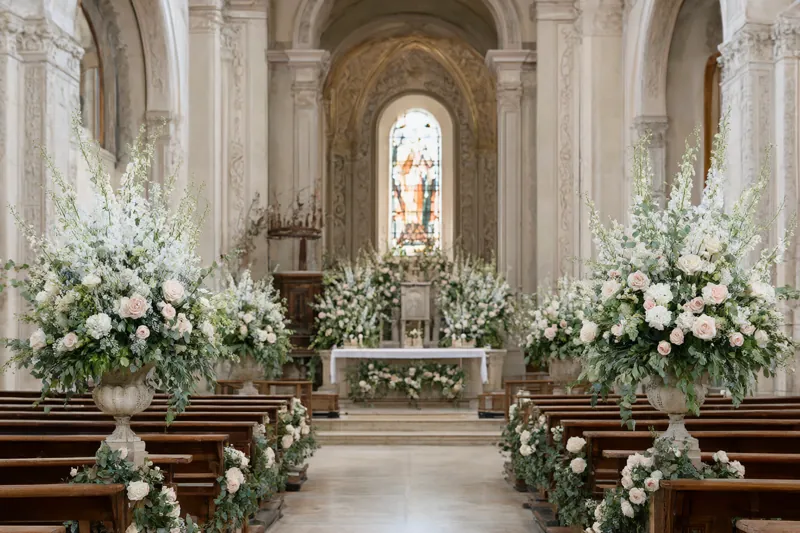
In a church, the parish rules come first. Structures near the altar are usually not allowed. An arch or floral frame at the entrance, around the doorway or on the steps outside is more often permitted. For full details, read our guide to church wedding flowers.
Size and proportion
The arch must comfortably hold the couple and the celebrant, and sometimes the witnesses. A few practical pointers:
- it should be taller than the tallest person, with room to spare for photos;
- it should be wide enough that no one is left outside the frame;
- in a small room, a huge arch crushes the space;
- in front of a wide view, an arch that is too small gets lost.
Exact measurements are decided during the site visit, tape measure in hand.
Reusing the arch at the reception
An arch used for half an hour is a significant investment. It is often moved:
- behind the couple's table, as a backdrop;
- to the entrance to dinner;
- next to the photo corner or the seating plan.
You need a team to take it down, move it and put it back up while guests are at the aperitivo, the Italian pre-dinner drinks. It has to be in the quote and the schedule. If the reception is somewhere else, consider whether moving it makes sense or whether reusing only the arrangements is better. For the couple's table there is a dedicated guide to top table flowers.
A plan B for rain
If the ceremony is outdoors, prepare an indoor alternative. The arch can move under a portico or into a room, if it was designed for that and the measurements allow it. Ask the florist how long the move takes and how late you can decide. Our guide to a rain plan for wedding flowers covers this.
Set-up times
An arch full of flowers takes time. The frame has to be assembled and anchored, then the arrangements added. With a team of several people it usually takes a few hours, depending on size. Ask the venue from what time you can access the ceremony space and whether there are other events, hotel guests or visits in the meantime. In summer it makes sense to put the frame up early and add the most delicate flowers at the last minute. Think about take-down too: if the venue wants the space cleared in the evening, a team has to stay late.
Questions to ask your florist
- Which shape would you suggest for my venue, and why?
- Is the frame yours, hired, or the venue's?
- How will you anchor it on my type of ground? Will it stand up to wind?
- What time will you set it up, given the sun?
- Do you use floral foam or foam-free techniques?
- Can it be moved to the reception? Who does it, and how long does it take?
- What happens if it rains?
- Does the quote include set-up, take-down and collecting the frame?
Final thoughts
A good arch starts from the place: what is behind the couple, where the wind comes from, where the sun will be. Choose the shape, ask how it will be anchored and decide whether to reuse it. For the outdoor ceremony as a whole, read our guide to flowers for a symbolic ceremony.
Once you have your venue, request a quote with photos of the ceremony spot and the planned time.