In short
- A flower wall is a panel covered in flowers or greenery, used as a backdrop for photos, the ceremony or the top table.
- It can be fresh, artificial, preserved or mixed: cost, lifespan and heat resistance all change.
- Outdoors, wind is the main problem: you need heavy bases and a plan to move it.
- The price is driven by structure, flowers, set-up and take-down: ask whether it is hired or built for you.
A flower wall at a wedding is a natural spot for photos. It is also one of the hardest installations to build and keep standing. This guide explains how it is made, which materials to choose, how much space you need, how it is installed and what can go wrong. To see who builds them, browse our list of florists for floral installations and ask for photos of work done at venues similar to yours.
What a flower wall is
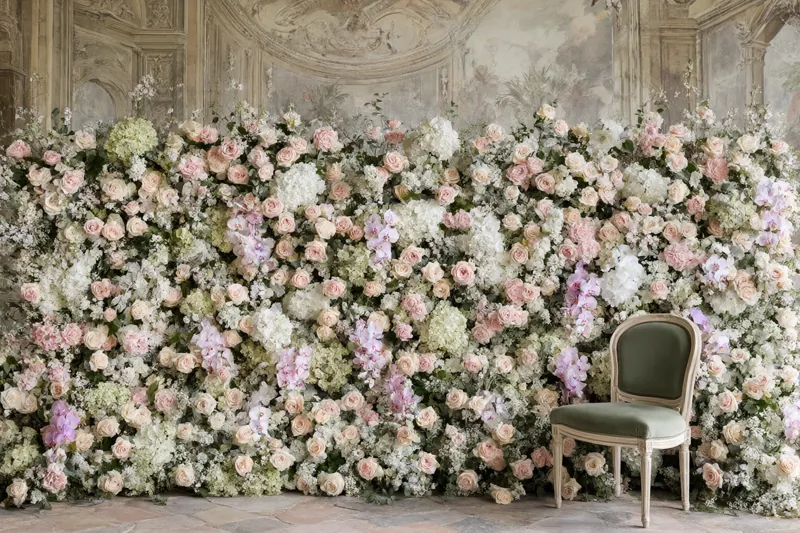
It is a vertical panel covered in flowers, foliage or both. It stands on a frame on the ground or, more rarely, hangs from above. It usually has three uses:
- a photo corner at the reception, where guests take pictures;
- a ceremony backdrop, especially for a civil or symbolic ceremony, in place of an arch;
- a backdrop for the top table or the cake.
It can be full, with dense flowers from bottom to top, or partial: greenery as a base with flowers gathered in one corner or along a diagonal. The partial version costs less and often photographs better, because it gives faces room to breathe.
Fresh, artificial or mixed
| Type | Pros | Cons | Best for |
|---|---|---|---|
| Fresh flowers | Scent, depth, natural colours | High cost, suffer in heat and sun, long set-up | Indoors, cool evenings, ceremony backdrops |
| Artificial flowers | Can be hired, cope with heat, quick set-up | Less lifelike up close, less room to personalise | Photo corners, long events, summer |
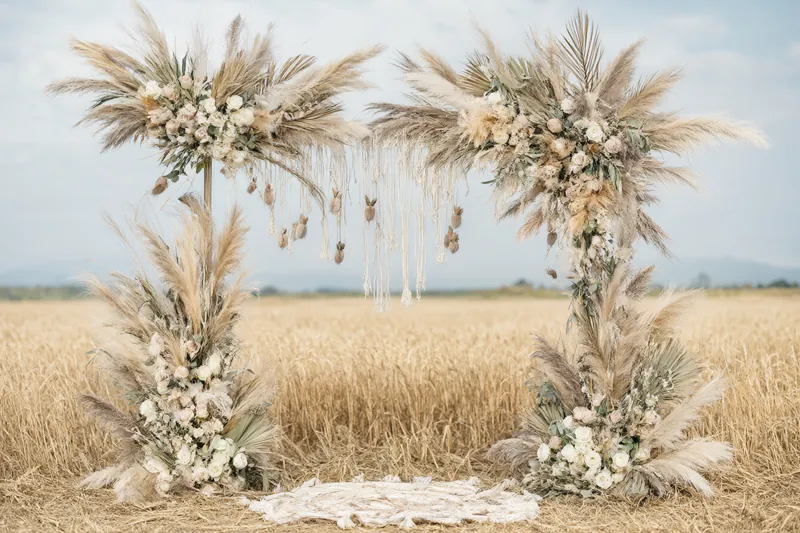
| Preserved or dried flowers | Last, no water needed | Material cost, fragile, possible allergies | Boho and neutral styles |
| Greenery only | Lower cost, natural effect | Less colour | A base for a few fresh flowers |
| Mixed | Balance between effect and cost | Needs careful design | Most weddings |
To understand the difference between preserved and dried flowers, read our guide to dried and preserved flowers. If sustainability matters to you, ask whether the wall can be built without floral foam and what happens to the materials after the party.
Structures and sizes
The wall only stands if the structure does. The most common solutions:
- metal frames with mesh or a grid to which flowers are fixed;
- modular panels, ready-made, that clip together;
- wooden frames with a wide base;
- existing structures at the venue, such as pergolas or railings, if the venue allows it.
There is no rule on size. Think about who will stand in front of it. For a couple's photo the wall must be wider than two people and taller than the taller one, with room above the head. A group photo needs much more space. For a ceremony backdrop the distance from the guests matters: from far away details disappear and blocks of colour count.
Two measurements to always ask for: the weight of the structure and the footprint of the base. A wide base is stable but takes up space and has to be hidden with greenery or fabric.
Set-up and timing
A wall of fresh flowers takes hours of work on site, often with several people. An artificial or modular one goes up faster. Ask:
- how many hours and how many people it takes;
- whether it is prepared in the studio and transported in sections;
- what time the florist can arrive under the venue's rules (many Italian villas set strict access times);
- whether a ladder or mobile scaffold is needed, and who brings it.
If the wall is used first for the ceremony and then for the reception, it has to be moved. Moving a structure full of flowers is not like moving a vase: it takes people, time and a clear route. Consider whether a single wall in one fixed spot makes more sense.
Wind, sun and rain
Outdoors a flower wall is a sail. On the lakes, by the sea and in the hills an afternoon wind is common. Ask your florist:
- how they weigh down the structure: sandbags, weights, stakes in the lawn;
- whether it can be fixed to a wall or pergola with the venue's permission;
- what they do if the wind gets stronger: lower it, turn it, move it under cover.
Direct sun heats fresh flowers and makes them wilt. Place the wall in the shade during the hottest hours or choose hardy flowers. In the rain an artificial wall dries off, while a fresh one gets heavier. Decide the plan B in advance: read our guide on marquees and wet-weather plans.
Lighter alternatives
You do not always need a full wall. If the space is small, the budget limited or the wind frequent, other solutions do a similar job:
- a greenery-only wall with a cluster of fresh flowers in one corner, drawing the eye to one point;
- a frame or arch with flowers only around the edge, leaving the landscape visible behind;
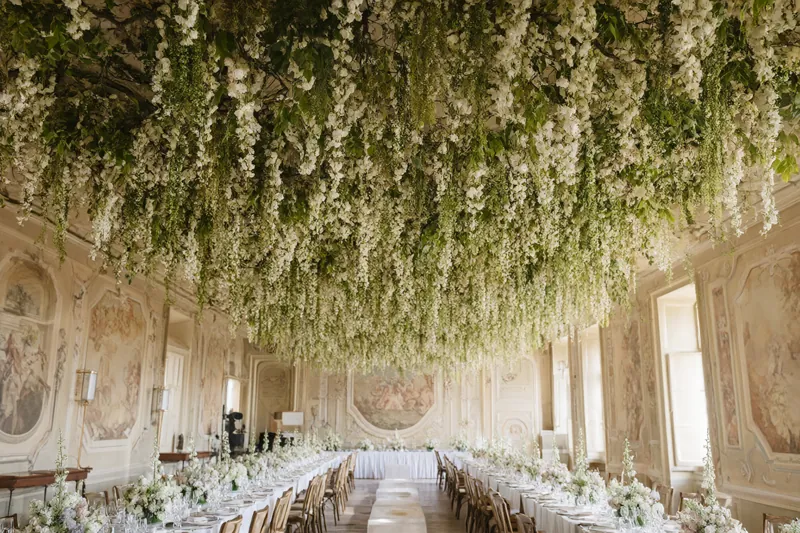
- curtains of flowers or leaves hung from a structure, lighter and less exposed to wind if fixed at the bottom;
- fabric panels with a few arrangements at the foot and on one side;
- a feature of the venue, such as an old doorway, a fountain or a staircase, decorated with flowers.
These options need less material and fewer hours of set-up. In many Italian villas and masserie (the fortified farmhouses of Puglia) the natural backdrop is already beautiful: sometimes framing it is enough.
The cost items
We do not give figures: they depend on size, materials, region and time of year. The items are almost always these.
| Item | What matters |
|---|---|
| Structure | Florist's own or hired, weight, transport |
| Flowers and greenery | Quantity per square metre, type, season |
| Labour | Hours of building in the studio and on site |
| Set-up and take-down | Times, access, late-night work |
| Transport | Distance, vehicles, stairs and narrow access |
| Lighting | Spotlights for evening photos |
| Moving | From ceremony to reception, if planned |
A full wall of fresh flowers is among the most expensive items in a wedding floral budget. A greenery base with fresh flowers concentrated in one area, or a hired artificial wall, usually costs much less. For ways to save without it showing, read our guide to saving money on wedding flowers.
Photos: light and background
The wall has to work on camera. Talk to your photographer:
- in daytime, avoid backlighting: people in front of the wall have the sun behind them and their faces in shadow;
- in the evening, you need dedicated light, soft and from the front;
- the space in front must let the photographer step back;
- very saturated colours can reflect onto skin: ask for a test shot if you can.
Questions to ask your florist
- Have you built flower walls before? Can I see photos of real work, not inspiration images?
- Fresh, artificial or mixed: what do you suggest for my month and my venue?
- Is the structure yours? Is it included in the price or hired separately?
- How much does it weigh and how much space does the base take?
- How do you secure it outdoors? What happens if there is strong wind?
- How many hours does set-up and take-down take? Who takes it down at the end of the party?
- Can it be moved from the ceremony to the reception? With how many people?
- Do you need power or lights? Will you talk to whoever is lighting the party?
How to decide
A flower wall is worth the cost if it stands where guests actually pass and if the light is right for photos. If the space is tight or windy, an arch or a few tall arrangements can do the same job: read our guide to the floral ceremony arch and the one on flower bars and photo corners. Once you know where it will go, request a quote with the size, the venue and how you plan to use it.