In short
- DIY works for small, repeatable pieces: bud vases, posies, place cards, loose greenery.
- It is wiser to hand over the bouquet, ceremony, structures and last-minute set-up.
- The real cost is your time in the days before the wedding, when you have the least of it.
- A mixed approach with a florist is often the calmest solution.
DIY wedding flowers are an appealing idea: they add a personal touch, seem to save money and involve friends and family. Sometimes it works beautifully. Sometimes it turns into a sleepless night with buckets of water everywhere. This guide is for anyone thinking about it who wants to decide with their feet on the ground: what you can do, what to leave to a professional and how to organise it. If you would first like to see what a professional would offer, browse the wedding florists and ask whether they accept mixed arrangements.
What you can do yourself and what you cannot
| Item | DIY? | Why |
|---|---|---|
| Small vases and bottles on tables | Yes | Simple, repeatable, can be prepared ahead |
| Place cards with a flower or sprig | Yes | Table work, done calmly |
| Loose greenery on a long table | Yes, with help | Laid shortly before, needs someone to do it |
| Flowers for the bride's house | Yes | No stress, no strict timing |
| Structured centrepieces | With caution | Need technique and practice |
| Bridal bouquet | Better to hand over | Technical piece, photographed close up, made that morning |
| Buttonholes and corsages | Better to hand over | Small, delicate, made at the last minute |
| Church flowers | It depends | Parish rules, tight time slots |
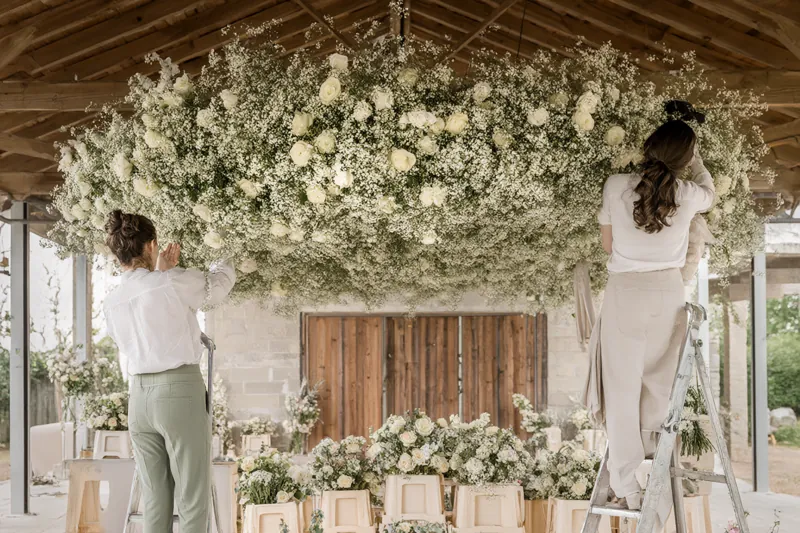
| Ceremony arch and backdrop | Better to hand over | Structures, anchoring, safety |
| Hanging installations | No | Need technical skills and permissions |
This table is a guide, not a rule. People with experience of flowers can go further.
In southern Italy, by the way, it is traditional to decorate the bride's family home on the wedding morning (addobbo della casa della sposa). It is one of the most relaxed jobs to do yourself.
The real problem: time
Flowers are fresh. You cannot prepare them a month ahead. The working window runs from two or three days before the wedding to the morning itself. That is exactly when you have:
- hair and make-up trials;
- guests arriving from out of town;
- final calls with the venue and suppliers;
- dinner with both families;
- the need to sleep.
Many couples only realise this at the end. If you want to go ahead, hand the work to others: friends, relatives, someone you trust. And be realistic about how much they can do, because the next day they are your guests.
Freshness and storage
A professional florist has a cold room, clean buckets, flower food and experience of when flowers open. At home, you have to recreate all that.
What you need:
- a cool, dark room, such as a cellar or a shaded garage;
- clean buckets and plenty of water;
- sharp scissors or a knife to cut stems at an angle;
- space to work and to put finished arrangements down.
In summer it gets harder. In a house without air conditioning flowers can open too fast, and Italian summers can be very hot. To see which flowers cope best with heat, read the guide to a summer wedding with heat-tolerant flowers.
Where to buy the flowers
There are three possible routes:
- A local florist, who orders the right quantities for you and tells you when to collect them.
- A flower market or wholesaler, if they sell to the public. Prices and access rules vary, so check first.
- A local grower, if there are farms near you selling cut flowers.
Either way, choose seasonal flowers: they are easier to find, fresher and often better value. To see what is available in your wedding month, read the guide to seasonal flowers in Italy.
Do not pick wild flowers without knowing whether it is allowed: some species are protected and much land is private. Ask the landowner first and check your region's rules.
The full sum
DIY looks cheap because people only look at the price of the flowers. Here are the items to add:
- vases and containers, if you do not have them;
- tools: scissors, ribbons, chicken wire, water tubes;
- spares: you always buy a little extra, to be safe;
- transport: a car full of buckets of water is awkward and risky;
- set-up at the venue: someone has to bring and place everything;
- takedown: someone has to clear it all at the end of the party, while you are dancing.
Compare the total with a professional quote for the same pieces. Sometimes there is a difference, sometimes it is smaller than you think. To understand how a professional price is built, read the guide to how much wedding flowers cost, and for savings that do not mean doing everything yourself, the one on how to save on wedding flowers.
Venue and church rules
Before planning DIY, ask the venue:
- whether it allows non-professional suppliers to do the styling;
- what time you can get in to set up;
- where buckets and materials can be left;
- who cleans up water, leaves and petals.
In a Catholic church, the parish priest decides. Some parishes have precise rules on what can go where and when. Others work with a florist they trust. Always ask first.
The mixed approach
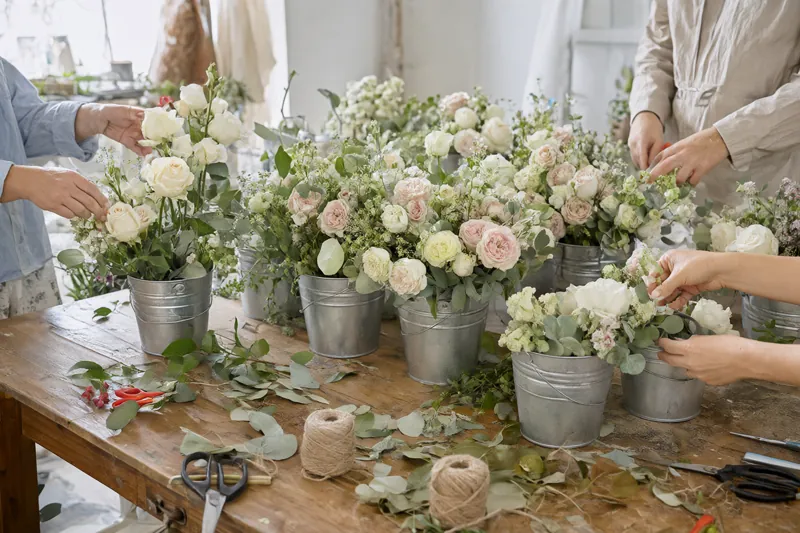
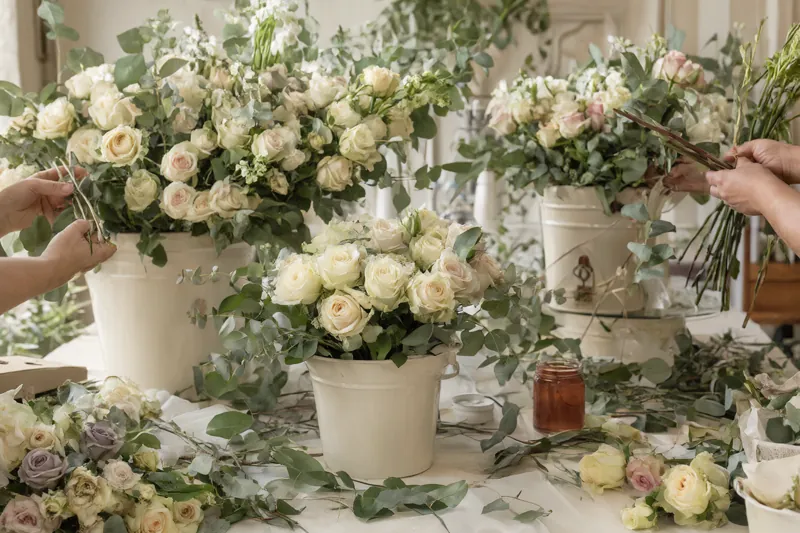
This is the solution that works most often. The florist handles the technical, visible pieces: bouquet, buttonholes, ceremony, any arch. You and your friends prepare the simple pieces: bud vases for the tables, place cards, flowers for the house.
To make it work:
- say so at the first meeting, without embarrassment;
- ask the florist to coordinate palette and flowers, so the result looks consistent;
- ask whether they can supply loose flowers for your DIY part, along with their own;
- agree who sets up what on the wedding day.
Not every florist accepts mixed arrangements, and that is fine. Many are happy to.
A realistic work plan
| When | What to do |
|---|---|
| A few months before | Decide what to do yourself, source vases, do a trial |
| A month before | Order the flowers, organise your helpers |
| Two or three days before | Collect the flowers, put them in water, prepare greenery |
| The day before | Make bud vases and place cards, keep them cool |
| The morning | Transport and place only what cannot be done earlier |
| After the party | Take down, recover vases, dispose of waste |
A trial run a few weeks before is essential: buying a few flowers and making one centrepiece tells you how long it really takes. If you want to learn the basics, a flower arranging workshop can help.
If you or your guests come from far away
At a wedding with many guests from abroad, or in a region where you do not live, DIY becomes much harder. You do not know local suppliers, you have no house to keep the flowers in, and the friends who could help arrive only the day before. Bringing flowers or greenery into Italy from outside the EU also runs into plant health rules. In these cases it is almost always better to rely on a local florist, even if only for the main pieces.
Questions to ask yourself before deciding
- Do I have a cool place to keep flowers for two or three days?
- Who is helping me, and will they be free in the days before?
- Does the venue accept styling done by non-professionals?
- Have I done a trial and do I know how long it takes?
- Who transports, who sets up, who takes down?
- Have I compared the full cost with a professional quote?
To wrap up
DIY is a lovely choice when it is a choice, not a burden in the final days. Decide what you will do and what to hand to people who do it for a living, and leave room to enjoy the evening before.
If you want to try a mixed approach, ask for a quote for just the bouquet and ceremony and see how much it changes.