In short
- Workshops of a few hours are for everyone: you learn by doing and take your own arrangement home.
- For companies and private groups, sessions can be tailored and held at outside venues.
- Professional courses are something else: they last months and are for people who want to make it a career.
- Before booking, check the programme, group size and what is included.
Working with flowers is hands-on and practical, which is why so many people enjoy it. More and more florists run flower arranging workshops for anyone who wants to try: an afternoon making a Christmas wreath, an evening with friends before a wedding, a team-building morning for a company. This guide helps you understand the formats, choose one and know what to expect, whether you live in Italy or are visiting. In the list of floral courses and workshops you will find florists running sessions in several regions.
The most common formats
| Format | Who it is for | Indicative length | What you take home |
|---|---|---|---|
| Open themed workshop | Hobbyists, beginners | A few hours | An arrangement, a wreath, a bouquet |
| Private session | Friends, families, hen parties | A few hours | One arrangement each |
| Corporate team building | Colleagues, departments, clients | One hour to half a day | Arrangements, sometimes for the office |
| Advanced workshop | People with some experience or in the trade | One or more days | Technique on a specific theme |
| Professional course | People who want a career in it | Weeks or months, in modules | Structured training, sometimes a placement |
Lengths are indicative and vary from tutor to tutor. Always ask for the programme.
Open workshops: getting started
They are the easiest way into flowers. They usually follow the seasons:
- spring: loose bouquets, ranunculus, tulips;
- summer: meadow flowers, arrangements with herbs;
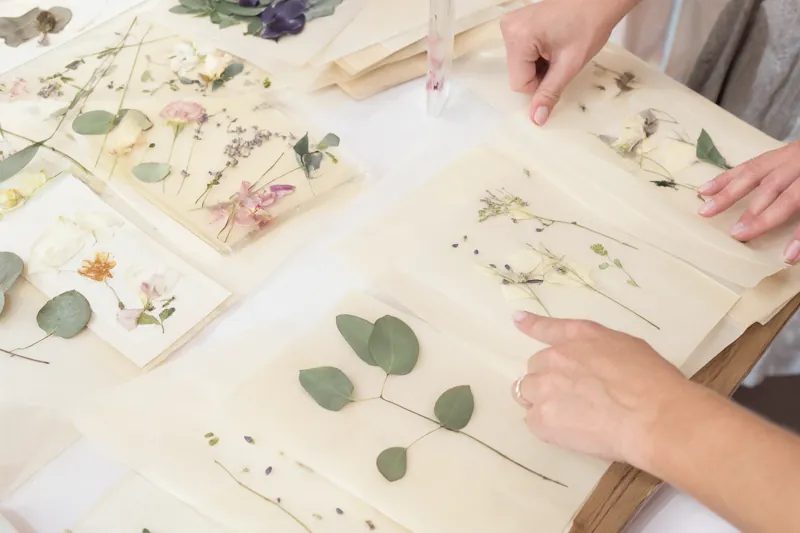
- autumn: wreaths with branches, berries and dried flowers;
- winter: Advent wreaths, Christmas centrepieces.
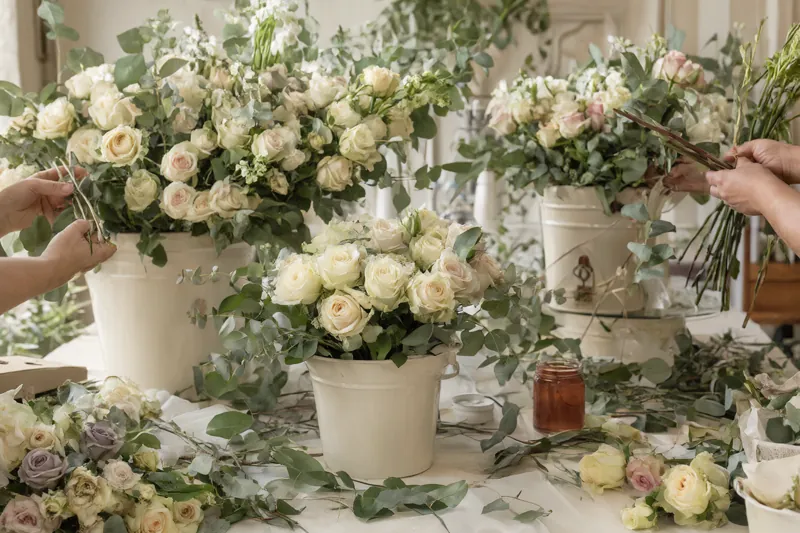
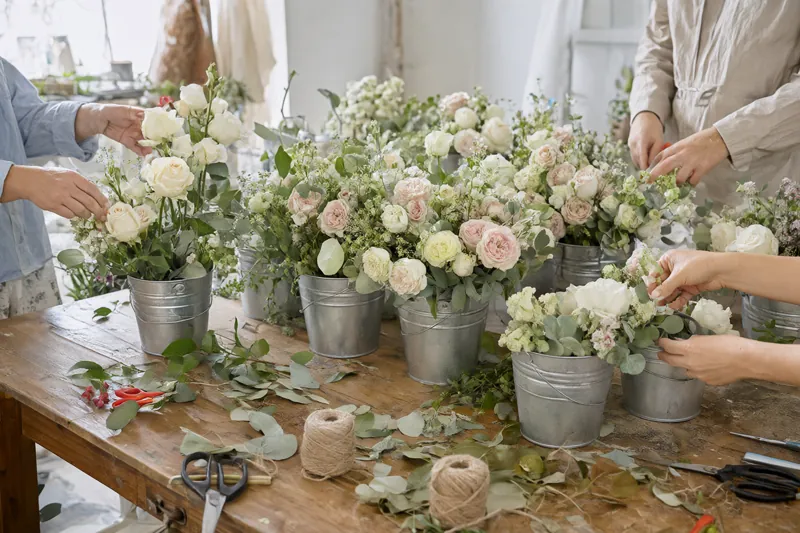
The tutor demonstrates the technique, then everyone works on their own arrangement. Flowers, containers and tools are normally included. Groups are small, because the work is manual and the tutor has to be able to help everyone. Open workshops are mostly taught in Italian; if you do not speak it, ask before booking.
Hen parties and private parties
A flower workshop is a relaxed alternative to a night out. It works well with small groups, can be paired with an aperitivo or a lunch, and everyone goes home with something.
Popular ideas:
- mini bouquets or posies to carry to the party;
- flower crowns to wear straight away;
- arrangements that later become decorations for the wedding.
Ask whether the session can be held at someone's home, in a villa or an agriturismo (a working farm that hosts guests), or only in the florist's studio.
Team building for companies
Flowers suit groups of colleagues because they are accessible to everyone, need no physical strength and produce a visible result. The most common formats:
- individual work, each person making their own arrangement;
- team work, with a shared theme and a short comparison at the end;
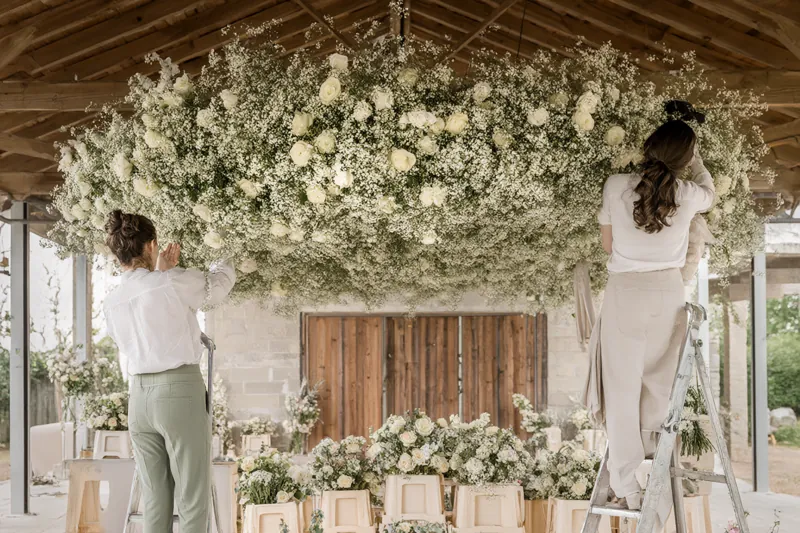
- a group project, such as an installation for the office or an event.
For a company, a few practical points need clearing up: where it takes place (on site, at a venue, at the studio), how much space it needs, how the floor is protected and who cleans up. The arrangements can stay in the office or go home with people.
If the workshop is part of a larger event, coordinate it with whoever handles the styling. The guide to floral design for corporate events explains how florists work with companies.
Workshops during a destination wedding
Couples planning a wedding in Italy with guests from abroad often look for activities for the days before or after. A flower workshop is a popular choice, alongside cooking classes and wine tastings. It works well in a villa or an agriturismo, in the morning, with local flowers and greenery: olive and citrus in the south, roses and herbs in the hills, meadow flowers in the mountains in the right months.
Ask the florist whether they teach in English or other languages, and whether they can use flowers left over from the wedding. To organise the rest, read the guide to a destination wedding in Italy.
Professional courses: for a career
If you want to become a florist or floral designer, you need longer training. There are courses run by private schools, trade associations, vocational training bodies and floral design studios. Some are modular, others intensive.
Before enrolling, consider:
- hands-on hours: how much time you actually spend working with flowers;
- topics: shop work, events, weddings, quoting, logistics;
- tutors: who they are and what they have done;
- placement: whether the course includes work on real events;
- certificate: what it is worth and who issues it.
To open a business in Italy, besides training you need to complete the formalities required of any company. Ask at the Chamber of Commerce (Camera di commercio) in your province or speak to an adviser. To understand how roles differ in the trade, read the guide to florist, floral designer and wedding designer.
Workshops for children and families
Some florists also run sessions for children, at birthday parties, family days for companies or seasonal markets. They need sturdy flowers, age-appropriate tools and one adult for every few children. Ask that no toxic or thorny plants are used and that the session is designed specifically for younger children.
What is included and what is not
Items to check before booking:
| Item | Question to ask |
|---|---|
| Flowers and greenery | Are they included? How many stems per person? |
| Tools | Scissors, wire, ribbons: do you supply them? |
| Container | Is a vase or basket included, and do I keep it? |
| Food and drink | Is there an aperitivo or lunch? Is it extra? |
| Venue | Is it at your studio, or do we need a space? |
| Group size | Is there a minimum and a maximum? |
| Cancellation | What happens if the group gets smaller? |
Sustainability in workshops
Many florists now work without floral foam, using chicken wire, water tubes or a kenzan (a metal pin holder). Ask whether the workshop uses seasonal, Italian-grown flowers and how waste is disposed of. It is a good way to learn more environmentally careful techniques too. Find out more in the guide to sustainable floral design.
What to bring and what to expect
- Comfortable clothes that can get water and soil on them.
- A bag or box to carry your arrangement home. If you are staying in a hotel, think about where it will go.
- Patience: your first bouquet is never perfect, and that is fine.
If you are allergic to pollen or certain plants, say so in advance. The tutor can choose different flowers for you.
What a workshop costs
The price varies a lot between formats and between cities. The items that make it up are almost always the same: flowers and greenery for each participant, the container, the tutor's hours, any assistant, the space, food and drink, and travel if the session is held off site. For a private or corporate group, ask for a per-person price and a total, with the minimum number of participants, and check whether VAT (IVA) is included. Here too, seasonal flowers help keep costs down.
Questions to ask before booking
- Is the workshop suitable for beginners?
- What is the maximum group size?
- What does the price include?
- Which flowers will we use? Are they in season?
- Can it be held privately, at an outside venue?
- Which language is it taught in?
- How does cancellation work?
- For professional courses: how many hands-on hours, what placement, what certificate?
To wrap up
A workshop is a good way to understand how much work goes into every arrangement. Many couples who have done one look at their wedding quote with different eyes. If instead you want to make part of your wedding flowers yourself, first read the guide to DIY wedding flowers.
If you are looking for a session for a group or a company, ask for a quote with the number of people, the town and the dates.