In short
- Lemons, oranges and olive bring the landscape of Southern Italy and the lakes into your decor.
- They are used as potted trees, fruiting branches, leaves or loose fruit on the table.
- Plants are hired: ask about weight, size, transport, placement, collection and deposit.
- Moving some plants, such as olive trees, is regulated in certain areas: rely on nurseries and suppliers.
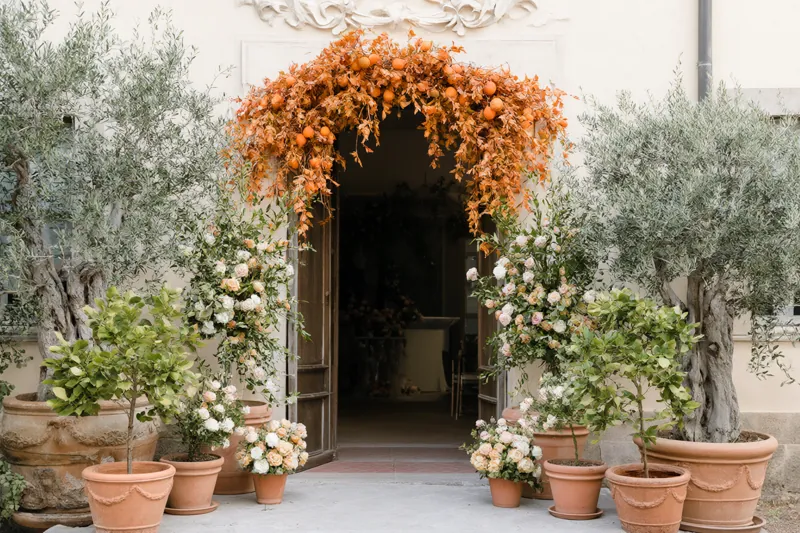
Lemons on the table, potted olive trees along the path, orange branches on the arch: it is one of the strongest images of a wedding in Italy, especially for couples coming from abroad. Lemon themes are popular well beyond weddings, from bridal showers to rehearsal dinners. This guide explains how lemon and olive tree wedding decor really works, what is available and when, how plant hire works and what to ask before you sign.
Why they work
Citrus and olive tell the story of a place. On the Amalfi Coast, in Sicily, in Puglia and on Lake Garda, with its historic lemon houses, they are part of the landscape. Bringing them into your decor makes the party feel at one with what your guests see around them.
They also have practical advantages:
- they cope well with heat, better than many cut flowers;
- they add volume with little arranging work;
- potted, they can be moved from the ceremony to the reception;
- the fruit adds colour to the table without needing many flowers.
If you are getting married in the South or by the sea, see our florists for destination weddings in Italy: many work in exactly this style.
Four ways to use them
| Element | How it is used | Points to watch |
|---|---|---|
| Potted trees | Paths, entrance, outdoor ceremony, corners of the room | Weight, transport, placement, watering, collection |
| Fruiting branches | Arches, large vases, garlands | Weight of the fruit, branch life, fruit falling |
| Citrus and olive leaves | Greenery for centrepieces and garlands | Light scent, good vase life |
| Loose fruit | On the table, in bowls, on the seating plan | Away from served food, no treated fruit near plates |
Many designs combine several elements: two olive trees at the entrance, a garland of leaves and lemons on the banquet table, a few white flowers.
Potted trees: how hire works
Potted trees are hired, usually from florists or nurseries with their own stock. A serious quote states:
- the number and size of the plants, with height;
- the type of pot: terracotta, concrete, decorative outer pot;
- transport, placement and collection, with times;
- the deposit and any costs if something is damaged;
- care: who waters them if they sit in the sun for hours.
A large potted olive tree can be very heavy. It needs suitable vehicles and several people to move it. Before choosing one, check with the venue: access, stairs, delicate floors, lifts, terraces with load limits. A terrace on the Amalfi Coast reachable only on foot changes everything. For hiring vases and structures, see our guide to hiring vases and floral structures.
Lemons, oranges, mandarins: what is available and when
Seasons are indicative and vary with region and year.
- Lemons: plants and fruiting branches are available for much of the year. Some varieties flower and fruit several times.
- Oranges and mandarins: ripe fruit is more typical of winter and spring.
- Small ornamental citrus, such as kumquat and calamondin: often available potted, even in winter.
- Zagara, the citrus blossom: very fragrant, it blooms mainly in spring. Cut, it lasts little, so a potted tree in flower is used more often. In Italy orange blossom has long been linked to brides, as a symbol of purity and good fortune.
Fruit is heavy. On an arch or a garland it has to be fixed carefully, because a lemon falling on a guest or on a laid table is not a minor detail. Ask your florist how they secure it.
Olive: trees, branches and leaves
Olive is used in three forms:
- potted trees, even large ones, for paths and outdoor ceremonies;
- branches in tall vases and arches;
- leaves as greenery for centrepieces and garlands, silvery and bright.
Olive branches last well in water; out of water the leaves curl after a few hours. For all greenery, olive included, see our guide to wedding greenery.
Plant-health rules: why use nurseries
Living plants are not ordinary objects. In the European Union, plants intended for planting that move between professional operators travel with a plant passport. Some diseases have specific rules. One example is Xylella fastidiosa, a bacterium that has hit many olive trees, especially in Puglia: moving host plants, olive included, out of the demarcated areas is regulated.
For you this means something simple: do not buy or move potted olive or citrus trees from improvised sources. Rely on nurseries and florists who know the rules. If in doubt, ask where the plants come from. The same applies to branches: they come from suppliers and growers, never cut from someone else's trees. And if you were thinking of taking a little tree home: bringing plants into the UK, the US, Australia or Canada is subject to strict import rules, so check with your own country's authorities first.
On the table: fruit and food
Lemons and oranges on the table look lovely, but they remain decoration. A few precautions:
- decorative fruit may be treated on the surface: keep it away from food being served;
- do not use decorative leaves or flowers as a garnish, unless the caterer supplies them as food-grade;
- leave space for plates, glasses and service.
For practical rules, see our guide to food-safe flowers.
Citrus in winter, olive all year
Citrus is not just for summer. In winter oranges, mandarins and kumquats are at their best, and branches with ripe fruit look wonderful in a Christmas design or a January wedding, with dark greenery and candles, where the venue allows them. Olive, an evergreen, works in every season: silvery and light in summer, simple and bright in winter. Lemon and orange leaves are valuable greenery too: glossy, fragrant when rubbed, and long-lasting.
Citrus and flowers: what goes together
Citrus pairs well with white flowers (roses, lilies, jasmine, white carnations), with Mediterranean greenery and with the blue of Southern Italian ceramics. With very colourful flowers it risks becoming an explosion of tones. For the complete look, see our guide to the Mediterranean style.
Questions to ask your florist
- Are the potted plants yours or from a nursery? Where do they come from?
- What size and weight are the largest pots?
- Does the hire include transport, placement, collection and care?
- Is there a deposit? What happens if a plant is damaged?
- How do you secure fruit on arches and garlands?
- Can you find branches with ripe fruit on my date?
- Can the plants be moved from the ceremony to the reception?
Final thoughts
Citrus and olive give character without needing lots of flowers. The real work is in the logistics: weights, access, timings and rules. If you are marrying on the Amalfi Coast or in Sicily, our guide to Amalfi Coast wedding flowers deals with exactly those stairs, terraces and transport issues.
Once you have a date and a venue, request a quote and ask straight away which plants are available and how they will reach the venue.
Sources
- Regulation (EU) 2016/2031 on protective measures against pests of plants: https://eur-lex.europa.eu/eli/reg/2016/2031/oj
- Commission Implementing Regulation (EU) 2020/1201 on measures to prevent the introduction into and the spread within the Union of Xylella fastidiosa: https://eur-lex.europa.eu/eli/reg_impl/2020/1201/oj