In short
- Christmas displays are installed between late November and early December: businesses and hotels should book in the autumn.
- Greenery (fir, pine, cypress, eucalyptus) is the base; flowers, berries and lights add the colour.
- With the heating on, fresh greenery dries faster: ask for checks and replacements.
- Poinsettia, mistletoe and holly should be kept away from children and pets.
December is the busiest month for anyone who works with flowers and greenery. Homes, shops, hotels, offices, churches and company dinners all want decorations at the same time. This guide to Christmas floral decorations is for anyone who needs to dress a space for the holidays, whether a business, a hotel, a church or their own home (or a villa rented for Christmas in Italy). It covers what to ask for, when to book and how to make the decorations last until Epiphany on 6 January, when Italians traditionally end the season.
To find professionals who handle this kind of work, see the list of florists for Christmas decorations.
Timing: book early, install early
The Christmas calendar is tight and the same for everyone:
| Period | What usually happens |
|---|---|
| September to October | Businesses and hotels request quotes and designs |
| November | Orders are confirmed and materials prepared |
| Late November to early December | Installation in shops, hotels and offices |
| December | Company dinners, events, private parties, winter weddings |
| After Epiphany (6 January) | Takedown and collection of hired items |
If you leave it late, you will find less availability and less choice. If you run a space open to the public, also ask about the takedown date: many florists fix it straight after 6 January.
Christmas trees: cut, potted or artificial
| Type | Pros | Cons |
|---|---|---|
| Cut real tree | Scent, natural look | Dries in the heat, drops needles, needs disposal |
| Potted real tree | Can be replanted or returned, if the service allows | Heavy, struggles in very warm rooms |
| Artificial tree | Reusable, no upkeep | Less natural, upfront cost |
| Hired tree | Set up and collected by the supplier | Needs booking early |
In shops, hotels and offices, large trees are often hired, with the decorations installed as part of the service. In public buildings, ask whoever manages the building about rules on decoration materials and lights: fire safety may require specific standards. Always check with the person in charge of the building.
Garlands, swags and doors
Garlands are the most recognisable sign of Christmas. They go on doors, fireplaces, staircases, counters and tables. Common ingredients:
- greenery: fir, pine, cypress, cedar, eucalyptus;
- berries and fruit: cultivated red berries, pomegranates, dried oranges, pine cones;
- flowers: roses, amaryllis, hellebore, anemones, ranunculus;
- details: ribbons, cinnamon, LED lights.
For an outdoor garland the climate matters. In northern Italy the cold keeps greenery fresh but the wind damages it; in the south the sun dries it out. Ask the florist what holds up in your area.
Christmas centrepieces
For a festive table the same rules apply as at a wedding: guests need to see and talk to each other, and there must be room for plates and glasses. Some common options:
- a low garland running down the table, with candles at intervals;
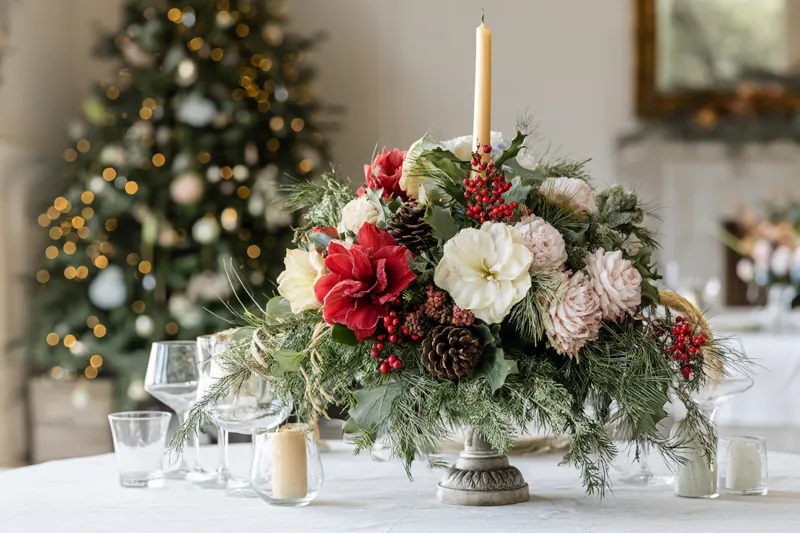
- a central arrangement of greenery, pine cones, fruit and a few flowers;
- small vases of amaryllis or flowering branches, repeated along the table;
- potted plants as centrepieces that guests can take home.
Keep real candles away from dry greenery and never leave them burning unattended. In restaurants and venues, the venue decides whether they are allowed. For more, read the guide on flowers and candles.
Christmas plants and flowers
| Plant or flower | Typical use | Note |
|---|---|---|
| Poinsettia | Pots, arrangements, churches | Irritant sap: keep away from children and pets |
| Amaryllis | Single pots, tall arrangements | Bulb is toxic if eaten |
| Hellebore (Christmas rose) | Low arrangements, garlands | Toxic plant, handle with care |
| Mistletoe | Doors, arches | Toxic berries |
| Holly and butcher's broom | Garlands, centrepieces | Use cultivated plants: picking from the wild is often regulated |
| Cyclamen | Pots, windowsills | Copes with cool rooms, less with dry heat |
| Red and white roses | Elegant arrangements | Available all year round |
Many Christmas plants should not be eaten. That is not a reason to avoid them, but in homes with children and pets they belong up high. In several Italian regions, picking holly, butcher's broom and other wild species is regulated or banned, so florists buy them from nurseries. If you want a more sustainable Christmas, the guide to sustainable floral design explains how to cut plastic, floral foam and waste.
Businesses and hotels: December is event month
For a business, Christmas often means two separate jobs:
- Dressing the spaces for the whole season: entrance, reception, windows, offices.
- One-off events: the company dinner, a staff party, a client event.
It makes sense to give both to the same florist, who can reuse some materials and keep the style consistent. Ask whether Christmas decorations are part of any flower subscription you already have or invoiced separately. For the dinner, read the guide to flowers for gala dinners as well.
Churches at Christmas
For Christmas Mass, Italian parishes often have their own volunteers or a florist they trust. If you want to donate flowers to a church, or if you are getting married over the holidays, ask the parish priest first. In many churches the nativity scene (presepe) and Christmas decorations are already in place, and wedding flowers have to fit around them. The guide to a winter wedding explains how.
What it costs
There are no standard prices. The cost depends on size, the amount of greenery, flowers, lights, hire, installation and takedown. For spaces open to the public, labour adds a lot to the cost, because installation often happens at night or out of hours. Ask for these items to be listed separately: materials, hire (trees, vases, structures), lights, installation, maintenance, takedown and disposal. Check whether VAT (IVA) is included in the quote; businesses will usually see it added on the invoice.
Shop windows
For a shop, the Christmas window is also a sales tool. Flowers and greenery should frame the goods, not hide them. A few practical points: keep arrangements away from spotlights and heat sources, which dry greenery in a few days; choose materials that do not drop needles or petals on the products on display; plan at least one check in mid-December, when customer traffic and heating start to take their toll.
Questions to ask the florist
- When can you install, and when do you take it down?
- Is the tree cut, potted, artificial or hired?
- Are lights included? Who connects them, and who is responsible if they fail?
- Will the greenery last until Epiphany with our heating?
- Is there a check or replacement in mid-December?
- Do you use cultivated greenery and berries?
- How do you dispose of trees and greenery at the end?
Christmas dinner at home
For a family dinner you do not need a hotel-style display. A low centrepiece with greenery, fruit and a few flowers, a garland on the door and a small posy in the bathroom or hallway are enough. You can ask the florist to deliver everything the day before, so you have time to lay the table calmly. If there are small children or pets, ask for arrangements without toxic berries and without real candles.
To wrap up
Good Christmas decorations are booked early, installed in a few days and have to last more than a month. Asking about timing, maintenance and takedown from the start saves unpleasant surprises in January.
If you manage a business space, read the guide to floral design for corporate events. When you have measurements and dates, ask for a quote.