In short
- Greenery gives structure, volume and breathing space to arrangements: it is not just a filler.
- The most used: eucalyptus, olive, ruscus, pittosporum, ivy, ferns and Mediterranean greenery.
- Per stem it often costs less than flowers, but long garlands need plenty of material and labour.
- Vase life varies a lot: some greens last hours out of water, others dry out quickly.
When you look at a floral arrangement, you often remember the flowers. But half the effect comes from the wedding greenery. This guide is for couples who want to understand which foliage to choose, how much it affects the cost and how long it lasts. You will find a table of the most used greens, the role of Mediterranean greenery and the questions to ask your florist.
What greenery is for
Foliage is not a side dish. It does three jobs:
- structure: it holds the flowers in place and gives the arrangement its shape;
- volume: it fills space with fewer flowers, so at a lower cost;
- style: loose, flowing greenery looks natural; compact greenery looks more formal.
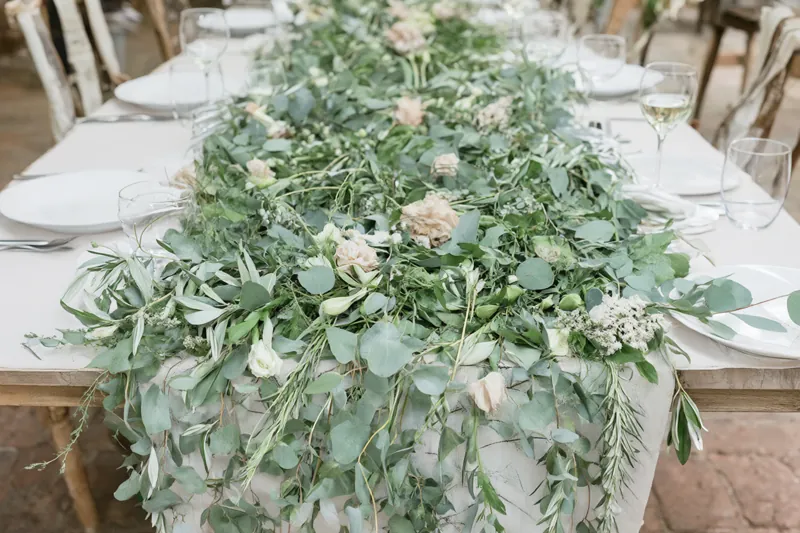
Many designs today make greenery the star. Garlands along banquet tables, arches of foliage, long branches in large vases. If you are looking for florists who work in this style, start with our list of wedding florists across Italy.
The most used greens
| Greenery | Look | Indicative vase life | Typical use |
|---|---|---|---|
| Eucalyptus (several varieties) | Round or long grey-blue leaves, fragrant | Good, copes with a few hours out of water | Garlands, bouquets, centrepieces |
| Olive | Thin silvery leaves, light branches | Good in water; out of water it dries after a few hours | Mediterranean style, church, tables |
| Ruscus | Small glossy leaves on long stems | Very good | Garlands, bases, arches |
| Pittosporum | Glossy leaves, green or variegated | Good | Filling, large arrangements |
| Ivy | Trailing stems | Good if in water | Cascades, cascading bouquets, tables |
| Ferns | Light, finely cut fronds | Varies: some very hardy, others delicate | Bouquets, bases |
| Mastic and myrtle | Small dark green leaves, fragrant | Good | Mediterranean style, Sardinia and the South |
| Magnolia | Large leaves, glossy on top and bronze underneath | Very good | Garlands, winter, classic style |
Vase life is indicative: it depends on heat, humidity and how the greenery has been stored.
Eucalyptus: the most versatile
Eucalyptus works in almost every style. There are several varieties: with round, coin-like leaves, with long thin leaves, with small round seed pods. The colour ranges from grey-green to blue.
It has a strong scent that many people like. On a table, in large amounts, you will notice it. Some thin-leaved varieties dry faster and tend to curl: for a garland that has to last many hours, your florist will choose the hardier ones.
Olive: the greenery of Italy
The olive (Olea europaea) is part of the landscape in many Italian regions, from Puglia to Tuscany, from Sicily to Lake Garda. The branches have thin, silvery leaves that catch the light. It is perfect for a Mediterranean style and for weddings in the countryside, at a masseria (a fortified farmhouse in Puglia) or in a hill town.
A few things to know:
- branches come from suppliers and growers, never cut from someone else's trees;
- they last well in water; out of water the leaves curl after a few hours;
- olive is also a symbol of peace, welcome in church;
- in full bloom, in spring, olive pollen can bother people with allergies: branches used in decorations are usually not in flower, but it is worth knowing.
For whole potted trees, see our guide to lemon, orange and olive trees in wedding decor.
Mediterranean greenery
As well as olive, the South and the islands offer very recognisable greenery: myrtle, mastic, bay laurel, rosemary, lemon and orange leaves. They are fragrant, they last well and they speak of the place. In Sardinia and Puglia, in Sicily and on the Amalfi Coast they are often the base of simple designs, with a few white flowers and candles.
One thing to be careful about: wild Mediterranean scrub cannot be picked freely. In many areas, especially in parks and protected zones, collecting plants is forbidden or restricted. Your florist uses cultivated material or buys from suppliers. For the full style, see our guide to the Mediterranean style.
Does greenery cost less?
Per stem, often yes. But watch the numbers:
- a garland along a banquet table many metres long needs a lot of material and hours of work;
- a greenery-only arch needs a frame and a long set-up;
- some special greens cost as much as a flower.
The saving is real when greenery replaces expensive flowers, not when it is added to an already rich design. For other strategies, see our guide on how to save on wedding flowers.
Fresh, preserved or artificial greenery
Greenery is not only fresh. There are also:
- preserved greenery: real leaves treated to last a long time without water. Preserved eucalyptus, ruscus and ferns are common. Useful for designs set up many days in advance or for long-running installations;
- dried greenery: branches, grasses and dried leaves, suited to boho style and autumn designs;
- artificial greenery: sometimes used for very large or reused structures. Up close it is recognisable, and not everyone likes it.
Each option has pros and cons. We cover them in our guide to dried and preserved flowers.
White and green: a classic
A much-requested combination for church and reception is white and green: white flowers, plenty of foliage, sometimes candles. It is elegant, suits almost any venue and holds its own against grand architecture. It works in every season, simply by changing the flowers: ranunculus in spring, roses and hydrangeas in summer, roses and amaryllis in winter.
Greenery and the seasons
Greenery has its seasons too, more than you might think:
- spring: blossom branches, young pale leaves, ferns;
- summer: olive, vine leaves, grasses;
- autumn: turning leaves, berried branches, oak leaves;
- winter: pine, fir, magnolia, bare branches, moss.
Many greens, such as eucalyptus and ruscus, are available all year. Part of the ornamental greenery sold in Italy is grown in the country, especially in Liguria and Tuscany.
Questions to ask your florist
- Which greens do you suggest for my style and season?
- Which will last best in the hours between set-up and the end of the party?
- Is the greenery Italian grown or imported?
- Is the table garland made with fresh greenery or partly preserved?
- Could the scent of eucalyptus be too strong at the table?
- Can the ceremony greenery be reused at the reception?
- How many people and how many hours does it take to set up garlands and greenery arches?
- Is the Mediterranean greenery you suggest cultivated or bought from suppliers?
Final thoughts
Greenery is half the design, and often the part that holds up best through the hours of the party. Choosing it well means richer, longer-lasting arrangements that suit the place. To pair it with seasonal flowers, read our guide to seasonal flowers in Italy.
Once you have a date and a venue, request a quote and ask the florist which greenery they suggest and how much it adds to the bill.