In short
- In Sardinia flowers must cope with strong sun, salt air and wind: choose hardy varieties and well-anchored structures.
- Mediterranean scrub (myrtle, helichrysum, mastic, olive) and succulents give a design rooted in the place, and a tougher one.
- A beach ceremony needs Comune rules and permits: check before you fall in love with a spot.
- On an island logistics count for a lot: flowers, hire items and team may arrive by sea, with timings to plan.
This guide is for you if you are planning a Sardinia wedding: on the Costa Smeralda, in the north-west around Alghero, on the south coast or inland. You will find seasons, venues, flowers that cope with the island climate, rules to ask about and questions for your floral designer.
Why Sardinia
Clear sea, white beaches, granite rocks, fragrant scrubland. Sardinia attracts Italian couples and many from abroad: northern Europe, Germany, the UK and the US. Couples who choose it usually want a wedding by the sea, outdoors, with strong light and long sunsets.
The landscape already does a lot. Flowers give shape to the spaces: ceremony, table, aperitivo. To find who works on the island, start with the list of floral designers in Sardinia.
Sardinia wedding venues
| Venue | Where it is often found | What it asks of the flowers |
|---|---|---|
| Seaside resort or hotel | Costa Smeralda, the south, the north-west | Working within the venue's rules, organised access |
| Private villa | North-east coast, hills above the sea | Logistics built from scratch: water, shade, working space |
| Stazzo or country farmhouse | Gallura and inland | Stone and granite, rustic set-ups, gravel roads |
| Beach or seaside terrace | All along the coast | Wind, sand, permits, anchoring |
| Village or country church | Inland and coastal towns | Parish rules, small spaces |
A stazzo is the traditional rural house of Gallura, in the north-east: built of stone, often among rocks and cork oaks. Many have been turned into event venues.
The wind: the first "supplier" to consider
In Sardinia wind is part of the climate. The maestrale (mistral), from the north-west, can blow hard for days, even in summer. You cannot predict it months ahead, so design as if it will be there.
What changes for the flowers:
- low arrangements on outdoor tables, with heavy bases;
- arches and structures anchored to the ground, never just standing;
- no open candles outdoors: closed lanterns or battery lights, always within the venue's rules;
- tablecloths secured and nothing light that can fly away, such as loose petals or long ribbons;
- hardy flowers: delicate ones tear and dry out quickly.
Always ask for a sheltered plan B: a portico, a hall, a marquee. Your florist must know which pieces to move and how fast. For the arch and outdoor ceremony, read the guide on floral arches for the ceremony.
Sun, heat and salt air
In summer the sun is strong and humidity near the sea can be high. Cut flowers suffer: they wilt sooner and petals scorch. Some choices help:
- set up as late as possible, with flowers kept cool until the last moment;
- use containers with a water source rather than dry arrangements;
- move the ceremony to late afternoon, when the sun is lower;
- lean on greenery and plants that know the heat well.
For many couples the best seasons are late spring and September: the sea already or still warm, temperatures easier to manage, the island less crowded. July and August are the busiest and the hottest months, and mid-August (Ferragosto) is peak Italian holiday time. For summer flower choices, read the guide on flowers that cope with the heat.
Mediterranean scrub and succulents
The macchia is the low, fragrant scrub that covers Sardinia's coasts. It is the material most tied to the place, and often the toughest.
| Plant | What it brings to the design | Watch out for |
|---|---|---|
| Myrtle | Glossy leaves, dark berries in autumn, scent | It is also a wedding symbol in many traditions |
| Helichrysum | Dry yellow flowers, intense scent | Strong scent near food |
| Mastic (lentisk) | Dense, hardy greenery | Excellent for garlands and bases |
| Olive | Silvery leaves, branches and potted trees | Potted trees must be hired and transported |
| Juniper | Dark, structured branches | Prickly branches, handle with care |
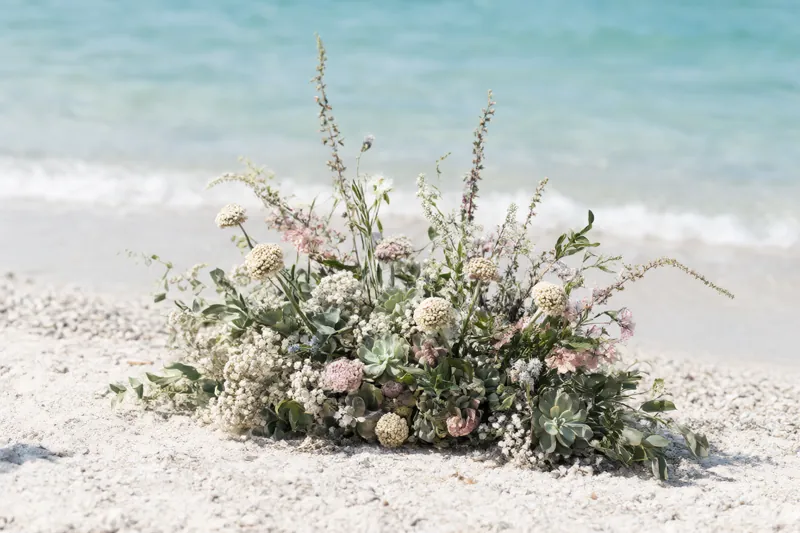
| Succulents and agaves | Sculptural shapes, long-lasting | Spines and weight, keep away from walkways |
| Bougainvillea | Intense colour, very Mediterranean | Delicate once cut |
One important rule: nothing is picked from the wild without knowing whether it is allowed. Many coasts are parks or protected areas. Florists source from nurseries and growers.
Watch out for oleander, very common in Sardinian gardens: it is a toxic plant and must not go near food or where children play. On this topic, read the guide on flowers near food.
Beaches: rules and respect for the place
A ceremony on the sand is the picture many couples have in mind. Before you choose it, check:
- who grants the space: beaches are public state property (demanio) and usually need authorisation from the Comune (the town council);
- whether the beach is in a protected area, where rules are stricter or events are not allowed;
- times and crowds: in August a public beach is never really empty;
- what can be left: no petals, paper confetti or decorations on the ground without a cleaning plan.
In Sardinia it is forbidden to take sand, pebbles and shells from the beaches. Do not use them in your decor and do not give them to guests. Ask the Comune which rules apply.
Often the best solution is a venue with a terrace or private access to the sea: the same view, fewer unknowns.
The logistics of an island
Marrying in Sardinia means everything must reach the island or already be there. For flowers:
- many varieties arrive from the mainland, by ship or plane: ask about timing and cost;
- hire items such as vases, structures and furniture may come from the island or from outside;
- if your florist comes from mainland Italy, travel includes the ferry, van, accommodation and the team's time;
- in high season ferries and accommodation fill up, so book early.
Distances count on the island too. From Cagliari to the Costa Smeralda is several hours by road. A local team near your venue cuts time and risk. If you are planning from abroad, read the guide on how to organise your flowers from a distance.
Questions to ask your floral designer
- Have you worked at this venue or on this coast before?
- Which flowers do you find in Sardinia and which do you bring from the mainland?
- How do you anchor arches and structures against the wind?
- Which arrangements cope best with sun and salt air?
- Do you have a plan B if the wind is too strong?
- Is travel (ferry, accommodation, van) included?
- Who applies for beach permits, if they are needed?
- Who clears petals and materials after the ceremony?
Final thoughts
In Sardinia the most beautiful flowers are often the ones that look as if they grew there: scrubland greenery, olive, succulents, a few hardy blooms. Think about the wind from the start, check the beach rules and rely on people who know the island. For a wider view, see the list of floral designers for destination weddings.
Once you have a date and venue, request a quote and ask how the team handles wind, heat and travel.