In short
- Centrepieces are often the biggest line in the flower budget, because they multiply by the tables.
- As an indicative range: low €40 to €150, tall €120 to €400 and up, each.
- Vases, stands and candelabra are often hired, with a deposit.
- Mixing low and tall pieces and reusing ceremony flowers are the most effective ways to spend less.
What does a wedding centrepiece cost in Italy? One centrepiece on its own does not cost much. Multiplied by fifteen or twenty tables, it becomes the most important part of the flower quote. This guide helps you understand what each type of centrepiece may cost in Italy, what sits behind the price and where you can save without making the room look bare.
Why centrepieces cost so much
The sum is simple: price per piece times number of tables. With 120 guests at tables of 8 to 10, you need 12 to 15 centrepieces, plus the top table. A difference of €50 a piece adds €600 to €750 to the total.
That is why it pays to decide the table layout early: round, long banquet tables or a mix. It changes the number of pieces and the type of arrangement. If you are looking for someone to design the room in your chosen area, start from the list of wedding florists in Italy.
What different centrepieces cost
The ranges below are indicative, per piece, with fresh seasonal flowers and labour. They do not include long-distance travel.
| Type | Indicative range | What moves it |
|---|---|---|
| Low arrangement in a vase or bowl | €40 to €150 | Diameter, flowers, amount of foliage |
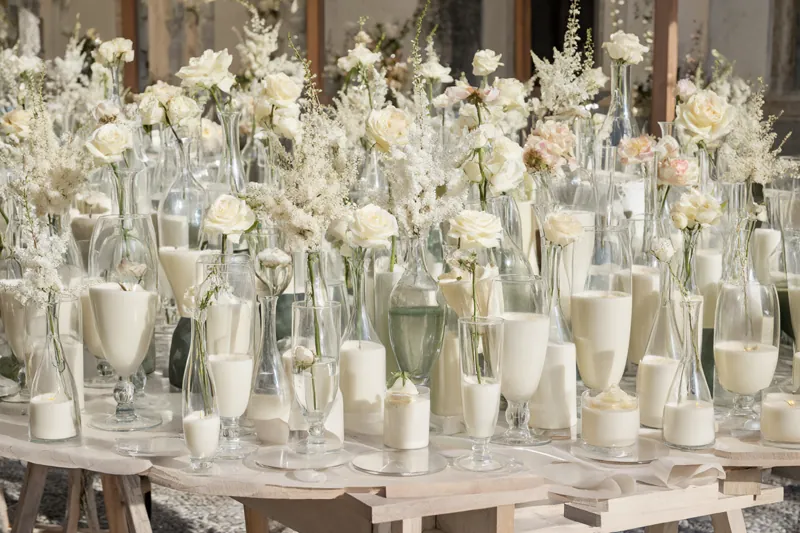
| Cluster of bud vases and bottles with single stems | €30 to €90 | Number of vases, glass hire |
| Tall centrepiece on a stand or candelabra | €120 to €400 and up | Height, structure, volume of flowers |
| Foliage garland on a long table | €25 to €80 per metre | Foliage only or with flowers, density |
| Garland with flowers and candles | €60 to €150 per metre | Flowers added, candles, protection |
| Top table arrangement | €200 to €900 | Length, front piece or garland |
Height is not just an aesthetic detail. A centrepiece has to let guests see and talk to each other: either low, or very tall on a slim stem. Ideas for every table shape are in the guide to wedding centrepieces.
Round tables and long banquet tables
Round tables
One piece per table, in the centre. Many florists suggest a mix: some tables with low arrangements and others with tall centrepieces, alternating. The room looks full and the cost stays below that of tall pieces everywhere.
Long banquet tables
On long tables the price works by the metre. A foliage-only garland, with eucalyptus, olive or ruscus, costs less than a dense garland of flowers. A common solution is a continuous foliage garland with small clusters of flowers here and there, plus candles and glassware. In Italy olive and citrus foliage are popular choices that also feel rooted in the landscape.
Watch the space: long tables also carry serving platters, bottles, water and wine glasses. Italian dinners are often served family style or with many courses. Before deciding how wide the garland is, ask the caterer how many centimetres stay free.
Hiring vases, stands and candles
There is almost always a container behind a centrepiece. It can be:
- included in the price of the piece, if it is one of the florist's simple vases;
- hired, as a separate line, especially for stands, candelabra and special glassware;
- bought, if you want to give it to guests or keep it.
Hire often comes with a deposit or a charge for pieces broken or missing at the end of the night. Ask who collects them and when. Everything that can be hired is explained in the guide to hiring vases and floral structures.
Candles
Candles are inexpensive and bring a lot of light to the table. But not every venue accepts open flames, especially near fabric, wooden beams or outdoors in the wind. Many historic villas have strict rules. Ask the venue and, if needed, consider LED candles or candles in glass cylinders. More detail is in the guide to flowers and candles.
How to save on centrepieces
| Choice | Effect on cost | What to keep in mind |
|---|---|---|
| Mix low and tall | Lower than tall only | The room stays varied and full |
| More foliage, fewer flowers | Lower | Works very well in Mediterranean and garden styles |
| Seasonal, Italian-grown flowers | Lower | Give the florist freedom to substitute |
| Bud vases with a few stems | Lower | Needs good candlelight |
| Reusing ceremony flowers | Lower | Someone has to move them in time |
| Fewer, larger tables | Lower | Depends on the room and the guests |
Reuse deserves a few more words. Arrangements from the altar or an outdoor ceremony can become the top table or the buffet pieces. Aisle vases can end up on the tables. It has to be planned in advance: not every arrangement is built to be transported.
More ideas for all the flowers, not just the tables, are in the guide on how to save on wedding flowers.
The centrepiece through the evening
A centrepiece stays on the table for four or five hours, often in a warm room, with lit candles and plates going back and forth. So durability matters too: well-hydrated flowers, a water reserve in the vase or in plant-based foam, and varieties that do not drop petals and pollen on the tablecloth. If dinner is outdoors in summer, ask your florist which flowers they recommend and what time they set up, so the arrangements spend less time in the sun.
Think about what happens afterwards, too. Many couples let guests take centrepieces home; others give them to relatives or have them taken to a care home or the parish the next day. If you are staying in a hotel and leaving soon after, it helps to decide this early. If the vases are hired, someone must remove the flowers and return the containers: agree this with the florist beforehand.
What about DIY?
With a few tables and a simple style, such as bud vases with one type of flower, homemade centrepieces can work. But remember that flowers need buying two days before, keeping cool, arranging the day before and bringing to the venue in the morning, exactly when you have a hundred other things to do. For a destination wedding, add finding a supplier in Italy, a cool room at the villa and buckets and tools you did not pack. Someone also has to clear everything away. Weigh up the pros and cons calmly in the guide on DIY wedding flowers.
Questions to ask your florist about centrepieces
- How many centrepieces do you plan, based on the table plan?
- What size are they, in diameter and height?
- Are vases and stands included or hired? Is there a deposit?
- Can we see a trial centrepiece before the wedding, or photos of one if we are abroad?
- Can the ceremony flowers become centrepieces? Who moves them?
- Are candles included? Does the venue allow them?
- Can guests take the flowers home at the end of the evening?
- Is the price including or excluding VAT (IVA)?
Final thoughts
Centrepieces are one line of the overall flower budget: for the full picture read how much wedding flowers cost in Italy. If you already have two offers, compare them with the method in the guide on how to read a florist's quote.
Once you have the table plan and the guest count, you can request a quote: with these details the florist can give you a concrete price per piece.