In short
- Decorating the couple's family homes is a custom found mainly in southern Italy, though you see it across the country.
- People usually decorate the front door, entrance hall, stairs and balconies, and sometimes the car.
- For the shared parts of an apartment building, tell the building manager and follow the building rules.
- Often the family who lives in each house pays, but it is a custom, not an obligation.
On the morning of a wedding, in many Italian towns and cities, you can tell where the bride lives from a big white bow on the front door. This guide explains the tradition of bride's home decorations, and of decorating the groom's home too: what gets decorated, how to do it without trouble with the neighbours and how to keep it simple. It is for couples who want to honour the custom and for those, perhaps from abroad, who are discovering it for the first time. If you are looking for someone to handle it along with the rest of your flowers, see our list of wedding florists in Italy.
Where the tradition comes from
In a traditional Italian wedding the bride leaves her parents' home to go to church. That home becomes the first place of the celebration: relatives, neighbours and the photographer arrive, and sometimes a small procession walks with the bride. Decorating it is a way to announce the wedding to the whole building and the neighbourhood.
The custom is strongest in Campania, Puglia, Calabria, Sicily and Basilicata, but it also appears in central Italy and, in quieter forms, in the North. Every area and every family has its own habits. What follows is a general picture, not a rule: ask the family how it has always been done.
The bride's home and the groom's home
It is not only the bride's home. Many families decorate both, with a few differences:
| Bride's home | Groom's home | |
|---|---|---|
| Moment | Leaving for the ceremony, photos with family | The groom leaving, sometimes guests' first visit |
| Typical decor | Front door, stairs, balcony, sometimes a photo corner | Front door and balcony, often simpler |
| Colours | White, ivory, the bouquet colours | White or the wedding colours |
| Who takes care of it | The bride's family, sometimes with the florist | The groom's family |
In some areas the groom's home is also decorated to welcome the couple after the wedding. If the couple already live together, the parents' home of one or both is often chosen.
What gets decorated
Front door and entrance
The most common decoration. A large bow of tulle or satin, sometimes with a bunch of fresh flowers at the centre. Two vases or plants with ribbons can stand on either side. If the door is old wood, no nails or glue: use hooks, ribbons or free-standing structures.
Entrance hall and stairs
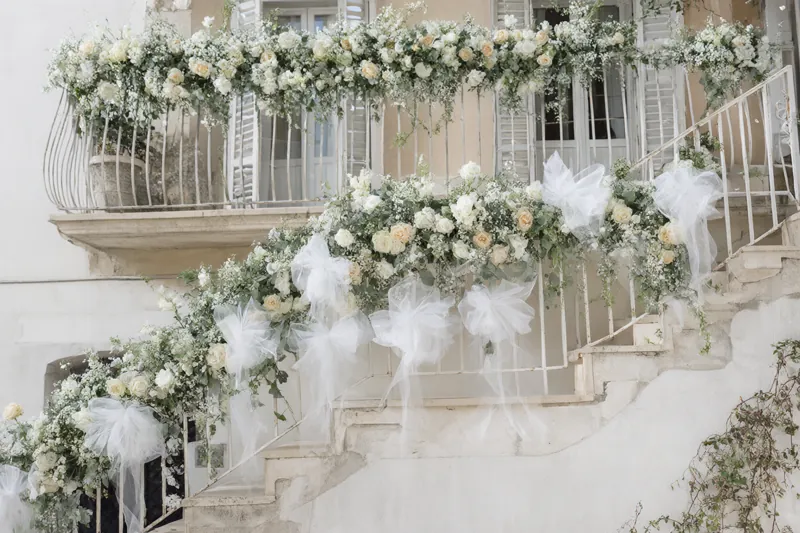
Bows on the banister every few steps, small arrangements on the landings, a rug in front of the flat door. Take more care here: these are shared spaces and must stay safe and clear for people going up and down.
Balconies and windows
Tulle draped over the railing, bows, flowering pots, sometimes garlands of greenery. They are visible from far away and form the backdrop to photos in the street. Fix them firmly: wind can tear tulle and flowers, and nothing must fall on passers-by.
The car
The family often decorates the car that takes the bride to the ceremony too. For ideas and safety, read our guide to wedding car flowers.
Inside the house
If relatives and friends are received at home before the ceremony, there is sometimes a table with sweets, sugared almonds (confetti) and a small centrepiece. A corner with good light and a few flowers also helps the photographer with getting-ready shots.
Building rules and safety
Many Italians live in apartment buildings (condomini), where the entrance hall, stairs and front door are shared. Before decorating them:
- tell the building manager (amministratore) and read the building rules, which may ban decorations or ask for notice;
- let the neighbours know, especially if the stairs will be crowded in the morning;
- do not block passages, exits, the lift, hydrants or fire extinguishers;
- no candles on the stairs and no tea lights on the floor;
- no nails, glue or tape that damage plaster, wood or marble;
- fix everything on balconies and railings securely;
- if a decoration takes up the pavement or street, ask the town hall (Comune) whether a permit is needed.
The next day, take everything down and sweep up petals and leaves. It is the best way to stay on good terms with the building.
Who pays
By tradition each family decorates its own home: the bride's parents her home, the groom's parents theirs. Some areas have other customs, for example the groom giving the bride her bouquet. Today many couples decide together and include the decorations in the florist's quote, so the style matches the rest. To see how flower costs can be split, read how much wedding flowers cost in Italy.
DIY or florist
Bows and tulle can be made by the family in the days before. Fresh flowers are another matter: they need to go up a few hours before and last until the bride leaves.
| Decoration | DIY | Better with a professional |
|---|---|---|
| Tulle and satin bows | Yes, even days before | If you want large, structured shapes |
| Ribbons on the banister | Yes | No |
| Fresh flower bunches on the door | Possible, on the morning | Yes, if matched to the bouquet |
| Floral arches or garlands | Difficult | Yes |
| High balconies | With caution | Yes, for safety |
Our guide to DIY wedding flowers helps you decide what to hand over. A florist can also make only the flowers and leave the family to put up bows and tulle.
Simple and less usual ideas
Many people want something different from the usual white bow. A few low-cost ideas:
- one flower, repeated: gerberas, hydrangeas or sunflowers in summer, all the same on door and banister;
- greenery instead of tulle: garlands of ivy, olive or eucalyptus, more natural and less fragile in the wind;
- the bouquet colours, even just in a ribbon, to link the house to the bride;
- lanterns with LED candles at the entrance, for an evening wedding;
- a frame or sign with your names and date, useful for photos;
- potted plants that stay in the family afterwards or are given away.
If your palette is not settled yet, our guide to wedding flower colour palettes will help.
Good to know if you come from abroad
If you are marrying someone from southern Italy and the custom is new to you, do not be surprised if relatives take charge of the house and the car: it is an act of celebration and affection. Ask how that family does it and whether there is a part for you. Other Italian wedding customs, such as sugared almonds and orange blossom, are explained in our guide to Italian wedding traditions and flowers.
Questions to ask your florist
- Do you also decorate the family homes? What time do you set up?
- Can you use the same flowers as the bouquet in a simpler version?
- Do you have hooks and stands that will not damage doors and railings?
- Who takes everything down, and when?
- How much does the house add to the quote if it is in a different area from the church?
To sum up
Decorating the family home is a small gesture that opens the day. A few well-made pieces and an agreement with the building are enough. For the full picture of wedding flowers, start with our complete guide to wedding flowers in Italy.
Once you know what to decorate, request a quote and list the homes to decorate along with the church and reception.